Fleetwood Town woke up to an extraordinary scene the morning after one of the most memorable nights in the club’s history. The League Two side had eliminated Arsenal from the Carabao Cup following a dramatic contest decided by a penalty shootout, leaving supporters, players and residents of the Lancashire fishing town struggling to believe what they had witnessed.
On a wet and windy night on England’s north-west coast, Fleetwood overcame a substantial difference in resources, reputation and league standing to defeat a club competing at the highest level of English Football. The result was more than a sporting surprise. For a community accustomed to supporting a comparatively small football club, it offered a rare opportunity to celebrate on a national stage.
The celebrations continued into the early hours, while the following morning brought a mixture of disbelief, excitement and anticipation. Supporters returned to the club shop to purchase souvenirs, local pubs welcomed football fans and conversations across the town focused on the remarkable result.
Yet Fleetwood’s achievement also raised a bigger question: could a famous cup victory become a turning point for a club seeking greater support, stronger attendances and a more prominent place in English football?
Fleetwood Town’s giant-killing victory leaves supporters in disbelief
Before the match, many Fleetwood supporters expected Arsenal to progress comfortably. The difference between the two clubs made the prospect of a home victory difficult for local fans to imagine.
Fleetwood sat 84 places below Arsenal in the English football league pyramid, underlining the scale of the challenge facing the League Two side. Arsenal possessed the stature, experience and resources associated with elite-level football, while Fleetwood entered the contest as the underdog.
That difference shaped expectations throughout the town. According to Zsofia Wright, Fleetwood Town’s ticket office and retail manager, excitement began building as information emerged about Arsenal’s travelling party and the strength of the team expected to play.
Wright explained that supporters initially planned simply to enjoy the occasion. However, when Fleetwood took the lead, the atmosphere changed dramatically.
She recalled the moment when people began looking at one another in disbelief, wondering whether the unexpected result was genuinely possible. Her reaction captured the feelings of a town that had prepared for a memorable occasion but had not necessarily expected a historic victory.
Arsenal subsequently equalised, seemingly restoring the contest to a more familiar pattern. However, the match continued without the score changing again, allowing Fleetwood to remain in contention until the decisive penalty shootout.
For the home supporters, every passing minute brought renewed hope. The eventual outcome transformed a match that many had expected Arsenal to win into an unforgettable chapter in Fleetwood Town’s history.
How the penalty shootout transformed an unlikely contest
Penalty shootouts are among football’s most unforgiving situations. After the tension of a closely contested match, the outcome can depend on a small number of individual attempts, with little room for recovery after a mistake.
For an underdog such as Fleetwood, reaching that stage against Arsenal represented an opportunity to turn a competitive performance into a major cup upset.
The supplied match account describes the decisive shootout as the moment Arsenal’s participation in the Carabao Cup ended. Fleetwood’s players converted five brilliant penalties, according to local supporter Sharon Brooks, who praised the team’s performance after initially expecting Arsenal to win comfortably.
Brooks had anticipated a defeat by three, four or even five goals. Instead, Fleetwood stayed in the contest, forced the match to penalties and emerged victorious.
The result demonstrated why cup competitions remain such an important part of football. League campaigns reward consistency over an extended period, but knockout matches create opportunities for smaller clubs to challenge opponents with substantially greater resources.
A single victory does not erase the differences between the clubs. Arsenal still operate at a different level of the football pyramid, and Fleetwood must continue competing within the demands of League Two. Nevertheless, the cup result gave Fleetwood something that league standings alone cannot provide: a moment of national attention and a story supporters can celebrate for years.
Why Fleetwood and Arsenal share an unexpected connection
Although the result appeared to bring together two clubs from completely different footballing worlds, Fleetwood and Arsenal have several unusual connections.
One of the most striking links involves their stadiums. Arsenal played at Highbury in north London until 2006, while Fleetwood’s home ground is also called Highbury. The name comes from Highbury Avenue, the adjoining street.
The shared name offers an unusual connection between a historic venue associated with Arsenal and the much smaller ground in Fleetwood.
The clubs also have a visual similarity. Fleetwood play in red shirts with white sleeves, resembling Arsenal’s traditional kit. The precise origin of the connection is uncertain, although Ray Curtis, a barman at Fleetwood’s King’s Arms pub, offered a local explanation.
According to Curtis, Arsenal donated Fleetwood’s first home kit. His account provides a possible explanation for the resemblance, although the available material does not independently establish the story as definitive club history.
There is another unusual connection in the form of Magno Vieira, a Brazilian striker who played for Fleetwood during the 2000s. His surname echoed that of Patrick Vieira, the former Arsenal captain, creating another coincidence linking the two clubs.
These connections do not diminish the sporting achievement. Instead, they give the result an additional layer of local interest, making the meeting between the clubs more memorable than a conventional cup tie between unrelated opponents.
Highbury becomes the centre of Fleetwood’s celebrations
Fleetwood’s Highbury ground became the focal point of the town’s celebrations, with supporters remaining on the pitch after the penalty shootout. Players, fans and club staff shared the excitement before moving towards the stadium bar.
Wright said she and others remained at the ground until approximately 1:30 a.m. The celebrations reflected the emotional significance of a victory that few people had anticipated when the teams first met.
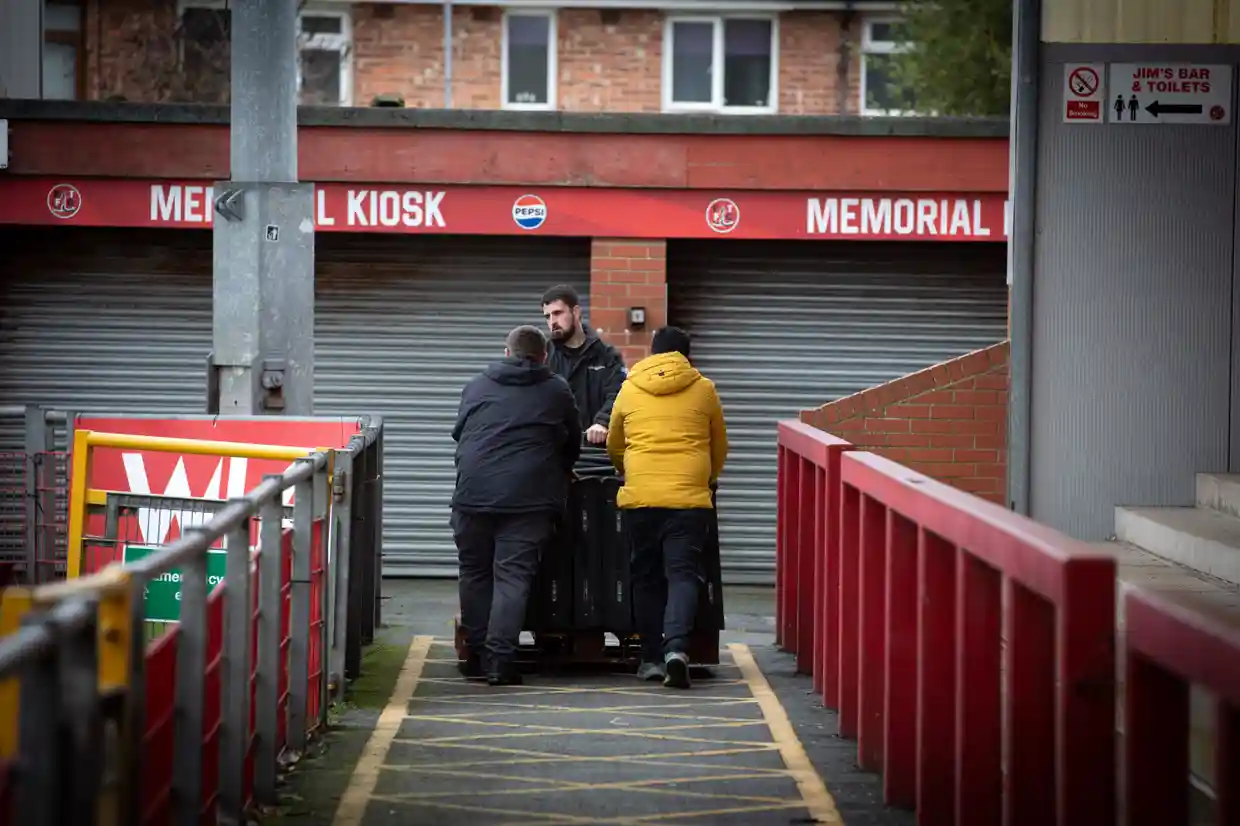
By Wednesday morning, the scene had changed. Floodlights hired for the occasion were being packed away, and the club was preparing to return to its usual routine.
Fleetwood’s stadium has a capacity of 5,300, making it a modest venue compared with the grounds of the Premier League’s largest clubs. Its size also reflects the different scale at which the club operates.
Wright described the return to everyday football as a return to reality. Fleetwood, she explained, remained a League Two club, and that was its normal environment.
Her comments highlighted an important distinction between a remarkable cup result and the day-to-day work of running a football club. The excitement of a single evening can generate tremendous goodwill, but maintaining progress requires continued effort from players, staff, supporters and the wider community.
Fleetwood’s club shop benefits from the historic result
The victory quickly created demand for souvenirs, giving Fleetwood’s retail operation an immediate reason to celebrate alongside the team.
Chris Newman, a 33-year-old supporter who attended the match with his son, returned to the club shop the following day to purchase two souvenir programmes. He described the experience as something that happened so quickly he had not expected it.
The club shop also recorded strong sales of half-and-half scarves featuring both Fleetwood and Arsenal. Such items allow supporters to commemorate a particular fixture while recognising both participating clubs.
The unexpected appeal of these scarves extended beyond Fleetwood supporters. One customer with a London accent explained that he supported Tottenham Hotspur and was delighted by the result.
That reaction illustrates how giant-killing victories can attract attention from football fans who have no direct connection to the winning club. Supporters of rival teams may enjoy seeing an established favourite eliminated by a smaller opponent, particularly when the result challenges expectations.
For Fleetwood, the commercial opportunity extends beyond souvenir sales. Increased interest can introduce new people to the club, encourage future visits to Highbury and give supporters a reason to follow the team’s subsequent matches.
However, the long-term value of that attention depends on whether casual interest becomes regular engagement. A busy club shop immediately after a major victory is encouraging, but sustained growth requires supporters to keep returning after the headlines fade.
Can the Arsenal victory help Fleetwood’s local economy?
For residents, the result offered more than footballing satisfaction. Several supporters hoped the excitement would bring additional business to a town they felt needed a boost.
Zsofia Wright said local bars and pubs had stayed open late during the celebrations. She expressed hope that the enthusiasm would continue throughout the season and help improve attendance at Fleetwood’s matches.
Her comments point towards one of the most important potential benefits of a major cup upset: the ability to attract attention to a community beyond the football ground.
Football supporters attending matches may spend money on food, drinks, merchandise and other local services. A high-profile fixture can also encourage visiting fans to explore the surrounding area, although the scale of any economic benefit depends on attendance, spending patterns and how long the additional interest lasts.
Fleetwood’s connection with the fishing industry provides a distinctive local identity. The club’s nicknames, including the Cod Army, the Fishermen, the Cods and the Trawlermen, reflect the town’s maritime heritage.
That identity makes the club an important symbol for residents who see football as part of the wider community rather than simply a sporting competition.
Paul Dagger, a Fleetwood supporter, said the town needed the positive attention. His comments reflected concerns about the local high street, where he pointed to the presence of charity shops and vape shops.
Gary Gill, a retired crane operator and Fleetwood supporter, similarly welcomed the result because he believed it could bring money into the town.
These comments express local hopes rather than measured evidence of an economic recovery. One football result cannot by itself resolve wider commercial challenges. Nevertheless, the victory created an opportunity for Fleetwood to promote itself, attract visitors and encourage residents to engage more closely with the club.
Small-town pride meets the scale of elite football
The difference between Fleetwood and Arsenal was particularly striking for residents who compared the size of their home town with the scale of the visiting club.
Jim Buckley described Fleetwood as a small town of approximately 25,000 people, noting that it did not have a railway station. He contrasted that scale with Arsenal’s Emirates Stadium, which can accommodate around 60,000 spectators.
The comparison illustrated the gulf between the communities and institutions represented by the two teams. Arsenal’s stadium capacity alone is greater than the population of Fleetwood described in the account.
Yet football offers smaller towns a platform that is not determined by population alone. A club can represent a community nationally through its performances, traditions and relationship with local supporters.
For Fleetwood, the victory provided an opportunity to challenge assumptions about what a club from a small coastal town can achieve on a major occasion.
Gill suggested that opponents would have to take Fleetwood seriously if the team continued to display the determination shown against Arsenal. His assessment reflected the confidence generated by the performance, although future results will determine whether the team can maintain that level.
The practical challenge is turning a memorable performance into a sustained improvement in competitiveness and supporter engagement. Cup football can create opportunities, but league football demands consistency across many matches.
Arsenal supporters find positives despite the disappointment
Although Fleetwood supporters dominated the celebrations, the reaction also revealed how football results can create unexpected moments of shared enjoyment.
The supplied account noted that travelling Arsenal fans appeared to have enjoyed aspects of their visit despite the defeat. Local pubs offered refreshments at prices that surprised some visitors from London.
Dagger recalled Arsenal supporters expressing disbelief at local beer prices, which he said were substantially lower than those they encountered at home.
These details added a lighter element to a night defined by sporting disappointment for Arsenal. They also showed how a football away day can involve more than the result itself, bringing supporters into contact with a different town, its businesses and its local culture.
For Fleetwood fans, the presence of Arsenal supporters helped make the occasion feel significant. Playing against a famous opponent brought a different atmosphere to the ground and gave the town an opportunity to welcome visitors.
For Arsenal, the defeat represented elimination from the competition. The available account does not establish the wider consequences for the club’s season, and it would be premature to draw broader conclusions from a single cup match.
A family moment captures the spirit of the upset
Among the most revealing reactions came from Sharon Brooks and her 12-year-old son, Ryan, who supported Arsenal.
Brooks said she had expected Arsenal to win comfortably but was impressed by Fleetwood’s ability to take the match to penalties and convert their opportunities.
Ryan admitted that he wanted Arsenal to win, yet he was pleased for Fleetwood. His reaction captured the complicated emotions that can emerge when football loyalty meets the appeal of an underdog story.
Supporting a major club does not necessarily prevent a fan from appreciating an unexpected achievement by a smaller team. In this case, the result provided a family with a memorable footballing experience while giving the local club a moment of celebration.
The response also illustrates why cup competitions can appeal to neutral supporters. A contest between clubs with different resources and expectations creates the possibility of a result that challenges the established order, even if only for one evening.
What happens next for Fleetwood Town?
Following the victory, attention turned towards the next Carabao Cup draw, which would determine Fleetwood’s next opponent.
Supporters gathered in the King’s Arms were eager to learn which club the Cod Army would face next. The prospect of another high-profile fixture offered a reason to continue celebrating while creating fresh anticipation around the competition.
Progress in a knockout tournament can bring additional matches, greater exposure and further opportunities for supporters to watch their club compete against unfamiliar opponents. However, the outcome of the draw and subsequent performances would determine how far Fleetwood could progress.
The club also faced a more immediate challenge: returning to its League Two campaign.
Maintaining focus after a major victory can be difficult, particularly when a result attracts attention from across the football community. The players must continue preparing for league fixtures, while the club must balance the excitement surrounding the cup with the practical demands of its regular season.
For supporters, the most meaningful outcome may not necessarily be winning the entire competition. Increased attendance, stronger community engagement and a greater connection between the club and the town could provide lasting benefits even if the cup run eventually ends.
Those possibilities remain dependent on what happens next. The available account records local optimism, strong souvenir sales and celebrations that continued into the early morning, but it does not establish whether the victory will produce a lasting increase in attendance or revenue.
Why Fleetwood’s victory matters beyond one football match
Fleetwood Town’s elimination of Arsenal was remarkable because it brought together everything that makes domestic cup football compelling: unequal expectations, a determined underdog, a dramatic finish and a community united by an unexpected result.
The victory also highlighted the difference between the resources available to clubs at different levels of English football. Fleetwood could not match Arsenal’s scale, but the match offered a reminder that financial and competitive advantages do not guarantee victory in an individual contest.
For the people of Fleetwood, the result became a source of shared pride. Supporters returned to buy souvenirs, local businesses experienced a surge of activity around the celebrations, and residents discussed the possibility that the attention might benefit the town beyond football.
The club’s challenge now is to build on that goodwill without losing sight of its ordinary responsibilities. Sustained attendance, competitive performances and a strong relationship with the community matter more over time than the excitement generated by one result.
At the Shark Chippy near the harbour, staff members Bethany Taylor and Louisa Smith summed up the mood with simple expressions of surprise and delight. Taylor, who lived near the ground, said she could tell the final score from the roar of the crowd and the flares.
Smith hoped Fleetwood could eventually lift the Carabao Cup, while acknowledging that the task would be difficult.
Her hope reflected the feeling shared across the town: the dream might be ambitious, but after a night in which Fleetwood defeated Arsenal, it was difficult not to imagine what could happen next.
For a club whose identity is tied to a Lancashire fishing town, the victory delivered a rare moment in the national spotlight. Whether it becomes the beginning of something bigger will depend on future performances and the community’s ability to turn excitement into lasting support.
For now, Fleetwood Town have a remarkable story to celebrate: a small club that defied expectations, defeated a giant and gave its town a footballing memory that will endure long after the floodlights have been packed away.
For breaking news and live news updates, like us on Facebook or follow us on Twitter and Instagram. Read more on Latest Football on thefoxdaily.com.






COMMENTS 0