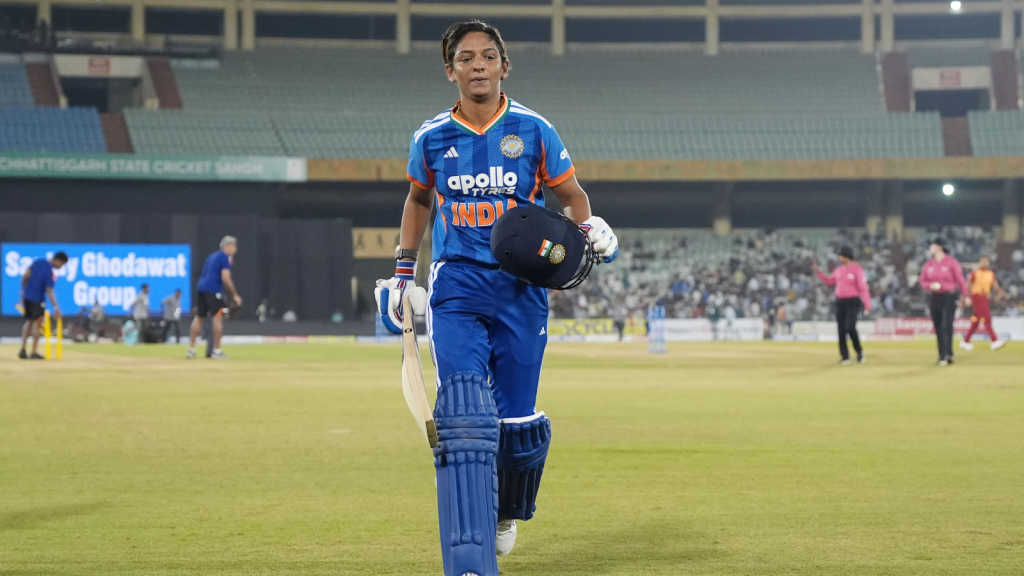
Harmanpreet Kaur delivered a stunning batting performance to guide India to a 92-run victory over Zimbabwe and complete a 3-0 series sweep on Tuesday. The former India captain smashed an unbeaten 91 off just 41 balls, producing an innings filled with powerful hitting and confidence. However, it was an emotional moment during the innings break that revealed the personal significance behind her performance.
Speaking to former India coach WV Raman during a mid-innings interview, Harmanpreet struggled to hold back her tears as she credited him with helping her rediscover the freedom to play her natural game. His simple advice, encouraging her to do what she wanted to do on the field, appeared to carry considerable emotional weight for the experienced batter.
The moment came at a particularly important stage in Harmanpreet’s career. Only days earlier, she had stepped down as India’s captain across all three formats, handing over the leadership responsibilities to Smriti Mandhana. Her explosive innings against Zimbabwe offered a reminder of her batting ability while providing a glimpse into the emotions surrounding her recent experiences.
Harmanpreet Kaur Gets Emotional While Thanking WV Raman
Harmanpreet’s conversation with Raman began with her expressing satisfaction at spending valuable time in the middle and enjoying her batting. As she continued, however, she shifted her attention towards the advice she had received from the former India coach.
She explained that Raman had encouraged her to play on her own terms, allowing her to enjoy batting rather than feeling restricted. The message appeared to resonate deeply with the experienced cricketer, who openly acknowledged his contribution to her renewed confidence.
“It feels great. Just wanted to enjoy myself, and great that I got some time in the middle and really enjoyed myself on the field. I think should give credit to you also. The moment we came, you stepped in and you said, ‘Now you do what you want to do,’ and that’s what I want to do, and really want to enjoy myself. Thanks for those words.”
As she spoke, Harmanpreet’s voice wavered and she wiped away her tears. The emotional moment became increasingly difficult for her, and she was seen throwing the microphone towards the end of the interview before walking away, unable to contain her emotions.
The incident quickly attracted attention from cricket fans, with many interpreting her reaction as a sign of how meaningful Raman’s words had been to her. While the precise reasons behind her emotions remain personal, the moment highlighted the importance that encouragement and trust can have for professional athletes dealing with pressure.
Unbeaten 91 off 41 Balls Powers India to a 3-0 Sweep
Harmanpreet’s emotional interview followed a remarkable display of attacking batting. Her unbeaten 91 from 41 deliveries helped India secure a commanding 92-run win over Zimbabwe, completing a clean sweep in the three-match series.
The innings was significant not only because of the number of runs she scored but also because of the confidence with which she approached the task. Rather than appearing hesitant, Harmanpreet played with freedom and intent, demonstrating her ability to take control of an innings and put pressure on the opposition.
For a batter with extensive international experience, the ability to find rhythm and trust her instincts remains crucial. Her performance against Zimbabwe suggested that she had found a way to translate that freedom into results, although one innings alone cannot determine how her form will develop over the coming matches.
The victory also gave India a positive conclusion to the series. Winning all three matches underlined the team’s overall success, while Harmanpreet’s contribution stood out as one of the defining moments of the final game.
A Timely Return to Form After a Difficult Period
Harmanpreet’s innings came after a relatively quiet spell with the bat. According to the supplied report, it was her first half-century in 10 matches, following an underwhelming run during the Asia Cup and limited opportunities at the crease during the Asian Games.
For an established international batter, a sequence of low scores or limited opportunities can make it difficult to build momentum. Even experienced players must continually manage expectations, maintain technical confidence and find ways to return to form when runs are not coming consistently.
Harmanpreet’s 91 against Zimbabwe was therefore an important individual achievement. It demonstrated that she could still produce a high-impact innings and make a substantial contribution when given time in the middle.
Her recent change in leadership responsibilities also added context to the performance. Having stepped down as captain across formats and handed the role to Smriti Mandhana, Harmanpreet is entering a different phase of her international career.
Leadership changes can alter the demands placed on an experienced player. Without the captaincy responsibilities, Harmanpreet may have a different set of priorities, although it would be premature to conclude that the change alone explains her performance or emotional reaction. Her comments instead pointed directly to the importance of enjoying her cricket and receiving encouragement from people who understand her game.
Harmanpreet Credits Batting Coach Himanshu for His Hard Work
WV Raman was not the only person Harmanpreet thanked after her performance. She also acknowledged her batting coach, Himanshu, highlighting the work they had completed during practice sessions before the match.
Harmanpreet explained that the time she spent in the nets after India’s previous two games had helped her prepare for the innings. She was particularly appreciative of the effort her coach had invested in helping her improve her batting.
“After the two games, I got some time in the nets. I really want to thank Himanshu bhaiya, who’s been working really hard on me and today’s batting all about him,” she said.
Her comments offered another perspective on the innings. Behind a performance lasting only 41 deliveries was preparation carried out away from the spotlight. Net sessions give batters opportunities to work on timing, shot selection, footwork and confidence, particularly when recent results have not matched expectations.
Harmanpreet’s acknowledgment of her coach also illustrated the collective effort that often contributes to individual success. Although the batter must execute her skills in the middle, guidance and preparation from coaches can help players approach matches with greater clarity.
The First Boundary Gave Harmanpreet the Confidence to Attack
Reflecting on her innings after the match, Harmanpreet explained that her first boundary played an important role in shaping her approach. The shot helped her assess the pitch and recognise that the ball was coming onto her bat comfortably.
That early confidence encouraged her to continue attacking rather than overthinking her approach. Once she felt comfortable with the conditions, she focused on maintaining momentum and seeing how far she could take the innings.
“The first ball when I hit for a four, that time I realised it’s a good pitch and bat was coming nicely to the ball and I think I got a lot of confidence from that shot and then I just thought, let me just keep going and let’s see how it goes.”
The explanation provides insight into how an experienced batter can build an innings. A well-timed early boundary can help establish rhythm, improve a player’s assessment of the pitch and create confidence in shot selection. From there, the batter can respond to the bowling rather than forcing shots prematurely.
Harmanpreet’s approach against Zimbabwe reflected that progression. Her unbeaten 91 was the result of sustained attacking intent, but her post-match explanation suggested that confidence developed as the innings progressed.
Why the Emotional Moment Resonated With Cricket Fans
Harmanpreet is widely recognised for her aggressive batting and competitive approach, making her emotional reaction during the interview particularly striking for viewers. The sight of an experienced international cricketer struggling to speak after a successful innings prompted supportive responses from fans on social media.
One supporter, posting on October 20, 2026, expressed concern about the emotional weight Harmanpreet might be carrying, writing that seeing someone known for her toughness break down showed how much she could be going through. The post also offered encouragement and wished her well.
Such reactions reflect how fans can connect with athletes beyond their performances. A scorecard records runs, balls faced and results, but it cannot fully capture the personal challenges or emotional experiences that may accompany a player’s career.
At the same time, Harmanpreet’s emotional response should not be treated as proof of any particular private difficulty. She publicly credited Raman’s words and thanked her batting coach, but the wider circumstances behind her feelings remain hers to share or keep private.
What Harmanpreet’s Performance Means for India’s Next Challenge
Harmanpreet’s return to form gives India an encouraging development to build on after the Zimbabwe series. Her ability to score 91 runs from 41 balls demonstrated the impact she can have when she finds her rhythm and plays with confidence.
Her experience remains valuable to the Indian batting group, particularly as the team adjusts to a change in leadership following Smriti Mandhana’s appointment as captain across formats. Harmanpreet can continue contributing through her batting, match awareness and understanding of international cricket.
The immediate priority will be to build on the performance rather than place excessive expectations on a single innings. Consistency over time will provide a clearer indication of whether she has fully regained her best form. The confidence gained against Zimbabwe, combined with continued preparation, could nevertheless provide a useful foundation.
Her comments also offered a broader lesson about the importance of allowing players to trust their instincts. Technical guidance and tactical planning matter in professional cricket, but confidence and freedom can be equally significant when a batter is trying to rediscover her rhythm.
‘Now You Do What You Want to Do’: Words That Meant More Than Runs
Harmanpreet Kaur’s unbeaten 91 will be remembered as a match-winning contribution that helped India complete a 3-0 sweep of Zimbabwe. Yet her emotional interview with WV Raman revealed another dimension to the performance: the value she placed on being encouraged to play freely and enjoy her cricket.
Her gratitude towards Raman and batting coach Himanshu highlighted the role that support and preparation can play in helping an athlete regain confidence. The innings itself showed the quality she continues to bring to India’s batting lineup, while her reaction reminded viewers that even the most experienced competitors can experience deeply emotional moments.
As Harmanpreet moves forward without the captaincy responsibilities she carried across formats, her focus on enjoying the game could become an important part of this next chapter. Whether that approach leads to sustained success will be determined by future performances, but her display against Zimbabwe offered an emphatic reminder of her capabilities.
For one evening, the numbers told only part of the story. The 91 runs secured India’s victory, but the words she recalled during the innings break revealed why the performance meant so much to her.
For breaking news and live news updates, like us on Facebook or follow us on Twitter and Instagram. Read more on Latest Cricket on thefoxdaily.com.






COMMENTS 0