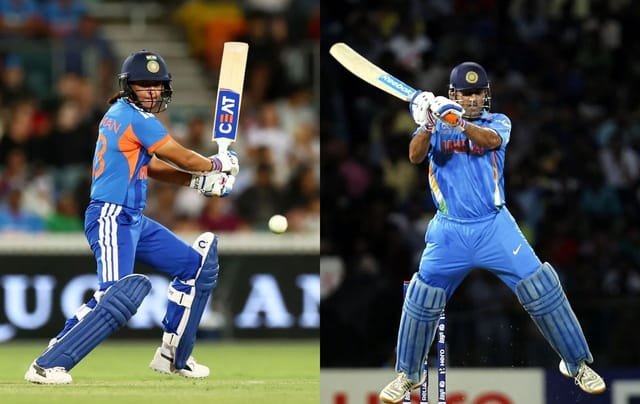
The ICC T20 World Cup has always been a stage where reputations are built, shattered, and immortalized. Ahead of the ICC Women’s T20 World Cup 2026 in England and Wales, a fascinating statistical comparison has brought two of India’s most influential captains into the same analytical frame—Harmanpreet Kaur and MS Dhoni—based on their first 29 T20 World Cup innings.
On paper, the comparison is not about equality of eras or formats, but about understanding how two clutch performers from different generations and teams performed under similar tournament pressure conditions.
And what the numbers reveal is far more nuanced than a simple “better or worse” debate.
Primary SEO Keyword: Harmanpreet Kaur vs MS Dhoni T20 World Cup stats comparison
Related semantic keywords: T20 World Cup batting records India, MS Dhoni ICC stats 2007 2016, Harmanpreet Kaur ICC Women T20 World Cup performance, India cricket World Cup averages, T20 World Cup knockout performance stats, Dhoni strike rate under pressure, Harmanpreet century T20 World Cup
Understanding the Context: Same Format, Different Worlds
Before diving into the numbers, it is important to understand the structural differences between the two datasets. MS Dhoni played his T20 World Cup matches in the early era of T20 cricket, when scoring rates were generally lower and match conditions were more conservative.
Harmanpreet Kaur, on the other hand, has played in a modern T20 environment where aggressive batting, power-hitting, and higher strike rates are the norm.
This means their statistics must be interpreted not just as raw numbers, but as reflections of different eras of cricket evolution.
Batting Performance After 29 T20 World Cup Innings
At the core of this comparison is the overall batting output after 29 innings in the T20 World Cup.
| Player | Runs | Average | Strike Rate | Highest Score | 100s | 50s |
|---|---|---|---|---|---|---|
| Harmanpreet Kaur | 576 | 20.57 | 107.66 | 103 | 1 | 2 |
| MS Dhoni | 529 | 35.26 | 123.88 | 45 | 0 | 0 |
At first glance, Harmanpreet leads in total runs and has the only century between the two. However, Dhoni’s superior average and strike rate highlight his consistency and efficiency in pressure situations.
This contrast reflects two different batting philosophies: Harmanpreet’s higher-risk, high-impact style versus Dhoni’s calculated finishing approach.
Performance Against Top Opposition Teams
One of the most revealing aspects of T20 World Cup performance is how players perform against strong opposition like Australia, South Africa, and New Zealand.
Harmanpreet Kaur has shown notable success against New Zealand, scoring 108 runs in four innings at a strike rate above 150, including her iconic 103-run innings that remains one of the greatest knocks in Women’s T20 World Cup history.
MS Dhoni, meanwhile, maintained strong numbers against South Africa, averaging 44.50 with a strike rate of 136.92 in five innings, showing his ability to adapt in high-pressure matches.
While Dhoni never registered a half-century in the T20 World Cup, his impact often came through controlled finishing roles rather than big individual scores.
Wins vs Losses: The Pressure Performance Split
One of the most important modern cricket metrics is performance under winning and losing conditions. It often reveals how players respond to team momentum.
| Player | Matches in Wins | Runs | Average | Strike Rate | 50s/100s |
|---|---|---|---|---|---|
| Harmanpreet Kaur | 19 | 372 | 31.00 | 127.83 | 1/1 |
| MS Dhoni | 20 | 308 | 44.00 | 147.36 | 0/0 |
The numbers clearly show Dhoni’s dominance in winning matches, where his average and strike rate spike significantly. This reinforces his reputation as one of cricket’s greatest finishers in successful run-chases and pressure games.
Harmanpreet, on the other hand, shows a strong peak-performance pattern, contributing heavily in wins with impactful innings rather than consistent accumulation.
Knockout Matches: The Ultimate Pressure Test
Knockout matches define legacy more than any other stage in ICC tournaments. This is where pressure peaks and performances become immortalized.
| Player | Knockout Matches | Runs | Average | Strike Rate | Best Score | 50s |
|---|---|---|---|---|---|---|
| Harmanpreet Kaur | 3 | 80 | 26.66 | 117.64 | 52 | 1 |
| MS Dhoni | 5 | 61 | 30.50 | 135.55 | 36 | 0 |
Dhoni once again stands out for consistency and efficiency under knockout pressure, maintaining a higher average and strike rate despite fewer opportunities for big scores.
Harmanpreet, however, has produced more match-defining moments in fewer games, including her explosive 52 against Australia in the 2023 semifinal, which remains one of the most important innings in India’s Women’s T20 World Cup history.
Key Insight: Two Different Types of Match Winners
This comparison highlights a critical insight often missed in surface-level statistics: not all match winners impact games in the same way.
MS Dhoni represents controlled stability—finishing matches, absorbing pressure, and maximizing efficiency in limited opportunities. His impact often comes in low-volume, high-value situations.
Harmanpreet Kaur represents momentum-changing aggression—capable of producing explosive innings that shift tournament narratives, even if consistency fluctuates.
Both approaches are valuable, but they function differently within team strategy.
Evolution of T20 Cricket: Why Direct Comparison Is Complex
Another important factor is the evolution of T20 cricket itself. Dhoni’s era featured slower scoring rates and more conservative batting strategies, especially in ICC tournaments where pitch conditions often favored bowlers.
Modern T20 cricket, as played by Harmanpreet Kaur, is built around power hitting, high strike rates, and aggressive intent from the start of the innings.
This makes direct statistical comparison challenging, but still useful for understanding adaptability under pressure.
What These Numbers Mean for India’s 2026 T20 World Cup Hopes
For India, Harmanpreet Kaur’s performance in the ICC Women’s T20 World Cup 2026 will be crucial, especially as this may be one of her final appearances in the tournament.
Her ability to replicate big-match performances like her 103 against New Zealand could determine India’s chances of finally lifting their first Women’s T20 World Cup title.
Meanwhile, the Dhoni comparison serves as a benchmark for what elite tournament temperament looks like—something India will hope Harmanpreet and her team can channel in pressure moments.
Final Verdict: Who Comes Out on Top?
If judged purely on averages and consistency, MS Dhoni has the stronger statistical profile. If judged on explosive match-winning impact and milestone innings, Harmanpreet Kaur makes a compelling case.
Ultimately, this is not a battle of superiority—it is a study in two different styles of greatness shaped by different eras, formats, and expectations.
And in the context of T20 World Cups, both remain defining figures in India’s cricketing story.
For breaking news and live news updates, like us on Facebook or follow us on Twitter and Instagram. Read more on Latest Sports on thefoxdaily.com.

COMMENTS 0