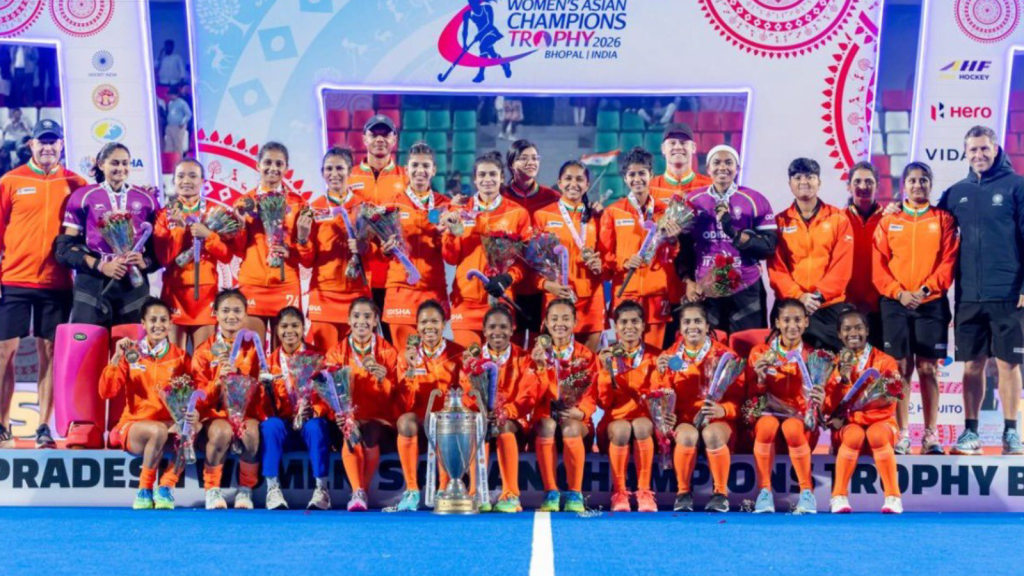
India’s women’s hockey team produced a remarkable second-half comeback to defeat China 3-1 in the final of the Asian Champions Trophy on Saturday, securing their fourth title at the Hockey Stadium in Bhopal. After trailing 0-1 at half-time, Sjoerd Marijne’s side scored three goals in the third quarter to turn the match around and confirm their place at the top of Asian women’s hockey.
The victory capped a successful campaign for India and made them the most successful team in the tournament’s history, moving ahead of South Korea, who have won the title three times. It also means India will finish the year fourth in the FIH world rankings and as the highest-ranked team in Asia.
India’s turnaround has been particularly significant given the uncertainty surrounding the team last year. Following the resignation of former coach Harender Singh in December, Sjoerd Marijne returned for a second stint in January. Since his appointment, the team has achieved its best-ever finish at the Hockey World Cup in 52 years, won Asian Games gold and secured a berth at the 2028 Olympics.
China take the lead in a difficult first half
India entered the final after dominating the group stage and producing a convincing performance in the semi-final. However, China made an aggressive start and immediately put pressure on the Indian defence.
Fengyu Long’s team attacked from the opening minute, testing India with a series of forward moves. The Indian players initially struggled to convert their opportunities, with captain Salima Tete and young forward Sakshi Rana missing clear chances.
China gradually gained momentum and were rewarded in the 24th minute. Dandan Zuo received a pass from Xue Zhang on the right flank before sending the ball across the circle. Yujun Chen, left unmarked in front of goal, finished the move to give China a 1-0 lead.
The goal put India in an unfamiliar position. For the first time in the tournament, Marijne’s team went into the half-time break trailing by a goal. Despite the setback, the players maintained their composure and appeared confident as they prepared for the second half.
India turn the final around with three quick goals
India began the second half with greater purpose, gradually neutralising China’s attacks before taking control of the match. The breakthrough arrived in the 38th minute through dragflick specialist Deepika.
Deepika’s effort took a deflection off a Chinese defender and found the net, bringing India level at 1-1. The equaliser lifted the energy inside the Bhopal stadium, with the home crowd responding enthusiastically as India increased the pressure.
Just four minutes later, India moved ahead. In the 42nd minute, Ishika reacted quickly to a loose ball inside the Chinese circle and fired it beneath the diving goalkeeper. Her field goal made it 2-1 and gave India the advantage for the first time in the final.
India struck again almost immediately. In the 43rd minute, Deepika unleashed a powerful dragflick into the bottom-right corner to extend the lead to 3-1. The two goals in quick succession gave China a difficult challenge and put India firmly in control of the contest.
Deepika’s two goals in the final took her tournament tally to 12, making her one of the standout performers of the competition. Her contribution was central to India’s comeback after a first half in which the team had struggled to find its rhythm.
India’s defence keeps China at bay
China attempted to fight their way back into the match, but India’s defensive organisation prevented them from creating the opportunities needed to reduce the deficit. The Indian players remained compact, disciplined and focused throughout the closing stages.
India finished the match with 52 per cent possession and recorded 15 circle entries, compared with China’s eight. The figures reflected the hosts’ control after the interval and their ability to turn attacking pressure into goals.
The team’s discipline was also a key part of the performance. Since returning as head coach, Marijne has placed emphasis on maintaining structure and following the team’s plans. That approach was particularly important after India fell behind in the first half.
Deepika and Salima credit the team’s belief
Deepika said India had not executed its plans properly during the opening half but remained confident that continuing with their natural style of play would eventually produce goals.
“We didn’t get our plans right in the first half. But we knew that if we continue our natural game, the goals will come. That’s what we did in the second half and the results came,” Deepika said.
Captain Salima Tete also highlighted the importance of discipline and trust among the players. She said the team understood that there was still an entire half available to change the result and focused on taking the ball forward.
“As a team we believe in each other and we just wanted to stay disciplined in the second half. We knew that there was one half left and all we needed to do was put the ball in the attack,” Salima told the broadcasters after the victory.
The comments reflected the confidence within the Indian camp, particularly after the team faced an early setback in a high-pressure final. Rather than allowing China’s first-half advantage to disrupt their approach, India returned with a clear plan and delivered three decisive goals.
A fourth title completes a successful year
The Asian Champions Trophy victory adds another major achievement to India’s growing list of accomplishments under Marijne’s second stint. The team’s fourth title also places it ahead of South Korea as the most successful side in the competition’s history.
India will end the year ranked fourth in the FIH standings and first among Asian teams. The progress follows a period of change that began after Harender Singh’s resignation and Marijne’s return in January. The team has since delivered results across major international competitions, including the Hockey World Cup and Asian Games.
However, the Indian side will not have much time to rest on its achievements. The next major challenge comes in the FIH Pro League, where India are scheduled to begin their campaign on February 10 next year. The competition will give Marijne’s players another opportunity to test themselves against some of the strongest teams in international hockey.
For now, India can celebrate a memorable victory in Bhopal. Coming back from a first-half deficit to score three times in the third quarter demonstrated the team’s composure, attacking quality and collective belief. With a fourth Asian Champions Trophy title secured, Marijne’s team has finished the season with another significant milestone and strengthened its position as the leading side in Asian women’s hockey.
For breaking news and live news updates, like us on Facebook or follow us on Twitter and Instagram. Read more on Latest Hockey on thefoxdaily.com.






COMMENTS 0