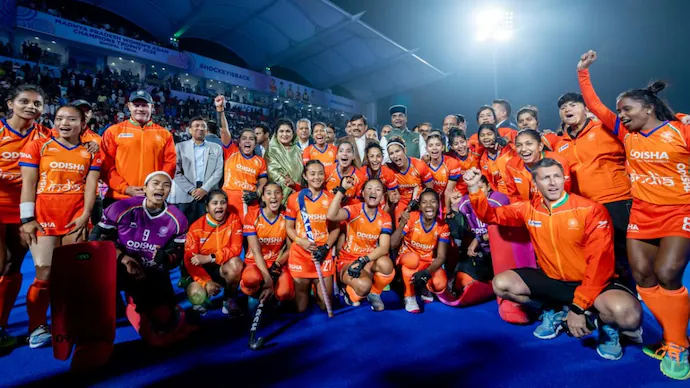
India’s women’s hockey team created history on Saturday by defeating China in the final of the Women’s Asian Champions Trophy to win their third consecutive title. Deepika scored twice through penalty corners, while Ishika added another goal as the hosts recovered from an early setback to secure a memorable victory and finish the tournament unbeaten.
The triumph completed India’s remarkable run of consecutive championships after their victories in Ranchi in 2023 and Rajgir in 2024. With this latest crown, India also became the most successful team in the history of the competition, claiming their fourth overall Asian Champions Trophy title.
Deepika emerged as India’s biggest match-winner in the final, converting two penalty corners after China had taken the lead through Yujun Chen in the first half. Ishika’s goal in the third quarter helped India take control, turning a difficult opening into a commanding performance.
The championship adds another milestone to an impressive year for Indian Women’s Hockey. The team had already secured direct qualification for the 2028 Olympics by defeating China 1-0 in the Asian Games final earlier in the year. On November 25, India also reached a historic fourth position in the FIH world rankings after defeating Japan 4-0.
India Complete Historic Hat-Trick of Asian Champions Trophy Titles
India’s latest victory underlines their growing consistency in continental women’s hockey. Winning three consecutive Asian Champions Trophy titles is a significant achievement, particularly given the competition posed by established teams such as China, Japan and other Asian rivals.
India first lifted the trophy in Ranchi in 2023 before defending the championship in Rajgir in 2024. Their latest success extended that winning sequence and took their overall title count to four, making them the most successful team in the tournament’s history.
The achievement reflects more than a successful final. India maintained an unbeaten record throughout the competition, demonstrating their ability to handle different opponents and match situations without losing momentum.
The final against China was particularly important because the two teams had already met during the round-robin stage, when India registered a convincing 6-2 victory. China approached the championship match with a more organised defensive structure and greater attacking intensity, making the contest considerably tighter.
China Take Early Lead as India Struggle to Find Rhythm
China began the final with greater urgency and immediately tested India’s defensive organisation. The visitors earned their first penalty corner in the second minute but failed to convert the opportunity.
India gradually settled into the match and began looking for openings in the Chinese defence. The hosts earned a penalty corner in the 10th minute, but captain Salima Tete could not convert after the initial effort produced a close-range rebound.
China continued to apply pressure and created further opportunities through set pieces. In the 22nd minute, the visitors earned two consecutive penalty corners, putting India’s defence under considerable pressure.
Goalkeeper Bichu Devi Kharibam played an important role during this period, producing two crucial saves to prevent China from taking the lead. Her interventions kept India in the contest while the hosts struggled to establish control in the attacking third.
However, China’s persistence eventually produced the breakthrough. In the 25th minute, Yujun Chen deflected a pass from the right into the Indian goal, giving the visitors a 1-0 advantage.
The goal increased the pressure on the hosts, who were finding it difficult to convert their penalty corners into meaningful scoring opportunities. Deepika had an opportunity in the 27th minute, but her effort lacked the power needed to trouble the Chinese goalkeeper.
India went into the interval trailing by a goal, with their attacking play yet to produce the breakthrough required to change the direction of the final.
Deepika’s Penalty Corner Brings India Back Into the Final
India returned after the interval with greater attacking intent and began putting China’s defence under sustained pressure. The change in approach soon paid off as the hosts found their equaliser in the 38th minute.
Deepika stepped up to take a penalty corner and delivered a powerful effort that beat the Chinese goalkeeper. The goal made it 1-1 and gave India renewed confidence after a difficult first half.
The equaliser changed the momentum of the match. India began attacking with greater purpose, while China found it increasingly difficult to maintain the defensive control it had shown during the opening two quarters.
Deepika’s contribution was especially important because penalty corners had been a major part of India’s attacking strategy throughout the tournament. Her ability to convert under pressure once again demonstrated why she was one of the competition’s most influential players.
Ishika Gives India the Lead, Deepika Strikes Again
India’s comeback gathered pace just four minutes after Deepika’s equaliser. In the 42nd minute, Ishika put the hosts ahead by finishing a loose ball inside the circle.
The opportunity was created through a combination involving Neha Goyal and Navneet Kaur, who helped move the ball into a dangerous position. Ishika reacted quickly to provide the finishing touch and give India a 2-1 lead.
The hosts struck again almost immediately. Just a minute after Ishika’s goal, India earned another penalty corner, and Deepika once again took responsibility.
She produced a superb low flick into the bottom-left corner, leaving the Chinese goalkeeper with little chance of stopping the effort. The goal extended India’s advantage to 3-1 and gave the hosts a crucial two-goal cushion.
The quick succession of goals transformed the final. India had gone into half-time trailing, but within a short period after the interval, they had taken control through Deepika’s finishing and Ishika’s timely contribution.
Indian Defence Holds Firm as China Search for a Comeback
With a two-goal advantage, India were able to manage the remainder of the match with greater confidence. The hosts continued to earn penalty corners and looked for opportunities to increase their lead.
India earned another set piece in the 53rd minute, but Deepika’s attempt went wide. Although the opportunity did not produce another goal, India remained in control of the contest.
China tried to find a route back into the final, but the Indian defence stayed organised and denied the visitors clear opportunities in front of goal.
The defensive effort was important in protecting the advantage created by the attacking players. After conceding in the 25th minute, India did not allow China to build another sustained scoring opportunity that could seriously threaten their lead.
India managed the closing stages effectively and held on to secure the championship. The victory was built on a strong response after the early setback, with the team combining attacking efficiency and defensive discipline when it mattered most.
Deepika Finishes as Tournament’s Leading Goalscorer With 10 Goals
Deepika’s performance in the final capped an outstanding individual campaign. She finished the Women’s Asian Champions Trophy as the tournament’s leading goalscorer with 10 goals, establishing herself as one of India’s most important attacking players.
Nine of her 10 goals came from penalty corners, highlighting her effectiveness in one of hockey’s most decisive scoring situations. Her ability to convert set pieces provided India with a reliable attacking option throughout the competition.
Penalty corners often become especially important in closely contested international matches, where organised defences can make open-play opportunities difficult to create. Deepika’s precision and composure gave India an additional advantage, particularly in the final against China.
Her two goals in the championship match were not simply individual highlights. The first restored parity when India were trailing, while the second extended the lead shortly after Ishika had put the hosts ahead.
That sequence made Deepika central to India’s turnaround and reinforced her status as the tournament’s most prolific scorer.
India’s Success Follows Asian Games Gold and World Ranking Milestone
The Asian Champions Trophy victory is another major achievement in a year that has strengthened India’s position in international women’s hockey.
Earlier in the year, India defeated China 1-0 in the Asian Games final to secure direct qualification for the 2028 Olympic Games. That victory was an important step towards the team’s Olympic ambitions, allowing India to book its place without relying on a separate qualification tournament.
The latest championship success followed another landmark achievement on November 25, when India climbed to fourth in the FIH world rankings after recording a 4-0 victory over Japan in the tournament.
Reaching World No. 4 represents a significant milestone for the Indian women’s team and reflects the progress made through consistent performances against strong international opponents.
The combination of Asian Games gold, direct Olympic qualification, a historic world ranking and a third consecutive Asian Champions Trophy title has made this period particularly important for Indian women’s hockey.
What the Asian Champions Trophy Hat-Trick Means for Indian Women’s Hockey
India’s latest title provides further evidence of the team’s growing ability to perform consistently at the continental level. Winning one championship can demonstrate a team’s quality, but defending the title repeatedly requires depth, tactical flexibility and the ability to respond when opponents adapt their approach.
The final against China illustrated that challenge. India had defeated the same opponents 6-2 in the round-robin stage, but China produced a much more competitive performance in the championship match and took an early lead.
India’s response demonstrated the importance of maintaining composure under pressure. Deepika’s penalty-corner goals changed the momentum, Ishika’s finish extended the advantage, and the defence protected the lead during the closing stages.
The tournament also offered another opportunity for players to strengthen their roles ahead of future international competitions. Deepika’s scoring form, the team’s unbeaten run and the defensive contribution in the final will provide important confidence as India continues preparing for the next stages of its international campaign.
India Establish Themselves as the Most Successful Team in the Competition
By winning their fourth overall title and completing a hat-trick of consecutive championships, India have established themselves as the most successful side in the Women’s Asian Champions Trophy.
The latest victory in front of home supporters was particularly memorable because it required the hosts to recover from a difficult start against a determined Chinese team. Rather than allowing the early deficit to disrupt their performance, India responded with three goals and controlled the closing stages.
Deepika’s brace will remain the defining contribution of the final, but the championship was secured through a collective effort involving the goalkeeper, defenders and attacking players. Bichu Devi’s saves in the second quarter helped prevent China from building a larger advantage, while Ishika’s goal proved decisive in the turnaround.
For Indian women’s hockey, the achievement is another step forward after a year of major milestones. With continental dominance, Olympic qualification and a historic fourth-place world ranking, the team has strengthened its position among the leading sides in international hockey.
The hat-trick of Asian Champions Trophy titles is therefore more than another trophy. It is a reflection of India’s sustained progress and a strong platform as the team looks towards the challenges ahead.
For breaking news and live news updates, like us on Facebook or follow us on Twitter and Instagram. Read more on Latest Hockey on thefoxdaily.com.






COMMENTS 0