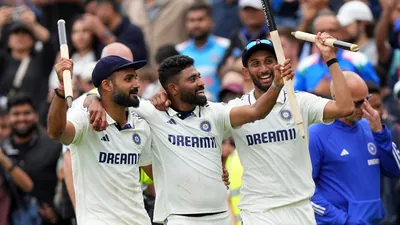
India’s Test bowling selection policy has become one of the most debated aspects of the national team’s transition period. While the selectors continue to reward outstanding domestic performers with maiden call-ups, many of those opportunities have proved remarkably short-lived. The inclusion of 33-year-old off-spinner Saransh Jain for the Sri Lanka Test series has once again raised an important question: are India’s newest bowling talents truly part of a long-term succession plan, or are they merely filling vacancies until senior players return?
Saransh’s selection is undoubtedly one of the most inspiring stories of the season. After years of consistency in domestic cricket, the Madhya Pradesh all-rounder has finally earned national recognition. Yet his call-up has also highlighted a recurring pattern in Indian Test cricket, where several promising bowlers have received opportunities but struggled to establish themselves because of limited chances rather than lack of ability.
Why Saransh Jain’s Selection Has Sparked a Bigger Conversation
Saransh Jain enters the squad following Washington Sundar’s hamstring injury, creating an unexpected opening in India’s spin department. While his selection rewards years of exceptional performances in domestic cricket, it also raises uncertainty about what happens once Sundar returns to full fitness.
The concern is not about Saransh’s ability. Instead, it reflects a broader trend in India’s Test selection strategy, where several bowlers have debuted only to disappear from the playing XI once established stars became available again.
For a player making his international breakthrough at 33, opportunities are naturally more limited than they are for younger prospects.
The World Test Championship Has Changed Selection Strategy
The introduction of the ICC World Test Championship (WTC) has fundamentally altered how teams approach squad selection.
Every Test match now directly impacts qualification for the WTC Final, leaving little room for experimentation. Unlike previous eras, captains and selectors rarely have the luxury of treating any Test as a developmental opportunity.
As a result, experienced performers often receive preference over newcomers, especially in high-pressure series where every point carries significant value.
This environment has inevitably reduced the patience traditionally afforded to debutants.
Recent Indian Bowling Debutants and Their Test Journeys
| Player | Primary Role | Opportunity | Current Situation |
|---|---|---|---|
| Saransh Jain | Off-spin all-rounder | Selected for Sri Lanka series | Awaiting possible Test debut |
| Manav Suthar | Left-arm spinner | Made Test debut against Afghanistan | Retained in squad |
| Akash Deep | Fast bowler | Impressive early Test performances | Outside current squad |
| Anshul Kamboj | Fast bowler | Debuted during injury crisis | Not retained afterward |
| Harshit Rana | Fast bowler | Played limited Tests | Currently focused on white-ball cricket |
| Mukesh Kumar | Fast bowler | Multiple Tests after debut | Waiting for another opportunity |
Domestic Cricket Continues to Produce Quality Bowlers
India’s domestic cricket system remains one of the strongest talent pipelines in world cricket. Competitions such as the Ranji Trophy consistently identify bowlers capable of succeeding in red-ball cricket.
Players like Saransh Jain, Harsh Dubey, Manav Suthar, and Akash Deep earned national recognition through sustained performances rather than short bursts of success.
The challenge therefore is not talent identification but creating enough opportunities for those players to establish themselves at international level.
Why Bowling Transitions Are More Difficult Than Batting
Replacing elite bowlers is often more complicated than replacing batters.
Fast bowlers and spinners generally require extended runs in the team to understand different conditions, develop partnerships with fellow bowlers, and build confidence against international opposition.
Unlike batting, where an individual fifty can secure selection momentum, bowlers frequently need multiple matches before their true potential becomes evident.
This makes consistency in selection especially valuable.
India’s Established Bowling Core Leaves Limited Opportunities
India’s current Test attack features several experienced match-winners who automatically command places when fit.
- Jasprit Bumrah remains India’s premier fast bowler.
- Mohammed Siraj continues to lead the pace attack.
- Ravindra Jadeja provides world-class spin and batting balance.
- Kuldeep Yadav offers attacking wrist-spin.
- Washington Sundar strengthens the all-round department.
Breaking into such an experienced group naturally becomes difficult for newcomers, regardless of domestic performances.
Does India Need a Long-Term Succession Plan?
Every successful Test team eventually faces the challenge of replacing experienced stars.
Several senior Indian bowlers have already spent years carrying the attack across all conditions. Planning for the future requires gradually integrating younger or uncapped players instead of waiting until multiple retirements occur simultaneously.
A structured succession plan allows newcomers to gain valuable international experience while senior players are still available to guide them.
Balancing Results and Development
Selecting a national Test team always involves balancing two priorities:
- Winning immediately.
- Preparing for future success.
In a World Test Championship cycle, immediate victories understandably receive greater emphasis. However, excessive short-term thinking can create long-term transition challenges once senior players retire or become unavailable.
The strongest teams generally find ways to pursue both objectives simultaneously.
Why Saransh Jain Could Offer Something Different
Saransh Jain’s profile differs from many recent debutants.
Rather than relying primarily on pace or mystery, he represents a classical off-spin all-rounder with years of first-class experience. His ability to bowl lengthy, disciplined spells and contribute useful runs lower down the order provides flexibility in squad selection.
Recent performances for India A in Sri Lanka further strengthened his credentials by demonstrating familiarity with subcontinental conditions.
The Mental Challenge of Limited Opportunities
One of the greatest difficulties for debutants is handling uncertainty.
Knowing that every spell, every session, or even every over could determine future selection creates enormous pressure. Established players often recover from poor performances because of proven track records, while newcomers may feel they have only one opportunity to impress.
This psychological challenge can influence performance as much as technical ability.
Can Domestic Success Translate Into International Cricket?
Domestic cricket remains the most reliable indicator of red-ball readiness, but international cricket introduces additional challenges.
Players must adjust to:
- Higher-quality opposition.
- Greater tactical planning.
- Increased media scrutiny.
- Faster game tempo.
- Consistent pressure across every session.
Providing debutants with multiple opportunities often helps bridge this adjustment period.
What Saransh Jain’s Story Means for Domestic Cricketers
Regardless of what happens next, Saransh Jain’s selection sends an encouraging message to India’s domestic circuit.
It confirms that exceptional performances in first-class cricket continue to receive recognition despite the growing influence of franchise tournaments. Players who consistently excel over several seasons can still earn international opportunities through traditional pathways.
That remains an important incentive for thousands of domestic cricketers across the country.
Will India Continue Rewarding Experience?
Saransh’s selection may also indicate a subtle shift in India’s selection philosophy.
Recent years have largely focused on identifying younger talent, but experienced domestic performers bring tactical maturity, consistency, and leadership that can immediately strengthen a Test squad.
If Saransh performs well in Sri Lanka, selectors may become increasingly willing to consider experienced first-class specialists alongside emerging youngsters.
Future Challenges for India’s Bowling Depth
Looking ahead, India’s biggest challenge will be maintaining one of the world’s deepest bowling pools while ensuring emerging players receive meaningful international exposure.
The transition from legendary performers to the next generation cannot happen overnight. It requires careful planning, balanced selection, and confidence in domestic performers who have consistently earned their opportunities.
Finding that balance may become one of the defining tasks for India’s selectors during the remainder of the current World Test Championship cycle.
Conclusion
Saransh Jain’s India Test call-up represents both a personal triumph and a reflection of broader questions surrounding India’s bowling succession strategy. His selection rewards years of outstanding domestic performances, but whether it develops into a lasting international career may depend on opportunities beyond a single series.
India possesses remarkable bowling depth, yet converting domestic excellence into sustained international success requires patience alongside performance. As the team prepares for the Sri Lanka Tests, Saransh Jain has an opportunity to prove he deserves more than a temporary role—and perhaps help reshape how India develops its next generation of Test bowlers.
For breaking news and live news updates, like us on Facebook or follow us on Twitter and Instagram. Read more on Latest Sports on thefoxdaily.com.



COMMENTS 0