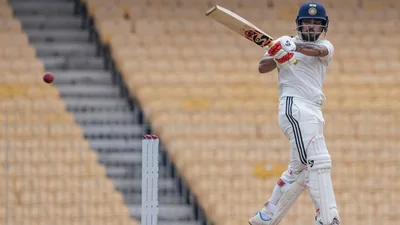
Ishan Kishan Duleep Trophy century has put the Jharkhand wicketkeeper-batter firmly back into the conversation for an India Test return. On the opening day of the 2026 Duleep Trophy final at the MA Chidambaram Stadium in Chennai, Kishan produced an unbeaten 111 for East Zone, delivering exactly the kind of red-ball performance that can attract the attention of national selectors.
The innings was particularly notable because chief selector Ajit Agarkar was present in the stands. Kishan’s performance therefore arrived at a potentially important moment in his Test ambitions, especially after Agarkar previously called for the batter to play more cricket and produce stronger performances before being considered again.
Kishan responded with a composed but increasingly aggressive hundred, striking 14 boundaries and two sixes. His innings helped East Zone finish the opening day on 385 for four in 79 overs, with Kumar Kushagra unbeaten on 63 and the pair sharing an unbroken 144-run partnership for the fifth wicket.
Why Ishan Kishan’s 111 Matters for His Test Ambitions
A century in domestic red-ball cricket does not automatically guarantee an India Test selection, but it can significantly improve a player’s case when selectors are assessing current form.
For Kishan, the timing is especially relevant. His international career has already demonstrated that he possesses the batting ability required at the highest level, but consistency and sustained red-ball cricket have been important parts of the selection discussion surrounding him.
The Duleep Trophy final provides Kishan with an opportunity to address precisely that area. Instead of producing a brief cameo, he converted his start into a three-figure score and remained unbeaten at the close of play.
That distinction matters in first-class cricket. A batter’s ability to spend substantial time at the crease, manage different phases of an innings and build partnerships is an important part of the assessment for Test cricket.
Ajit Agarkar Was Watching From the Stands
The presence of Ajit Agarkar added another layer to Kishan’s century. India’s chief selector had previously spoken publicly about the need for Kishan to play more cricket and demonstrate his form before forcing his way back into the Test conversation.
Agarkar’s earlier message was straightforward: Kishan is recognised as a talented player, but his performances needed to become more consistent.
That makes the Duleep Trophy final an important opportunity. Kishan was not merely scoring runs in a domestic competition; he was producing a substantial red-ball innings while one of the key figures responsible for India’s Test selection was watching.
It would be premature to assume that Agarkar’s presence guarantees a selection decision. However, a performance of this quality gives selectors fresh evidence to consider when the next Test squad is discussed.
Kishan’s Innings Was Built Across Two Different Sessions
Kishan’s century was not simply a fast start followed by a quick hundred. His innings developed through different phases as the match progressed.
He reached his first fifty from 71 balls, showing patience during the earlier part of his stay at the crease. That approach was important on a Chennai surface where batters were generally able to settle once they had survived the initial challenges.
In the final session, Kishan increased the tempo. South Zone struggled to take wickets and conceded runs at a rapid rate, allowing East Zone’s middle order to dominate.
When the bowlers continued using short deliveries, Kishan found opportunities to attack. He also took on the spin once it was introduced, moving from a controlled half-century toward his second career Duleep Trophy hundred.
The ability to change gears without losing his wicket was one of the most valuable aspects of the innings.
East Zone Benefited From Kishan’s Partnership With Kumar Kushagra
Kishan did not construct the innings alone. Kumar Kushagra provided important support at the other end, finishing the day unbeaten on 63.
The pair added 144 runs without being separated, taking East Zone to a strong 385 for four by the close of play.
Partnerships are particularly important in first-class cricket because they allow batters to reduce pressure, control the tempo and put the bowling side under sustained stress.
For Kishan, spending a long period at the crease alongside another established young batter also gave him the opportunity to demonstrate that he can contribute to a large team total rather than relying entirely on individual stroke-making.
His Red-Ball Form Has Not Been Limited to One Innings
Although the Duleep Trophy century is the latest highlight, Kishan has previously produced evidence that he can perform in longer-format cricket.
He played only three innings in the previous Ranji Trophy season but accumulated 246 runs at an average of 82, including a score of 173.
That sample was relatively small, which explains why selectors could still ask for greater consistency and more regular red-ball participation.
The current season gives Kishan an opportunity to change that narrative. A strong Duleep Trophy campaign followed by consistent performances in domestic cricket would provide a much stronger argument than a single isolated innings.
County Cricket Had Already Strengthened His Red-Ball Credentials
Kishan’s red-ball ambitions also received attention after his county stint with Nottinghamshire. On his County Championship debut last year, he produced scores of 87 and 77 against Yorkshire and Somerset.
Those performances showed that Kishan could adapt to conditions outside India and contribute against experienced county attacks.
His India A involvement in England also formed part of the broader pathway toward international selection. Such experiences can be valuable for players trying to demonstrate that their technique and temperament can translate across different red-ball environments.
The challenge for Kishan now is turning these individual performances into a sustained body of work.
The Rishabh Pant Factor in India’s Test Selection
Kishan’s Test prospects have also been influenced by the competition for India’s wicketkeeper-batter position.
When Rishabh Pant was injured during the England Test series, Kishan was selected as a replacement but ultimately did not travel because he was still recovering from his own injury. N Jagadeesan was subsequently brought into the squad.
The situation demonstrated how quickly wicketkeeping options can change when injuries affect the first-choice player.
However, Pant’s eventual return to the selection picture means Kishan’s path is unlikely to be straightforward. He will have to make his case through performances rather than simply waiting for an opening in the squad.
That makes his current red-ball form particularly important.
Why Consistency Could Be the Key for Kishan
The biggest challenge facing Kishan may not be proving that he can score a century. He has already done that in multiple forms of cricket.
The more important task is demonstrating that substantial performances can become a regular feature of his red-ball career.
Test selectors typically need confidence that a player can handle the demands of five-day cricket, including long periods of concentration, changing match situations and different bowling plans.
Kishan’s latest innings addresses part of that requirement, but the selectors will likely want to see what follows.
If he can continue scoring heavily in the Duleep Trophy and then carry that form into the Ranji Trophy season, his Test case could become increasingly difficult to overlook.
How Kishan’s Batting Profile Fits India’s Test Team
Kishan offers India a left-handed batting option who can also keep wicket. His aggressive approach gives him the ability to change the momentum of an innings, while his experience across international formats provides familiarity with high-pressure cricket.
That skill set can be particularly valuable in modern Test cricket, where wicketkeeper-batters are increasingly expected to contribute meaningful runs rather than simply perform their duties behind the stumps.
However, aggression needs to be balanced with situation awareness in the longest format. Kishan’s unbeaten 111 was encouraging in that regard because he showed patience before increasing the scoring rate.
That combination could be an important part of his development as a red-ball batter.
Duleep Trophy Provides a Valuable Selection Platform
The Duleep Trophy remains an important domestic competition for players attempting to enter or return to India’s Test setup.
Performances in the tournament allow selectors to assess players in a competitive red-ball environment while also comparing them with other candidates for national selection.
For Kishan, the timing is ideal. A century in the final provides greater visibility than an ordinary early-season performance and gives him a platform from which to build momentum.
His challenge is now to make sure the innings becomes the beginning of a consistent run rather than the high point of a short stretch.
India’s Upcoming Test Calendar Adds Urgency
India’s future Test schedule gives Kishan an additional reason to maintain his form. The team is looking ahead to an important run of red-ball cricket, including an upcoming tour of New Zealand and a home series against Australia.
With the World Test Championship cycle also influencing selection priorities, India’s management will want a strong pool of players capable of stepping into the Test side when required.
That does not mean Kishan is guaranteed a place. It means the timing of his performances could be important because selectors need reliable options across the squad.
A sustained run of domestic form would give Kishan the strongest possible argument.
Ishan Kishan’s Test Return Path So Far
| Stage | Development |
|---|---|
| Domestic cricket | Produced major Ranji Trophy performances, including a 173. |
| County Championship | Scored 87 and 77 on his Nottinghamshire debut. |
| India A pathway | Featured in India’s developmental red-ball setup in England. |
| England Test squad situation | Selected as a replacement option after Rishabh Pant’s injury but did not travel while recovering. |
| West Indies Test selection | Was not included in the playing XI despite being part of the wider selection discussion. |
| 2026-27 Duleep Trophy | Scored an unbeaten 111 in the final for East Zone. |
What Ajit Agarkar Will Look For Next
One strong performance can reopen a selection conversation, but sustained output is what can ultimately change a player’s position in the pecking order.
For Agarkar and India’s selection panel, the next question will likely be whether Kishan can continue producing runs after his Duleep Trophy hundred.
They will also need to assess the balance between his wicketkeeping ability, batting form and the other options available to India.
That means Kishan should view the century as an important step rather than a finished argument.
The best response to a selector asking for more performances is to keep producing them, and the Duleep Trophy final has given Kishan an ideal starting point.
Could Kishan Force His Way Back Into the Test Squad?
It is certainly possible, but the process will depend on more than one innings.
Kishan has already demonstrated that he possesses the batting talent to compete at the international level. His T20I and ODI returns have also shown that he remains within India’s wider white-ball plans.
The Test format requires a separate evaluation. His recent Duleep Trophy century strengthens his case because it directly addresses the red-ball requirement that selectors have emphasised.
If he follows the hundred with more substantial scores, he could turn a renewed discussion into a genuine selection challenge.
That would create a healthy competition for India’s wicketkeeper-batter spots, particularly as the team plans for an important Test schedule.
The Biggest Test for Ishan Kishan Is Consistency
The central storyline around Kishan is no longer about whether he can produce an exceptional innings. He has done so before, and his unbeaten 111 is the latest example.
The real test is whether he can build a sustained red-ball record that leaves selectors with little reason to question his consistency.
His latest performance offers several encouraging signs: patience early in the innings, controlled aggression later, a century under pressure and an unbeaten partnership that helped East Zone establish a dominant position.
Those qualities are exactly what can strengthen a Test selection case.
Conclusion
Ishan Kishan Duleep Trophy century has significantly revived the conversation around the wicketkeeper-batter’s Test ambitions. His unbeaten 111 for East Zone in the Duleep Trophy final was a timely red-ball statement, particularly with chief selector Ajit Agarkar watching from the stands.
The innings also fits into a broader pattern. Kishan has previously produced strong domestic numbers, impressed during county cricket and remained part of India’s wider international setup. However, questions over regular red-ball cricket and consistency have prevented him from securing a sustained Test role.
His latest century does not guarantee an immediate recall, especially with competition for India’s wicketkeeper-batter position. But it gives Kishan something extremely valuable: fresh evidence that he can deliver in the longest format.
The next phase will be crucial. If Kishan continues scoring heavily in domestic red-ball cricket, the case for an India Test return could become much stronger. For now, his 111 has done exactly what he needed it to do — put his name firmly back into the selection conversation.
For breaking news and live news updates, like us on Facebook or follow us on Twitter and Instagram. Read more on Latest Cricket on thefoxdaily.com.






COMMENTS 0