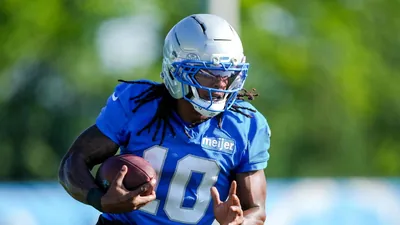
Isiah Pacheco injury has created an unexpected problem for the Detroit Lions just days before the start of the 2026 NFL regular season. Detroit placed the veteran running back on Reserve/Injured on September 1, meaning he will miss the team’s September 13 season opener against the New Orleans Saints.
Pacheco had been brought in during the offseason to provide experience behind Jahmyr Gibbs after the Lions traded David Montgomery to the Houston Texans. The idea was straightforward: Gibbs would become the primary option in the backfield, while Pacheco would give Detroit a proven and physical second running back capable of handling meaningful snaps.
That plan has now been disrupted.
The timing is particularly important because Detroit is entering the season with a significantly different running back group. Pacheco’s experience was supposed to stabilize the depth chart, but his absence means Jacob Saylors, Sione Vaki and Jabari Small could have to take on larger responsibilities behind Gibbs.
The bigger question is whether Detroit can manage the situation internally or whether the club eventually needs to look outside the organization for additional running back depth.
Why Isiah Pacheco was placed on injured reserve
Pacheco’s current situation follows a recovery process that became more complicated than the Lions initially expected.
The running back had been recovering from an MCL sprain, but there was optimism earlier in the offseason that he could be ready for the beginning of the regular season. Head coach Dan Campbell had previously expressed confidence about Pacheco’s ability to return around the start of the campaign.
That outlook changed when a back problem became part of his rehabilitation.
Campbell indicated on August 27 that Pacheco’s knee was no longer the primary concern, but he acknowledged that the recovery had encountered some difficulties. The coaching staff did not provide a specific timetable for his return at that point.
The placement on injured reserve now makes his absence from the season opener official and gives Detroit a clearer short-term picture of its backfield.
How Pacheco’s injury changes the Lions’ original plan
The Lions’ offseason strategy suggested that the team wanted more stability behind Gibbs.
Detroit traded Montgomery to Houston, leaving Gibbs positioned for a much larger role. That decision made it important to have another experienced runner available in case Gibbs needed a breather, the offense wanted a different style of running back or injuries affected the backfield.
Pacheco appeared to be a natural solution.
He arrived with significant NFL experience and had already played an important role for the Kansas City Chiefs during their successful run. His physical running style and familiarity with high-pressure games made him an attractive veteran addition.
Instead of entering the season as the dependable No. 2 option, however, Pacheco will begin the campaign on injured reserve.
That forces Detroit to reconsider how it distributes snaps and how aggressively it uses Gibbs during the opening weeks.
Jahmyr Gibbs becomes even more important
With Pacheco unavailable, Jahmyr Gibbs becomes the clear centre of attention in Detroit’s backfield.
Gibbs was already expected to take on a leading role after Montgomery’s departure. Pacheco’s absence increases that responsibility because the Lions no longer have the veteran backup they specifically signed to provide support.
The issue is not necessarily whether Gibbs can handle a large workload. The bigger concern is how Detroit manages that workload over the course of a long NFL season.
Running backs absorb repeated physical contact, and teams generally benefit from having multiple players capable of contributing. A strong backup can reduce pressure on the starter while keeping the offense effective when personnel changes are required.
Detroit now has fewer proven options behind Gibbs.
That makes his health one of the most important factors in the Lions’ early-season backfield outlook.
Who will replace Pacheco on the Lions depth chart?
The Lions retained five running backs on their initial 53-man roster, a decision that now looks especially significant given Pacheco’s injury situation.
Jacob Saylors, Sione Vaki and Jabari Small are among the players expected to provide depth behind Gibbs while Pacheco is unavailable.
| Player | Expected role | Why it matters |
|---|---|---|
| Jahmyr Gibbs | Primary running back | Expected to handle the largest share of the workload |
| Jacob Saylors | Key backup candidate | Could receive increased opportunities while Pacheco is sidelined |
| Sione Vaki | Depth option | Provides another available backfield option |
| Jabari Small | Depth option | Could see an expanded role if Detroit needs additional rotation |
| Isiah Pacheco | Reserve/Injured | Unavailable for the season opener and currently outside the active backfield rotation |
Among the available players, Saylors appears positioned to receive the most meaningful opportunities while Pacheco is sidelined. Exactly how the workload is divided, however, will depend on game situations and the coaching staff’s confidence in each player.
Isiah Pacheco’s NFL production explains why his absence matters
Pacheco’s value to Detroit was based partly on his experience and previous production with Kansas City.
He rushed for 830 yards during his rookie season and improved to 935 rushing yards in his second NFL season. His numbers dropped significantly in 2024, when he played only seven games and finished with 310 rushing yards.
He returned to action for 13 games last season and recorded 462 rushing yards.
Those numbers do not tell the entire story of his value to Detroit. The Lions did not sign Pacheco because they expected him to become their primary offensive star. They signed him because he had already experienced the demands of NFL football and could provide a reliable veteran presence behind Gibbs.
That distinction is important.
Detroit’s current issue is not simply replacing Pacheco’s rushing statistics. It is replacing the role the team expected him to play within its overall running back rotation.
The hidden problem: workload management
The most important consequence of Pacheco’s absence may not appear immediately on the stat sheet.
Detroit’s biggest challenge is managing Gibbs’ workload without reducing the effectiveness of its offense.
If Gibbs handles a very large percentage of running back touches, the Lions could maintain continuity in the short term. But that approach could also make the offense more dependent on one player and reduce flexibility later in the season.
That is why backup running backs become more important than their individual statistics might suggest.
A backup does not necessarily need to produce like a starter. The player needs to provide enough quality that the coaching staff feels comfortable rotating him into the offense.
Pacheco was expected to provide exactly that security.
Could the Lions sign another running back?
Detroit’s decision will depend on how confident the coaching staff is in its current group.
The Lions already kept five running backs on their initial 53-man roster, which suggests the team was aware that depth could become important. That decision gives Detroit internal options rather than forcing an immediate move.
However, the situation could change quickly if another injury occurs.
If Gibbs were to miss time, the Lions would suddenly lose both their expected primary running back and their most experienced backup option. At that point, outside help could become much more attractive.
Detroit could therefore monitor the available veteran market without necessarily making an immediate signing.
The smart approach would be to evaluate how Saylors, Vaki and Small perform in actual regular-season situations before making a major decision.
What Pacheco brings that the younger backs cannot easily replace
Experience is the most obvious difference.
Pacheco has played in important NFL games and has been part of a championship-winning environment with the Kansas City Chiefs. He understands the preparation required for a long season and the pressure that comes with meaningful games.
That does not automatically make him better than every younger running back on the roster. But it does mean Detroit was adding a known quantity to an otherwise changing backfield.
Young players can provide energy and upside, but coaches often value veterans because they know what to expect from them.
That predictability is especially useful when a team is trying to protect its lead running back from an unnecessarily heavy workload.
A comparison with Detroit’s previous backfield structure
Detroit’s previous arrangement offered a clear division of responsibilities. Montgomery provided veteran experience and a complementary option alongside Gibbs.
After Montgomery’s departure, the Lions attempted to recreate some of that security by adding Pacheco.
| Backfield setup | Key characteristic | Potential impact |
|---|---|---|
| Previous structure | Gibbs plus Montgomery | Established combination of youth and veteran experience |
| Planned 2026 structure | Gibbs plus Pacheco | Gibbs as lead option with an experienced backup |
| Current situation | Gibbs plus younger depth | Greater workload pressure on Gibbs and less proven experience |
This comparison explains why Pacheco’s injury is more significant than a normal backup injury. Detroit intentionally changed its backfield structure during the offseason, and the new plan has been disrupted before the regular season has even begun.
The September 13 opener becomes a test for Detroit’s depth
The Lions will open their regular season against the New Orleans Saints on September 13. That game will provide the first real indication of how the coaching staff intends to operate without Pacheco.
Gibbs is expected to receive the largest workload, but the important detail will be how often Detroit trusts its other running backs.
If the backups perform reliably, the Lions may have little reason to make an immediate change. If the gap between Gibbs and the rest of the group becomes obvious, outside options could receive greater consideration.
The opening game therefore has importance beyond the result. It could help Detroit determine whether its current running back depth is good enough for the demands of the season.
Why the Pacheco situation matters beyond Week 1
The Lions are not simply trying to survive one game without Pacheco. They need to think about the entire season.
Injuries are unavoidable in the NFL, which means roster depth becomes increasingly valuable as the schedule progresses. A team with only one highly trusted running back can quickly become vulnerable if that player misses time.
Detroit’s situation is therefore a test of roster construction.
The club has already anticipated some of the uncertainty by keeping multiple running backs. The question is whether those players can provide enough production and reliability to make the absence of Pacheco manageable.
If they can, the Lions may view Pacheco’s absence as a temporary setback. If they cannot, the pressure to find another experienced option will increase.
What to watch for when Pacheco returns
Pacheco’s eventual return could also change the backfield again.
If Gibbs establishes himself as Detroit’s clear lead back while Pacheco is away, the coaching staff may initially use Pacheco in a controlled role rather than immediately giving him a major workload.
His recovery will be the first priority, particularly because his recent rehabilitation involved both a knee issue and a back problem.
Once he is healthy, his experience could restore some of the depth and flexibility Detroit expected when signing him.
The timing of that return will determine whether Pacheco becomes an important part of the backfield rotation early in the season or has to work his way back gradually.
Final outlook for the Lions
The Isiah Pacheco injury has forced the Detroit Lions to alter their plans before the 2026 season has even started. The veteran running back was signed to provide experience behind Jahmyr Gibbs, but his move to injured reserve removes that safety net for the opening weeks.
Gibbs now becomes even more important to Detroit’s offense, while Jacob Saylors, Sione Vaki and Jabari Small will have an opportunity to prove that the Lions have enough internal depth.
The good news for Detroit is that the team anticipated the importance of running back depth by keeping five players at the position on its initial roster. The concern is that the available options do not yet offer the same level of proven NFL experience Pacheco was expected to provide.
The Lions therefore have two choices: trust their current young depth and manage Gibbs carefully, or monitor the market for another experienced running back.
The most likely short-term outcome is greater responsibility for Gibbs and increased opportunities for the players behind him. But the longer Pacheco remains unavailable, the more important the depth question becomes.
Ultimately, Pacheco’s absence may not determine Detroit’s season by itself. It will, however, reveal how well the Lions’ revamped backfield can handle adversity—and whether their offseason plan was deep enough to withstand an early setback.
For breaking news and live news updates, like us on Facebook or follow us on Twitter and Instagram. Read more on Latest Sports on thefoxdaily.com.

COMMENTS 0