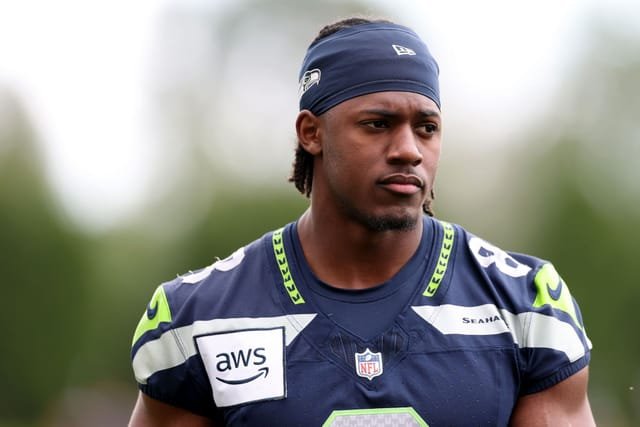
Jadarian Price limited usage became one of the biggest talking points after the Seattle Seahawks opened their season with a 13-10 victory over the New England Patriots. Despite averaging more than five yards per carry, the rookie running back was not consistently used during important offensive situations.
Price finished the game with 10 carries for 52 rushing yards, showing that he could provide an explosive element to Seattle’s offense. However, his opportunities were spread out rather than concentrated, particularly when the Seahawks entered third-down, two-minute and red-zone situations.
The decision attracted criticism from former NFL tackle Breiden Fehoko, who questioned why a first-round running back who appeared effective when given the ball was repeatedly taken off the field. Sports doctor and injury analyst Jeff Mueller also mocked Seattle’s approach on social media.
Jadarian Price produces despite limited opportunities
The Seahawks selected Price with the No. 32 overall pick in the 2026 NFL Draft after his productive college career at Notre Dame. Expectations were therefore high for the rookie entering his first regular-season game.
Price’s numbers against New England offered plenty of encouragement. He carried the ball 10 times for 52 yards, producing an average of 5.2 yards per attempt. His performance suggested that Seattle could have used his rushing ability more frequently.
His strongest stretch came during the opening half. Price participated in 10 of Seattle’s first 25 offensive plays and gained 42 yards on six carries, averaging seven yards per attempt during that period.
Yet his involvement dropped in situations where offensive coordinators often rely heavily on their most trusted playmakers. According to the supplied report, Price was not used during third downs, two-minute drills or red-zone situations.
That usage pattern naturally raised questions because those situations can determine the outcome of a close NFL game.
Why Breiden Fehoko criticized Seattle’s decision
Former NFL player Breiden Fehoko was particularly frustrated by Price’s role. The former tackle argued that Seattle had invested a first-round selection in a running back who appeared capable of creating momentum, only to repeatedly remove him from the offense.
Fehoko’s comments were aimed at the Seahawks’ offensive decision-making, particularly offensive coordinator Brian Fleury. His criticism became highly visible because it came immediately after Price had demonstrated efficiency with limited touches.
Fehoko also made a provocative personal remark about the situation while questioning why Price was repeatedly being taken off the field. The remark was clearly intended as sarcasm rather than a factual allegation, and there is no information in the supplied report establishing such a claim.
The broader point behind Fehoko’s criticism was straightforward: if a rookie running back is averaging more than five yards per carry, why isn’t he receiving a larger role when the offense needs production?
Seahawks’ offensive situation made the decision more noticeable
Price’s limited workload became even more significant because Seattle’s offense faced several challenges during the game.
The Seahawks entered halftime trailing 7-0. Their situation became more difficult when starting quarterback Sam Darnold left the game with an early injury, forcing Drew Lock into action.
New England subsequently extended its advantage to 10-0 through a 50-yard field goal from Andrés Borregales. Seattle therefore needed to find ways to generate offense while operating without its starting quarterback.
In that environment, an efficient running game could have helped reduce pressure on Lock and provide the offense with a more dependable foundation.
Instead, Seattle’s comeback was largely built through a combination of defensive resistance, field goals and a big passing play.
How Seattle completed the comeback
The Seahawks eventually turned the game around despite their early problems.
Jason Myers got Seattle on the scoreboard with a 30-yard field goal. The decisive offensive moment arrived in the fourth quarter when Lock connected with Jaxon Smith-Njigba for a 45-yard touchdown.
That touchdown brought Seattle back into the contest and demonstrated that Lock could make an impact despite entering the game unexpectedly.
Myers then completed the comeback by converting a 26-yard field goal, giving Seattle a 13-10 victory in its season opener.
The final score meant the Seahawks achieved their immediate objective, but the way they reached the victory left plenty of questions about offensive personnel usage.
Jeff Mueller joins criticism of Jadarian Price usage
Fehoko was not the only person to question Seattle’s handling of Price.
Injury analyst Jeff Mueller also highlighted the rookie’s limited involvement. His social-media reaction sarcastically suggested that Seattle should have continued using Price after seeing him produce an explosive play.
Mueller’s comment reflected a common football debate: should coaches immediately increase the workload of a young player who demonstrates efficiency, or should they maintain a predetermined rotation regardless of early production?
There are legitimate reasons for limiting a rookie’s snaps. Coaches may want to manage workload, protect a young player from excessive early-season responsibilities or use different backs according to specific formations and situations.
However, those explanations become harder for fans to accept when the player is producing efficiently whenever he receives an opportunity.
Price’s Notre Dame background adds to expectations
Price arrived in Seattle with a strong college résumé. During three seasons with the Notre Dame Fighting Irish, he accumulated 1,692 rushing yards and 21 rushing touchdowns.
Those numbers helped establish him as a player capable of contributing both as a runner and as an explosive offensive weapon.
Seattle’s decision to select him No. 32 overall also indicates the organization viewed him as more than a developmental depth option. A first-round selection generally comes with expectations of meaningful involvement, although rookie workloads can vary considerably.
His NFL debut therefore provided an interesting contrast. Price looked productive statistically, but his overall role remained relatively small.
What could Price’s role look like going forward?
The most important question for Seattle is whether Price’s Week 1 workload was simply part of the team’s game plan or a sign of a longer-term rotation.
If the Seahawks continue to give Price around 10 carries per game despite strong efficiency, opponents may begin forcing Seattle to explain why its first-round running back is not receiving more opportunities.
On the other hand, one game is not enough to establish a permanent offensive role. Seattle’s coaching staff may have specific plans for how Price develops throughout the season, particularly with a rookie learning NFL protections, route concepts and situational responsibilities.
Third-down usage is particularly important because running backs must demonstrate more than rushing ability to become trusted in those situations. Pass protection, receiving assignments and decision-making can all influence whether a young running back stays on the field.
Price’s future workload could therefore depend on how quickly he earns trust beyond simply carrying the football.
Price’s efficiency gives Seattle an intriguing option
The encouraging part for the Seahawks is that Price did not look overwhelmed by his first NFL action. His 5.2 yards-per-carry average provided evidence that he can create positive plays against professional defenses.
His first-half seven-yards-per-carry figure was even more impressive, although it came from only six attempts and should not be treated as proof that the rookie would maintain that rate over an entire season.
Still, the performance gives Seattle a reason to experiment with a larger role.
If Price can combine his rushing production with reliable blocking and receiving work, he could become increasingly difficult for the coaching staff to keep off the field.
Seahawks may need to balance rotation and production
Running back rotations are common in modern NFL offenses because teams want to manage workload and keep players fresh. But rotations can become frustrating when a productive player is removed during important possessions.
Seattle’s challenge will be finding the right balance between keeping Price fresh and maximizing his impact.
| Factor | What Price showed | Why it matters |
|---|---|---|
| Rushing | 52 yards on 10 carries | Demonstrated efficiency with limited opportunities |
| First-half production | 42 yards on six carries | Provided an early indication of explosiveness |
| Touchdown production | No rushing touchdown | Seattle used other players in key scoring situations |
| Situational usage | Limited in key situations | Created questions about coaching strategy |
| Draft status | No. 32 overall pick | Raises expectations for meaningful playing time |
Why the criticism could continue
The Seahawks won the game, which ultimately protects the coaching staff from some criticism. If Seattle had lost after trailing throughout the contest, Price’s limited involvement would likely have received even greater attention.
But close games can magnify individual personnel decisions. A difference of one or two successful offensive plays can change an NFL result, making the deployment of explosive players particularly important.
Price’s performance has already created a simple storyline for the coming weeks: if he continues producing at a strong rate, Seattle may eventually have to increase his workload.
Conversely, if his role remains limited and the Seahawks struggle offensively, questions surrounding the rookie’s usage are likely to become louder.
What this means for the Seahawks
Seattle can take several positives from the season opener. The team overcame an early deficit, survived an injury to its starting quarterback and found enough offense to secure a three-point victory.
At the same time, the game exposed areas that could require adjustment. The Seahawks will need to monitor Darnold’s availability, determine how much responsibility Lock should receive if necessary and find the most effective combination of skill-position players.
Price could be an important part of that equation.
The rookie does not necessarily need 20 or 25 carries every week. Instead, the Seahawks need to identify situations where his speed and explosiveness can have the greatest impact while continuing to develop the other parts of his game.
Jadarian Price vs expectations: A closer look
Price’s debut illustrates the difference between statistical efficiency and overall offensive involvement. A player can produce excellent numbers without receiving a large workload, while another player can dominate touches without being particularly efficient.
For Seattle, the ideal outcome would be to combine both elements. If Price continues producing efficiently while becoming more dependable in passing situations, his snap count could naturally increase.
That would also answer much of the criticism surrounding his debut without requiring the coaching staff to abandon its overall rotation strategy.
Final Verdict
Jadarian Price’s NFL debut was encouraging from a production standpoint but puzzling from a usage perspective. The first-round rookie averaged 5.2 yards per carry and showed flashes of explosiveness, yet he was not consistently trusted in several important offensive situations.
Breiden Fehoko and Jeff Mueller’s criticism has placed additional attention on Seattle’s running-back rotation, although the Seahawks still walked away with a 13-10 victory.
The real test will come over the next several games. If Price continues to make an impact whenever he receives the football, Seattle may have a compelling reason to expand his role. For now, his debut has created more questions than answers about how prominently the Seahawks plan to feature their first-round rookie.
For breaking news and live news updates, like us on Facebook or follow us on Twitter and Instagram. Read more on Latest NFL on thefoxdaily.com.




COMMENTS 0