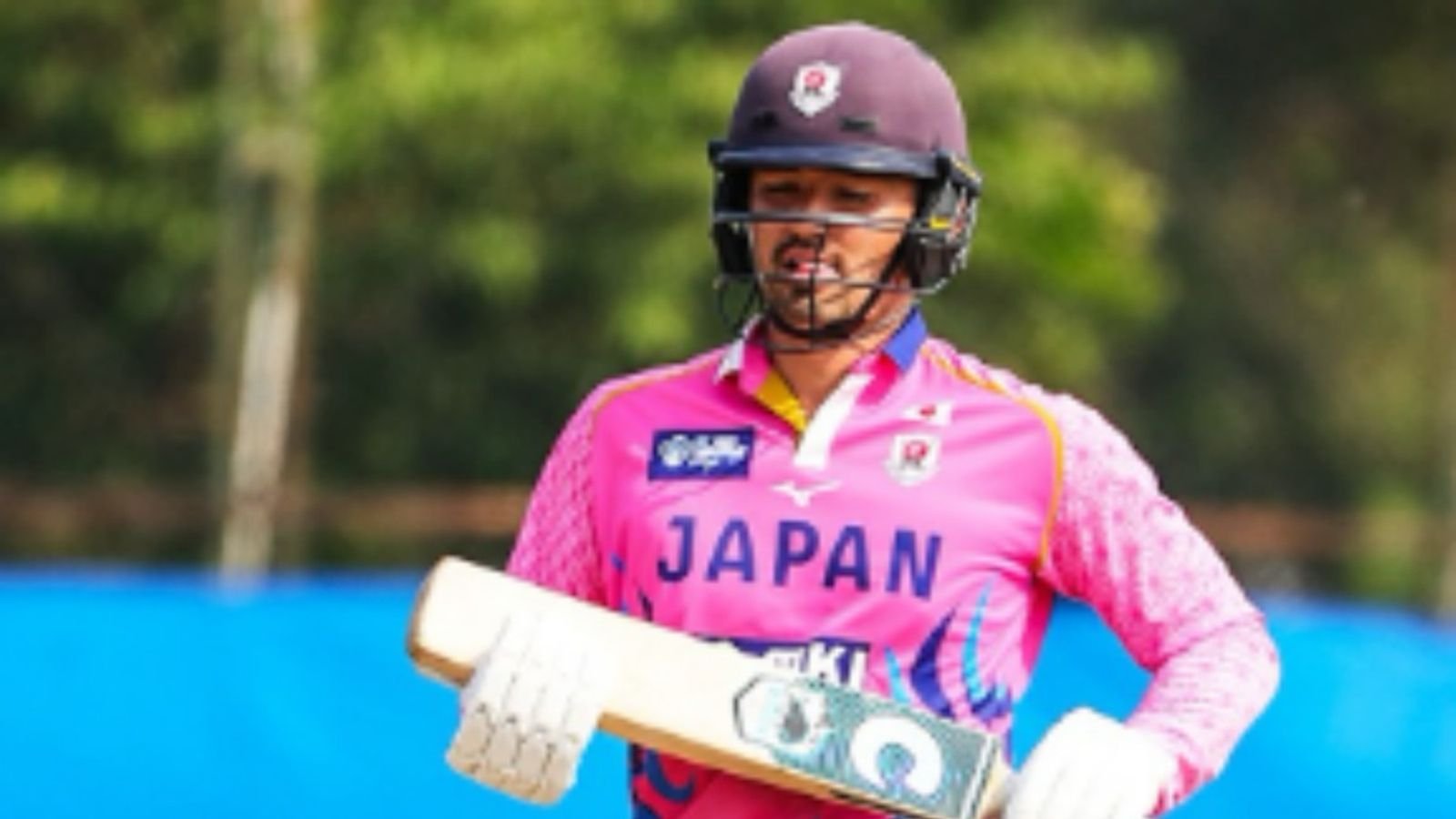
Japan have announced their 15-member squad for the historic T20I against India, with Kendel Kadowaki-Fleming continuing as captain for the Suzuki Cup fixture in Sano on September 22.
The match will be a major occasion for Japanese cricket as the national side prepares to face one of the world’s most prominent cricket teams. Japan’s squad combines experienced T20I performers with three players from the A squad, while several members were also part of Japan’s Asian Games 2026 campaign.
India are yet to announce their squad for the Suzuki Cup, although the side led by Shreyas Iyer is expected to reach Sano on September 19. The fixture will also give India an opportunity to acclimatise to local conditions ahead of their wider commitments.
Kendel Kadowaki-Fleming named Japan captain
Kendel Kadowaki-Fleming will once again lead Japan and enters the historic fixture as the team’s most productive T20I batter.
The 30-year-old has accumulated 1,871 runs in 55 T20I matches, averaging 38.18 with a strike rate of 139.41. His record includes two centuries and 12 half-centuries, highlighting his consistency and ability to score quickly in the shortest international format.
Kadowaki-Fleming has also reached 1,000 T20I runs faster than all but two players in the format’s history, according to the figures provided for the Japan team.
His experience will be particularly valuable against India. Japan’s batting lineup will face a significantly different challenge from the opposition they regularly encounter in regional T20 cricket, making the captain’s role crucial in setting the team’s approach.
Japan name 15-player squad for India clash
The Japan Cricket Association has selected a 15-player group for the only T20I against India.
The squad includes the established core of the Japanese side as well as three players promoted from the A squad. Tsuyoshi Takada, Jake Kusuda-Nairn and Alester Kadowaki-Fleming have all been included for the landmark fixture.
The selection indicates that Japan are using the occasion not only to compete against India but also to expose a wider group of players to a high-level international environment.
| Japan Squad | Role/Status |
|---|---|
| Kendel Kadowaki-Fleming | Captain |
| Charlie Hara-Hinze | Squad member |
| Benjamin Gou-Ito Davis | Squad member |
| Kohei Kubota | Squad member |
| Wataru Miyauchi | Squad member |
| Reo Sakurano-Thomas | Squad member |
| Declan Suzuki-McComb | Squad member |
| Shoma Sugaya-Slater | Squad member |
| Alexander Shirai-Patmore | Squad member |
| Lachlan Yamamoto-Lake | Squad member |
| Makoto Taniyama | Squad member |
| Ibrahim Takahashi | Leading wicket-taker in current squad |
| Tsuyoshi Takada | A squad call-up |
| Jake Kusuda-Nairn | A squad call-up |
| Alester Kadowaki-Fleming | A squad call-up |
Japan’s strong T20I form in 2026
Japan arrive at the India fixture with encouraging results in T20I cricket during 2026.
The team have lost only two of their 10 T20Is played this year. That record suggests that Japan have developed into a competitive side in the shortest format and are entering the India fixture with confidence rather than simply treating it as an exhibition occasion.
One of the more notable aspects of Japan’s recent performances has been their ability to remain competitive even when facing challenging situations. They pushed Cook Islands to the final delivery in one of their 2026 matches, demonstrating their capacity to fight until the end.
Japan’s lowest T20I total in 2026 is 90, although their overall record includes considerably higher scores in previous years.
Japan’s batting benchmark: 258 without loss
Japan’s highest T20I total remains a remarkable 258 for no loss, achieved against China in 2024.
That score provides an indication of the batting potential available within Japanese cricket. While reproducing such a total against India would be an enormous challenge, Japan’s recent form shows that their batting unit should not be underestimated.
Kadowaki-Fleming remains the central figure in that batting structure. His combination of experience, strike rate and record of converting starts into major scores makes him an obvious player for India to monitor.
His two T20I centuries also demonstrate that he is capable of playing long innings rather than relying solely on short bursts of aggressive batting.
Ibrahim Takahashi leads Japan’s current bowling attack
Japan’s most successful T20I wicket-taker overall is Sabaorish Ravichandran, but he has not been included in the squad for the India match.
Ravichandran has taken 63 wickets from 53 T20Is at an average of 11.76. His record includes two five-wicket hauls and one four-wicket haul, while his economy rate stands at 4.84 runs per over.
With Ravichandran absent, Ibrahim Takahashi enters the fixture as the leading wicket-taker among the selected players.
Takahashi has claimed 48 wickets in 46 T20I matches at an average of 16.87. His experience will be important against an Indian batting lineup that could contain several high-quality T20 players.
Why Sabaorish Ravichandran’s absence matters
Ravichandran’s omission is notable because of his exceptional record for Japan. His wicket-taking numbers and economy rate have made him one of the country’s most effective T20I bowlers.
However, his absence also creates an opportunity for other bowlers to step into a bigger role.
Against India, Japan’s bowling group will need to be disciplined rather than simply searching for wickets. India’s batting depth means that expensive overs could quickly change the momentum of the match.
Keeping the scoring rate under control and making the most of wicket-taking opportunities will therefore be central to Japan’s chances.
Three A squad players included for India fixture
Japan have also used the historic occasion to bring three players from their A squad into the national group.
Tsuyoshi Takada, Jake Kusuda-Nairn and Alester Kadowaki-Fleming have been selected, giving the trio an opportunity to experience a high-profile international match.
Their inclusion is significant for Japan’s long-term development because playing alongside established national players against India could accelerate their understanding of international-level cricket.
It also demonstrates the depth-building approach within Japanese cricket, with the national team looking beyond its established core.
12 Asian Games players in Japan’s squad
The squad also contains 12 players who featured for Japan at the Asian Games 2026.
The continuity between the Asian Games group and the Suzuki Cup squad should help Japan maintain familiarity within the team. Players who have already worked together in a major multi-sport event can carry that experience into the historic meeting with India.
For Japan, maintaining a stable core could be particularly important because the challenge of facing India will be significantly different from many of their previous international assignments.
India expected to arrive in Sano on September 19
India have not yet announced their squad for the Suzuki Cup fixture, according to the source information.
The Shreyas Iyer-led team is expected to reach Sano on September 19, three days before the scheduled T20I against Japan.
India could largely use the same group selected for the Asian Games 2026, although the possibility of including net bowlers has also been mentioned if required.
The short gap between India’s arrival and the match makes acclimatisation an important consideration. Familiarising themselves with the local conditions and venue will be part of India’s preparation before the historic encounter.
Why the India vs Japan T20I is significant
The fixture represents an important moment for Japanese cricket.
India are one of the most influential teams in world cricket, while Japan have been steadily building their international programme. A meeting between the two sides gives Japanese players the opportunity to test themselves against elite opposition and provides additional visibility for cricket in Japan.
For India, the match can serve a different purpose. Rather than simply focusing on the result, the team can use the fixture to gain experience of conditions ahead of its wider schedule.
This makes the game valuable to both sides, even though their immediate objectives are different.
Kadowaki-Fleming will be Japan’s key player
If Japan are to challenge India, their captain is likely to play an important role.
Kadowaki-Fleming’s numbers make him the team’s obvious batting leader. His average above 38 and strike rate above 139 show a combination of consistency and attacking intent that is well suited to T20 cricket.
His two centuries and 12 fifties also underline his ability to produce substantial scores. Against an Indian attack, however, he will face a much higher level of pressure.
Japan’s ideal scenario would be for Kadowaki-Fleming to provide the foundation while other batters contribute around him. That would allow the team to build an innings rather than becoming overly dependent on a single player.
What Japan can gain from playing India
Regardless of the result, the India fixture could have a lasting impact on Japanese cricket.
Players will gain experience of playing against a side accustomed to high-pressure international matches, while coaches can assess how their systems perform against elite opposition.
The exposure can also help younger players understand the standards required to compete at the highest levels of the sport.
For Japanese cricket, these opportunities are important because development depends not only on domestic competition but also on regular exposure to stronger international teams.
Conclusion
Japan have announced their 15-player squad for the historic T20I against India, with Kendel Kadowaki-Fleming retaining the captaincy for the September 22 fixture in Sano.
The 30-year-old enters the match as Japan’s leading T20I run-scorer, with 1,871 runs, two centuries and 12 fifties from 55 matches. Ibrahim Takahashi will be another important player after becoming the leading wicket-taker in the current squad following Sabaorish Ravichandran’s omission.
Japan’s encouraging 2026 record, with only two defeats in 10 T20Is, provides confidence ahead of their biggest challenge of the year. The inclusion of three A squad players and the continuity of 12 Asian Games players further highlights the developmental importance of the fixture.
India are expected to arrive in Sano on September 19, giving the Shreyas Iyer-led side a short window to prepare before the historic meeting. For Japan, however, the occasion represents far more than one match: it is an opportunity to showcase the progress of Japanese cricket on a major international stage.
For breaking news and live news updates, like us on Facebook or follow us on Twitter and Instagram. Read more on Latest Cricket on thefoxdaily.com.




COMMENTS 0