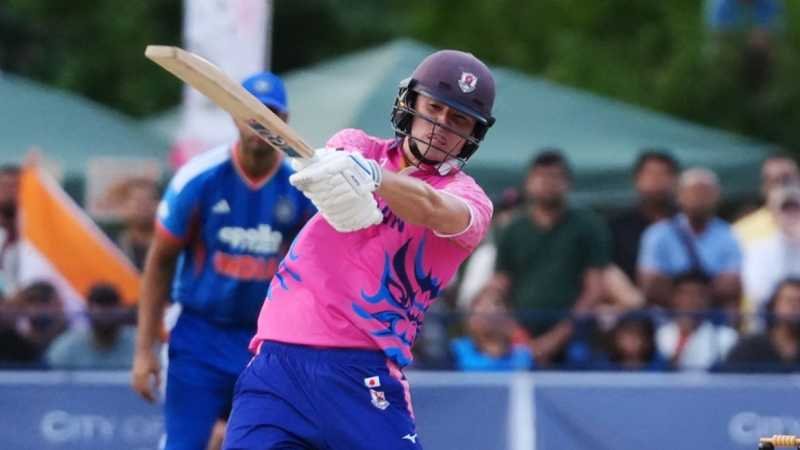
Japan captain Kendel Kadowaki-Fleming said his team felt both disappointment and pride after pushing India to the final stages of a dramatic five-over contest in Sano.
Japan came remarkably close to producing one of the most memorable results in their men’s cricket history before India held on for a two-run victory in Sano on September 22, 2026.
The rain-affected one-off T20I was reduced to five overs per side, but the shortened format did little to reduce the drama. India were restricted to just 32 for 4 before Japan finished their chase on 30 for 3.
For Japan captain Kendel Kadowaki-Fleming, the narrow defeat was difficult to accept because his team had remained within touching distance until the final delivery. At the same time, he said the players could take considerable pride from the way they competed against India.
The match also represented a major occasion for Japanese cricket, as it was Japan’s first men’s international encounter against a Full Member side.
Kadowaki-Fleming Says Emotions Were High
Kadowaki-Fleming admitted that the closeness of the contest made the defeat particularly difficult for the Japanese team.
Japan had restricted India to only 32 runs and then entered the final over of their chase with a realistic opportunity to complete the upset. Although they ultimately fell short, their performance kept India under pressure throughout the match.
The Japan captain said the team was experiencing mixed emotions after the final result. There was disappointment because victory had been within reach, but there was also pride in taking India to the last ball.
For Japan, the experience was about more than the result. It provided their players with an opportunity to test themselves against one of the world’s leading cricket nations in an official international match.
Japan Took India to the Final Stages
India’s innings showed just how effectively Japan adapted to the difficult conditions. The Sano pitch was turning sharply, making it difficult for batters to play conventional attacking shots.
India managed only 32 for 4 from five overs. Shreyas Iyer was the only Indian batter to reach double figures, scoring 16 from 12 deliveries.
Japan’s spinners played a major role in restricting the Indian lineup. Their bowling attack prevented India from building momentum, despite the visitors possessing several established T20 batters.
Japan then began their chase knowing that 33 runs were required from five overs. On a difficult surface, that target was not as straightforward as it might have appeared.
Kadowaki-Fleming Top-Scored for Japan
Kadowaki-Fleming played an important role at the top of Japan’s chase. He scored 12 from 12 deliveries before being dismissed on the final ball of the fourth over.
His dismissal left Japan needing nine runs from the final six deliveries. That gave them a genuine opportunity to complete the chase, although India still had Axar Patel available to bowl the final over.
Kadowaki-Fleming’s innings was Japan’s highest individual score and provided stability during a chase in which scoring boundaries were difficult to find.
The captain also recognised the quality of India’s spin attack, which included Axar Patel, Washington Sundar and Ravi Bishnoi.
India’s Spinners Created a Major Challenge
The conditions in Sano were particularly suited to spin, with the ball turning sharply from the surface. Japan knew before the game that dealing with India’s spin options would be one of their biggest challenges.
Axar, Washington and Bishnoi all possess extensive experience in international and franchise cricket, making the challenge even more demanding for Japan.
However, Kadowaki-Fleming explained that the required run rate gave Japan a reason to believe they could still compete. With roughly six and a half runs needed per over, the captain felt that one or two well-timed shots could potentially change the match.
That belief remained alive until the final over, when a series of decisions and deliveries created further drama.
Wide Decision Adds Drama to Final Over
One of the most talked-about moments came during Axar’s final over. An earlier delivery that went well down the leg side had been called a wide.
A subsequent delivery also appeared to miss the leg side and was initially signalled as a wide. However, after questions from the Indian players, the decision was overturned.
The change had a significant impact on the situation. Had the second wide remained, Japan would have required six runs from four deliveries instead of the more difficult equation that followed.
The incident became another reminder of how small margins can determine the outcome of a shortened cricket match.
Japan ultimately could not find the runs needed, allowing India to complete a two-run victory.
17-Year-Old Charlie Hara-Hinze Impresses
One of Japan’s biggest positives from the match was the performance of 17-year-old left-arm spinner Charlie Hara-Hinze.
Hara-Hinze finished with 2 for 17 from his two overs, playing an important role in restricting India to their low total.
His performance was particularly significant because he is still in the early stages of his international career. He represented Japan at the Under-19 World Cup last year and has already accumulated considerable experience at senior level.
According to the supplied match report, Hara-Hinze has played 38 T20Is for Japan despite his young age.
Kadowaki-Fleming described him as a prodigy and explained that the youngster has been around Japan’s men’s squad for several years.
Hara-Hinze Has History With India’s Vaibhav Sooryavanshi
Hara-Hinze’s performance also brought back memories of his previous meeting with Indian youngster Vaibhav Sooryavanshi at the Under-19 World Cup.
Hara-Hinze had dismissed Sooryavanshi during that tournament, with the Indian batter scoring 23 runs from 23 deliveries.
Kadowaki-Fleming jokingly referenced that history while discussing the match, noting that he would have liked to see Sooryavanshi included in India’s team for the Sano contest.
Sooryavanshi was not part of India’s playing group for this match, meaning the two young players did not get another opportunity to face each other.
Japan’s First Match Against a Full Member
The historical significance of the contest was not lost on the Japanese team. Facing India represented their first men’s international match against a Full Member nation.
That made their performance particularly notable. Rather than being overwhelmed by the occasion, Japan restricted India to 32 and then pushed the chase deep into the final over.
For players developing cricket in Japan, the experience provided exposure to a level of opposition they do not regularly encounter.
Kadowaki-Fleming described the occasion as a major moment for Japanese cricket. The narrow margin also ensured that the team left Sano with a performance they could build upon rather than simply focusing on the result.
Japan Have Little Time to Recover
Japan will not have much time to dwell on the defeat. Their next assignment begins quickly, with the Asian Games men’s cricket competition scheduled to start shortly after the India match.
Kadowaki-Fleming said the team has roughly 36 hours before the beginning of their campaign. The immediate priority will therefore be recovery before turning their attention toward the next opponent.
Japan’s first Asian Games match is against Afghanistan on September 24 in Nisshin. They will then face Nepal two days later.
The two group matches will be important because Japan still have the opportunity to progress further in the competition.
Japan Target Another Full Member Opponent
Kadowaki-Fleming also outlined an ambitious target for the Asian Games. If Japan can win one of their next two matches, they would have an opportunity to face another Full Member side in the knockout stage, according to the supplied report.
That possibility gives the team an immediate reason to shift its focus away from the narrow India defeat.
The experience against India can also provide practical lessons. Japan’s spinners demonstrated that they can exploit difficult conditions, while their batting showed an ability to remain competitive despite a demanding target and high-quality opposition.
The challenge now is to carry that performance into the Asian Games rather than treating the India contest as an isolated achievement.
What Japan Can Take From the India Match
There were several clear positives for Japan. Their bowling unit successfully restricted India to 32, their young spinner Hara-Hinze delivered an impressive spell, and the batting group kept the chase alive until the final over.
The match also gave Japan experience of handling pressure against a major international side. Even though they fell short by two runs, the players were involved in a contest where every delivery mattered.
For a developing cricket nation, such exposure can be valuable. The players now have direct experience of India’s international-level spin attack, the pressure of defending or chasing a low total and the importance of executing plans in a five-over match.
India’s Narrow Escape Gives Japan Confidence
India ultimately walked away with the victory, but Japan’s performance ensured that the result was far closer than the final score might suggest.
India’s 32 for 4 was below what would normally be expected from their batting lineup, while Japan’s 30 for 3 showed that the hosts were capable of matching India’s scoring rate on a challenging surface.
The narrow margin also explains why Kadowaki-Fleming described the emotions within the Japanese group as intense. A two-run defeat naturally creates frustration, particularly when a team has been close enough to imagine victory.
At the same time, Japan can use the experience as preparation for the much larger challenge of the Asian Games.
Japan vs India: Match Snapshot
| Team | Score | Overs | Result |
|---|---|---|---|
| India | 32/4 | 5 | Won by 2 runs |
| Japan | 30/3 | 5 | Lost by 2 runs |
Kadowaki-Fleming was Japan’s highest scorer with 12 from 12 balls, while Hara-Hinze’s 2 for 17 was the team’s leading bowling contribution. The contest was reduced to five overs per side because of the wet conditions.
Final Verdict
Japan’s two-run defeat to India was a narrow result in a match that produced an important moment for the country’s men’s cricket team. Their bowlers restricted India to 32, while the chase remained alive until the final delivery.
Kendel Kadowaki-Fleming’s 12-run contribution helped keep Japan within reach, while 17-year-old Charlie Hara-Hinze delivered one of the standout performances with the ball.
The result will understandably leave Japan disappointed, especially after coming so close to a landmark victory. However, the performance against a Full Member side gives the team a competitive experience to carry into the Asian Games.
Japan’s immediate focus now shifts to Afghanistan on September 24 and Nepal on September 26. With a possible knockout-stage meeting against another Full Member still within their tournament path, the Sano thriller could become an important reference point for the team.
For breaking news and live news updates, like us on Facebook or follow us on Twitter and Instagram. Read more on Latest Cricket on thefoxdaily.com.




COMMENTS 0