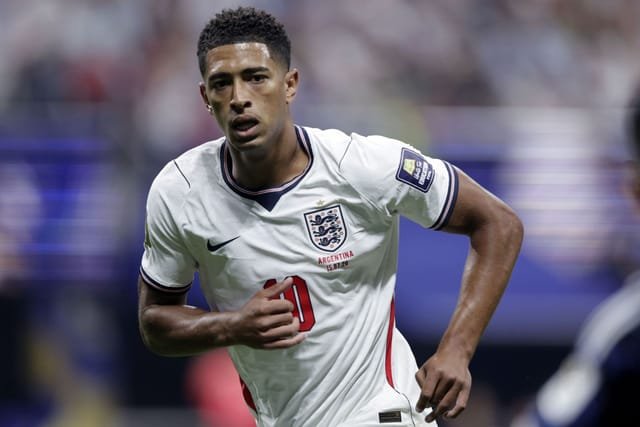
The aftermath of England’s 2-1 FIFA World Cup semi-final loss to Argentina has generated intense debate about tactics, substitutions, and individual performances. Among the most discussed subjects is the surprisingly quiet display from Jude Bellingham, a player many expected to dominate one of the tournament’s biggest matches.
Instead, the Real Madrid midfielder struggled to impose himself on proceedings as Lionel Messi inspired Argentina’s comeback victory in Atlanta. While football matches are often analyzed through statistics, formations, and tactical decisions, former Italy international Giuseppe Rossi has proposed a different explanation.
According to Rossi, the defining moment of Bellingham’s evening may have occurred within the opening minutes when Argentina midfielder Leandro Paredes delivered a late physical challenge after the English star had already released the ball.
His argument raises a fascinating question: can a single psychological moment alter the performance of one of the world’s best midfielders on football’s biggest stage?
What Happened Between Jude Bellingham and Leandro Paredes?
Early in the semi-final, Bellingham received possession in midfield and quickly moved the ball. Moments after releasing his pass, he was met by a late challenge from Argentine midfielder Leandro Paredes.
While the incident itself was not extraordinary by World Cup standards, Rossi believes its impact extended far beyond the physical contact.
The former Italian international argued that the challenge immediately shifted Bellingham’s focus away from controlling the match and toward the physical battle unfolding around him.
Whether one agrees with that assessment or not, the incident reflected a broader theme that has defined many successful Argentine teams throughout football history: establishing a psychological edge as early as possible.
Why Argentina’s Mental Approach Is So Effective
One of the most underrated aspects of elite football is the mental battle that unfolds alongside the tactical one.
At the highest level, physical fitness and technical quality are often relatively equal. The difference frequently comes down to concentration, confidence, composure, and emotional control.
Argentina have built a reputation for excelling in these areas.
Throughout international football history, Argentine teams have often combined technical brilliance with relentless competitiveness. They rarely allow opponents to become comfortable.
This approach can include:
- Early physical challenges.
- Constant pressure on key players.
- Aggressive midfield battles.
- Emotional intensity.
- Strategic game management.
The objective is not simply to win possession. It is to influence how opponents think and react during the match.
Was Jude Bellingham Really Taken Out of the Game?
The statistical evidence suggests Bellingham struggled to influence the contest compared to his usual standards.
For a player who often dictates tempo, creates chances, and drives attacks forward, his impact was noticeably limited.
| Performance Metric | Jude Bellingham vs Argentina |
|---|---|
| Minutes Played | 90 |
| Completed Passes | 19 |
| Passes Into Final Third | 1 |
| Shots Attempted | 0 |
| Chances Created | 0 |
| Ground Duels Won | 6 of 14 |
These numbers do not necessarily prove Rossi’s theory, but they do illustrate how effectively Argentina limited one of England’s most important players.
The key point is that Bellingham was not simply quiet in possession. He struggled to exert influence across multiple areas of the game.
The Tactical Reasons Behind Bellingham’s Difficult Night
While psychological factors have attracted significant attention, tactical explanations should not be overlooked.
Argentina entered the match with a clear strategy to congest central areas and reduce England’s ability to progress through midfield.
Bellingham often thrives when he can:
- Carry the ball through midfield.
- Link attack and defense.
- Arrive late into dangerous areas.
- Create numerical advantages.
- Operate between opposition lines.
Argentina consistently denied him those opportunities.
Their midfield structure forced England into less effective attacking patterns, reducing Bellingham’s influence long before the decisive goals arrived.
Why Psychological Battles Matter at World Cups
World Cup knockout matches are different from ordinary club fixtures.
The stakes are enormous. Every mistake is magnified. Every moment carries emotional weight.
In these environments, psychological resilience becomes as important as technical ability.
History is filled with examples of great players struggling because opponents successfully disrupted their rhythm, confidence, or focus.
That does not mean those players lacked quality. Rather, it demonstrates how small mental advantages can produce significant competitive benefits.
Rossi’s comments highlight this reality.
At the elite level, football is often won by teams that manage emotions as effectively as they manage tactics.
Argentina’s Experience Advantage
Another factor working against England was Argentina’s collective experience.
Many members of the squad have spent years competing in major international tournaments, Copa América campaigns, and World Cup knockout matches.
That experience helps players remain composed during difficult moments.
When England took the lead, Argentina did not panic.
Instead, they gradually increased pressure, controlled possession, and trusted their ability to create opportunities.
This composure ultimately proved decisive as Lionel Messi orchestrated the comeback.
The Lionel Messi Effect
Any analysis of the semi-final must acknowledge Messi’s influence.
While discussions have centered on Bellingham, the game was ultimately shaped by Argentina’s captain.
Messi’s two assists transformed the contest and demonstrated why he remains one of football’s most influential players even at the latter stages of his career.
His ability to create decisive moments forces opponents to defend differently and often shifts attention away from other Argentine players.
That dynamic can make life even more difficult for opposing midfielders attempting to control matches.
England’s Bigger Problem Against Elite Teams
The defeat also highlighted a broader trend that has haunted England for decades.
Against lower-ranked opponents, England frequently look capable of winning major tournaments.
Against elite sides in knockout football, the story often changes.
The loss to Argentina extended a concerning pattern against top-ranked international opposition.
These matches are often decided not by talent alone but by moments of composure, tactical flexibility, and psychological strength.
England continue to possess world-class players, yet they repeatedly struggle to overcome the final hurdle against football’s most experienced tournament nations.
What Thomas Tuchel Must Learn From This Defeat
The semi-final provides valuable lessons for England manager Thomas Tuchel.
One of the most important involves protecting key players from being isolated during intense midfield battles.
When Bellingham was unable to influence the game, England lacked alternative solutions.
Future tournament success may depend on creating systems that allow star players to recover from difficult starts rather than becoming increasingly disconnected from proceedings.
Elite opponents will continue targeting England’s most dangerous players.
Developing tactical responses to that reality will be essential.
The Unique Insight Competitors Are Missing
Most discussions have focused on whether Paredes’ challenge directly caused Bellingham’s poor performance.
However, the deeper issue is not the tackle itself but England’s collective response.
Championship-winning teams rarely allow one psychological moment to dictate an entire match.
Whether Rossi’s theory is correct or not, Argentina consistently demonstrated greater emotional control throughout the contest.
The true lesson may therefore be less about Bellingham and more about the difference between experienced tournament winners and talented challengers still learning how to navigate football’s highest-pressure moments.
What Comes Next for Jude Bellingham?
One difficult performance should not overshadow Bellingham’s overall tournament contribution or his status as one of the world’s premier midfielders.
At just 23 years old, he remains one of England’s most important players for the next decade.
In fact, experiences like this often accelerate development.
Many football legends endured painful World Cup setbacks before eventually achieving international success.
The challenge now is transforming disappointment into motivation ahead of future tournaments.
Prediction: This Defeat Could Strengthen Bellingham’s Leadership
The greatest players often learn more from losses than victories.
Bellingham’s difficult night against Argentina may ultimately become a valuable milestone in his development as an international leader.
Experiencing how elite teams manipulate momentum, emotions, and pressure could help him become even more complete in future tournaments.
Rather than defining his career, the semi-final may serve as an important lesson that shapes the next chapter.
Conclusion
Giuseppe Rossi’s claim that an early challenge from Leandro Paredes disrupted Jude Bellingham’s focus offers an intriguing perspective on England’s World Cup semi-final defeat. While it is impossible to prove that a single moment determined the midfielder’s performance, there is little doubt that Argentina successfully limited his influence throughout the match.
The defeat ultimately reflected a combination of tactical execution, psychological resilience, and tournament experience. Argentina excelled in all three areas, while England struggled to regain control once momentum shifted.
For Bellingham, the match represents a rare setback in an otherwise remarkable career. For England, it serves as another reminder that winning a World Cup requires more than talent alone. At the highest level, football’s greatest battles are often fought in the mind as much as on the pitch.
For breaking news and live news updates, like us on Facebook or follow us on Twitter and Instagram. Read more on Latest Sports on thefoxdaily.com.






COMMENTS 0