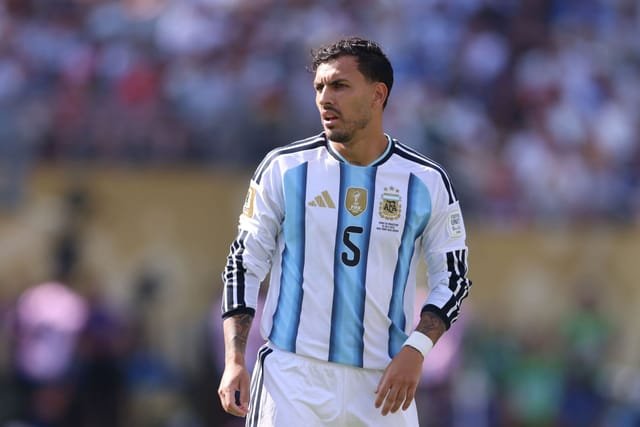
Leandro Paredes has been handed a 10-match suspension by FIFA following his involvement in the on-pitch confrontation after Argentina’s 1-0 defeat to Spain in the 2026 FIFA World Cup final on July 19, 2026.
The disciplinary decision has extended the fallout from the final beyond the result itself. FIFA investigated several Argentina players and officials after a physical altercation broke out at New York New Jersey Stadium following the final whistle. Paredes received the most severe player punishment, while Nahuel Molina was also handed a lengthy suspension.
The sanctions mean the consequences of the incident will follow Argentina into its upcoming international fixtures. FIFA has confirmed that the suspensions will be carried over to the next matches of the relevant representative teams, making the ruling particularly significant for Argentina’s post-World Cup plans.
What happened after the Argentina vs Spain World Cup final?
Argentina entered the 2026 FIFA World Cup final hoping to retain the world title but suffered a 1-0 defeat against Spain. The disappointment quickly turned into controversy when a confrontation involving players from both teams developed after the match.
FIFA subsequently opened disciplinary proceedings against the Argentinian Football Association, Paredes, Molina, Thiago Almada and coaching staff member Roberto Ayala.
Paredes faced three charges, while Molina was charged with two. Almada and Ayala were each charged with one offence. FIFA later announced separate punishments based on the conduct attributed to each individual.
Paredes was suspended for 10 matches and fined $90,000. Molina received a seven-match suspension and a $90,000 fine. Almada was given a one-match suspension and fined $30,000, while Ayala received a three-match suspension and a $30,000 fine.
Leandro Paredes’ 10-match ban explained
The length of Paredes’ suspension is the most significant part of FIFA’s ruling. A 10-match international ban can have a major effect because national teams play considerably fewer competitive fixtures than clubs.
FIFA confirmed that the match suspensions are to be carried over to the next matches of the relevant representative teams. As a result, Paredes will miss a substantial run of Argentina fixtures rather than simply serving the punishment in a small number of immediate games.
The $90,000 fine adds a financial penalty to the sporting punishment. However, the international suspension is likely to have the greater practical impact on Paredes because it prevents him from being selected for Argentina during the period in which the ban remains active.
Why did FIFA punish Paredes and Molina so heavily?
The severity of the sanctions is linked to the physical nature of the confrontation. The incident reportedly went beyond heated exchanges or verbal arguments and involved physical contact between several players.
Molina was seemingly one of the main figures involved in the initial escalation. He appeared to throw a punch toward Rodri’s stomach as the Spain midfielder moved across the pitch to join his teammates during the celebrations.
Paredes subsequently became involved in the confrontation. He grabbed Eric Garcia by the throat and pushed him to the ground before later pushing Gavi in the face and wrestling him to the ground.
These incidents are significant because conduct after the final whistle remains subject to football’s disciplinary regulations. The end of competitive play does not remove players’ responsibility for violent or inappropriate behaviour.
Paredes was not sent off during the final
One of the more notable aspects of the controversy is that Paredes did not receive a red card during the match itself, despite being involved in several fouls during the final.
Initial reports suggested that Paredes had been sent off for his conduct during the confrontation. Later reports clarified that he had not actually received a red card.
That distinction is important because an in-match dismissal and a subsequent FIFA disciplinary sanction are separate matters. FIFA can investigate incidents that officials may not have punished with a red card during the game, particularly when video evidence or post-match reports provide grounds for further action.
Argentina’s other World Cup final sanctions
| Argentina figure | Suspension | Fine |
|---|---|---|
| Leandro Paredes | 10 matches | $90,000 |
| Nahuel Molina | 7 matches | $90,000 |
| Thiago Almada | 1 match | $30,000 |
| Roberto Ayala | 3 matches | $30,000 |
The different punishments show that FIFA did not treat every participant in the same way. The length of each suspension reflects the specific charges and conduct considered during the disciplinary process.
For Argentina, Paredes and Molina are the two players facing the biggest sporting consequences. Their absence could become particularly relevant if the national team enters a period of important competitive fixtures shortly after the World Cup.
FIFA also fined the Argentina Football Association
The disciplinary case was not limited to individual players. FIFA also imposed significant sanctions on the Argentinian Football Association, with fines reportedly totaling $321,000 for breaches of regulations during the World Cup.
The governing body said the sanctions were connected to the use of a sporting event for demonstrations of a non-sporting nature, including discrimination and racial abuse.
The case included an incident following Argentina’s 2-1 semi-final victory over England, when some Argentina players displayed a white banner carrying the message “Las Malvinas Son Argentina,” referring to the Falkland Islands.
FIFA regulations prohibit political messages being displayed by players or teams during its competitions. The disciplinary response therefore goes beyond the post-final confrontation and highlights FIFA’s wider approach to political demonstrations at major tournaments.
Argentina faces restrictions on future home matches
The financial penalties against the AFA were accompanied by a sporting and logistical consequence. FIFA ordered Argentina to play its next two home matches with a limited number of spectators.
That restriction could affect the atmosphere around Argentina’s next home fixtures and reduce the usual advantage that comes from playing in front of a large home crowd.
For a national team that regularly attracts strong support, even a temporary reduction in stadium capacity can have a wider effect. The financial consequences of reduced attendance can also become an additional concern for the national federation, although the precise impact depends on the venues and ticketing arrangements involved.
What the bans mean for Argentina after the World Cup
The biggest sporting question is how Argentina manages the absence of Paredes and Molina during the early stages of its next international cycle.
Paredes has long provided experience and physicality in midfield, while Molina offers experience on the defensive side. Losing both players for multiple international matches could force Argentina’s coaching staff to consider different combinations.
The situation also creates an opportunity for younger or less-established players to compete for places. International suspensions often accelerate squad changes because coaches have to test alternatives under competitive conditions rather than simply experimenting during training.
Argentina’s response will therefore be an important part of the post-World Cup transition. The bans are a setback, but they could also create opportunities for emerging players to establish themselves in the national team.
The bigger lesson from FIFA’s disciplinary decision
The most important takeaway from the case is that FIFA is treating player conduct away from active play as a serious disciplinary matter. Emotional scenes after major matches are not unusual, but physical confrontation can result in significant consequences even when a referee does not issue an immediate red card.
The decision also demonstrates why players and teams must remain disciplined after the final whistle. World Cup matches attract enormous global attention, and incidents that might otherwise disappear quickly can become the subject of detailed disciplinary investigations.
For Argentina, the controversy is particularly unfortunate because the final itself was already a defining moment of the tournament. Instead of being remembered solely for Spain’s victory, the match has also become associated with the confrontation and the subsequent FIFA sanctions.
Could the suspensions change Argentina’s midfield plans?
Paredes’ absence could force Argentina to rethink its midfield structure. His suspension removes an experienced option and may require the coaching staff to place greater responsibility on other midfielders.
The effect will depend heavily on Argentina’s fixture schedule and the tactical preferences of the coaching staff. If the team needs greater defensive stability, another player could be used as a deeper midfielder. Alternatively, Argentina could choose a more possession-oriented setup and compensate for Paredes’ absence through additional technical quality.
This is where the punishment could have a longer-term sporting consequence. A lengthy suspension does not merely remove one player from a team sheet; it can influence tactical development, player hierarchy and the emergence of new partnerships.
Why the Argentina sanctions matter beyond one incident
FIFA’s decision carries significance beyond Argentina and Spain. Major international tournaments increasingly operate under intense scrutiny, with player behaviour, political demonstrations and disciplinary conduct all subject to global attention.
The case sends a straightforward message to national teams: competitive intensity does not provide unlimited freedom to players once the boundaries of sporting conduct are crossed.
It also reinforces the importance of separating sporting expression from political messaging. FIFA’s regulations restrict political demonstrations at its competitions, meaning federations and players must understand the rules before making statements or displaying messages in tournament environments.
What happens next for Leandro Paredes and Argentina?
Paredes’ immediate challenge will be to remain ready for club football while serving his international suspension. His national-team return will depend on the number of applicable fixtures that take place while the ban is active.
Argentina, meanwhile, must move forward without two experienced players for a significant period. The coaching staff will have to identify alternatives, while the AFA will also have to ensure that future matches comply with FIFA’s disciplinary requirements.
The situation is unlikely to erase the sporting achievement of reaching the 2026 World Cup final, but it does add a difficult chapter to Argentina’s post-tournament story.
Conclusion: A costly ending to Argentina’s World Cup campaign
Leandro Paredes’ 10-match FIFA suspension is the clearest indication of how seriously football’s governing body viewed the confrontation following Argentina’s World Cup final defeat to Spain. Alongside the $90,000 fine, the ban represents a significant international setback for the midfielder.
Nahuel Molina’s seven-match suspension, the punishments handed to Almada and Ayala, and the wider financial penalties against the AFA ensure that the consequences extend beyond one player.
For Argentina, the focus now shifts from disciplinary fallout to rebuilding. The national team must cope with the absence of important players, adjust its squad and avoid further regulatory problems.
The larger lesson is equally clear: in modern international football, the final whistle does not necessarily end a player’s responsibility. What happens after the match can be examined just as closely as what happens during it, and FIFA’s latest sanctions demonstrate that misconduct can carry consequences long after the trophy has been lifted.
For breaking news and live news updates, like us on Facebook or follow us on Twitter and Instagram. Read more on Latest Football on thefoxdaily.com.





COMMENTS 0