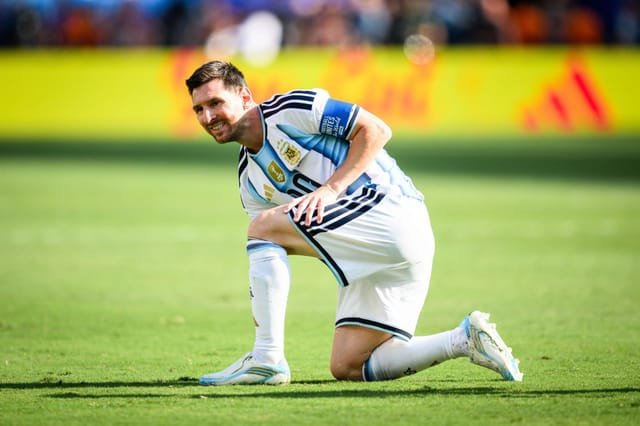
Lionel Messi‘s Argentina future remains uncertain after the 2026 FIFA World Cup, but the Argentine Football Association has no intention of rushing the legendary forward into a decision. AFA president Chiqui Tapia has stressed that Messi deserves privacy and time to determine whether he wants to continue representing La Albiceleste.
The uncertainty follows Argentina’s heartbreaking 1-0 defeat to Spain in the 2026 World Cup final. Messi, who had once again produced an outstanding tournament, finished the competition with eight goals and four assists in eight appearances and received the Silver Ball for his performances.
At 39, the Inter Miami superstar is now approaching a very different stage of his international career. The 2026 tournament could have been his final World Cup, but Tapia’s comments suggest Argentina will not attempt to influence his decision either way.
That approach is significant because Messi’s international career has already exceeded almost every reasonable expectation. He has won the 2022 World Cup, two Copa America titles and multiple individual awards while becoming Argentina’s most influential footballer of the modern era.
Chiqui Tapia refuses to pressure Lionel Messi
Tapia’s message was straightforward: Messi’s decision belongs to Messi.
“It’s a purely personal decision. We have to leave him in peace and give him space.”
The AFA president also reflected emotionally on Argentina’s World Cup campaign and the personal relationship he shares with the players and staff.
His comments are important because speculation about Messi’s international future usually begins almost immediately after major tournaments. This time, however, Argentina’s football leadership appears determined to avoid creating additional pressure around the veteran captain.
That could be the most sensible approach.
Messi does not need to prove anything else internationally. Whether he chooses to continue through the next Copa America cycle or steps away from international football, his legacy with Argentina is already secure.
Why Messi’s 2026 World Cup makes the decision complicated
The timing of the decision is particularly difficult because Messi did not look like a player simply hanging on during the tournament.
He remained one of Argentina’s central attacking figures and finished the World Cup with eight goals and four assists. Those numbers underline just how influential he remained even at 39.
Argentina ultimately fell short against Spain, losing the final 1-0 after a demanding tournament.
For Messi, that creates a strange contrast. Individually, he had another remarkable World Cup. Collectively, Argentina came within one victory of defending the title they had won four years earlier.
That could make walking away emotionally difficult.
At the same time, losing another World Cup final may also reinforce the argument for ending his international career on his own terms rather than continuing indefinitely.
Messi has already experienced both World Cup heartbreak and glory
Messi’s relationship with the World Cup has changed dramatically throughout his career.
In 2014, he led Argentina to the final in Brazil, scoring four goals and providing an assist during the tournament. Argentina ultimately lost 1-0 to Germany in extra time, leaving Messi with the Golden Ball but not the trophy.
Eight years later, he returned to the final stage with an even more productive campaign.
At the 2022 World Cup, Messi scored seven goals and supplied three assists across seven matches. He scored twice in the final against France as Argentina eventually prevailed in one of the most dramatic World Cup finals ever played.
That victory removed the biggest missing achievement from his résumé.
It also changed the conversation around his international career. Before Qatar, Messi’s critics could point to the absence of a World Cup title. After Qatar, that argument disappeared.
Messi has now reached another historic World Cup milestone
Messi’s performances in 2026 further strengthened his place in World Cup history.
He became the only player to win the tournament’s Golden Ball more than once after receiving the award in both 2014 and 2022. In 2026, he added another individual distinction by receiving the Silver Ball.
His international statistical résumé is equally extraordinary.
Messi has scored 125 international goals and made 207 appearances for Argentina, figures that place him second in both categories behind Cristiano Ronaldo in the all-time international rankings cited in the source material.
Those numbers demonstrate that his importance to Argentina has extended far beyond a single generation.
Messi’s Argentina legacy is already complete
There is an important distinction between Messi’s legacy and his future.
His future is uncertain.
His legacy is not.
Alongside the 2022 World Cup, Messi helped Argentina win the 2021 and 2024 Copa America titles. Those victories transformed an international career that had once been defined by near misses into one filled with major trophies.
For years, Argentina supporters endured painful defeats with Messi at the center of the team. The Copa America triumph in 2021 finally ended that wait, and the World Cup victory in 2022 elevated the story to another level.
Consequently, if Messi retires from international football now, he would be leaving after helping Argentina establish one of the strongest periods in the country’s recent football history.
Messi’s quick return to Inter Miami is telling
While his Argentina future remains undecided, Messi has already returned to club football with Inter Miami.
Just 15 days after Argentina’s defeat to Spain in the World Cup final, the 39-year-old returned to the field for the Herons. He initially came off the bench against Columbus Crew in a 2-2 MLS draw before making his first start since the World Cup against Atletico San Luis.
The response was immediate.
Messi scored twice and provided an assist in Inter Miami’s 4-2 victory over San Luis in a Leagues Cup group-stage match on August 6.
His performance demonstrated that the disappointment of the World Cup final has not prevented him from immediately returning to the rhythm of club football.
Messi’s San Luis performance changes the retirement conversation
The timing of Messi’s return is worth examining because physical performance is likely to be one of the most important factors in his eventual decision.
Against San Luis, Messi scored in the 11th minute with a controlled side-footed volley after Noah Allen’s cross. He then doubled his tally in the 44th minute by finishing Allen’s cutback into the top corner.
He also delivered a precise corner late in the first half that allowed Micael to score Miami’s fourth goal.
In other words, Messi did not simply return to the pitch. He immediately influenced the match in multiple ways.
That does not prove he will continue with Argentina, but it does show that his ability to produce decisive moments remains intact.
What Messi must consider before making his decision
At this stage of his career, the question is unlikely to be whether Messi is capable of playing international football.
The more important question is whether he wants to.
International football requires repeated travel, demanding preparation and the emotional intensity that comes with representing Argentina. For a player who has already won the biggest trophies available, the motivation required to continue may be different.
Messi also has to consider his role.
Continuing does not necessarily mean playing every match for 90 minutes. He could potentially transition into a more selective role, depending on his physical condition and the direction of the national team.
That possibility gives Argentina another reason to avoid demanding an immediate answer.
The biggest factor may be Messi’s motivation, not his ability
This is the key distinction missing from many retirement debates.
Messi’s 2026 performances suggest he can still make a significant contribution. But being capable of playing is not the same as wanting to continue through another international cycle.
The emotional cost of the 2026 World Cup final could also matter.
Argentina reached the final but lost to Spain, meaning Messi experienced another painful defeat on the biggest stage despite producing a strong individual tournament.
He may want another opportunity to compete for Argentina.
Or he may decide that winning the 2022 World Cup and two Copa America titles provides the perfect ending to his international story.
Only Messi can answer that question.
Lionel Messi’s international career at a glance
| Achievement | Messi’s Argentina record |
|---|---|
| International appearances | 207 |
| International goals | 125 |
| World Cup titles | 1, in 2022 |
| Copa America titles | 2, in 2021 and 2024 |
| World Cup Golden Balls | 2, in 2014 and 2022 |
| 2026 World Cup performance | 8 goals and 4 assists |
| 2026 World Cup individual award | Silver Ball |
What Argentina could look like without Messi
Argentina’s biggest challenge is not simply replacing Messi’s goals.
It is replacing his entire influence on the team’s attacking structure.
For years, Argentina have been able to rely on Messi to create opportunities, draw defenders, dictate attacking sequences and produce decisive moments when matches become difficult.
Replacing those responsibilities would likely require a collective solution rather than one direct successor.
The next generation of Argentine attackers will therefore be judged against an almost impossible standard. Messi’s departure would force the team to develop a different attacking identity rather than simply asking another player to become “the next Messi.”
Why Argentina should give Messi complete control
Tapia’s decision to give Messi space could ultimately benefit both parties.
If Messi wants to continue, Argentina can welcome him without the pressure of having publicly demanded his return.
If he decides to retire, the federation can celebrate his career without creating the impression that he was pushed toward another campaign.
That distinction matters for a player who has given more than two decades to international football.
Messi’s relationship with Argentina has already survived intense criticism, painful defeats and enormous expectations. Allowing him to choose the final chapter protects that relationship.
Could Messi play beyond the 2026 World Cup?
It remains possible that Messi could continue playing for Argentina, but there is currently no certainty that he will.
The most realistic approach is to wait rather than interpret every club appearance or public comment as evidence of an impending retirement announcement.
His return to Inter Miami and immediate two-goal performance are encouraging from a physical standpoint, but club football and international football involve different demands.
The next major international cycle will also provide more information about Messi’s motivation and Argentina’s evolving squad.
If he remains available and motivated, Argentina would almost certainly benefit from his experience. If he chooses to step away, the team will have to begin building its next era without its greatest modern star.
Prediction: Messi is unlikely to rush his Argentina decision
The most likely short-term outcome is that Messi takes time before announcing whether he will continue with Argentina.
There is little reason for him to make an immediate decision after such an emotionally demanding tournament. His quick return to club football gives him an opportunity to focus on Inter Miami while allowing the disappointment of the World Cup final to settle.
Argentina’s leadership appears willing to wait, and that could be crucial.
If Messi eventually chooses to return, the decision will feel voluntary rather than obligatory. If he retires, he will do so knowing that Argentina’s football leadership respected his choice.
Conclusion: Lionel Messi’s Argentina future belongs to Lionel Messi
Lionel Messi’s future with Argentina remains one of the biggest questions following the 2026 World Cup, but AFA president Chiqui Tapia has made it clear that the legendary forward will not be pressured.
Messi leaves the tournament after another remarkable individual campaign, producing eight goals and four assists and collecting the Silver Ball despite Argentina’s 1-0 final defeat to Spain.
His international legacy is already extraordinary. He has won the 2022 World Cup, two Copa America titles and two World Cup Golden Ball awards, while establishing himself as Argentina’s all-time leader in international goals and appearances.
At 39, however, the decision to continue is no longer simply about what Messi can do on the pitch. It is about what he wants from the final stage of his career.
His immediate return to Inter Miami, followed by two goals and an assist against Atletico San Luis, shows that his footballing quality remains evident. But whether that translates into another international campaign is a personal choice.
Argentina can wait. Messi has earned that freedom, and the next chapter of his international story should begin only when he decides he is ready to write it.
For breaking news and live news updates, like us on Facebook or follow us on Twitter and Instagram. Read more on Latest Football on thefoxdaily.com.






COMMENTS 0