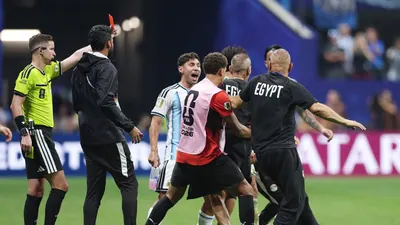
The controversy surrounding Argentina’s dramatic victory over Egypt at the FIFA World Cup 2026 has entered a new phase after FIFA refereeing chief Pierluigi Collina publicly addressed allegations that match officials favored the defending champions.
What began as frustration over a handful of contentious decisions has evolved into one of the tournament’s biggest stories, raising broader questions about VAR consistency, referee accountability, transparency, and the growing pressure facing Football officials in the digital age.
Collina’s intervention is significant because it represents FIFA’s clearest response so far to accusations made by Egypt’s football authorities following their dramatic Round of 16 elimination.
His message was direct: debate about decisions is acceptable, but questioning the integrity of referees is not.
Why the Argentina vs Egypt Match Sparked Global Debate
Few matches at the 2026 World Cup have generated as much discussion as Argentina’s 3-2 comeback victory over Egypt.
The defending champions appeared to be heading toward a shocking elimination after falling two goals behind against a disciplined Egyptian side.
Instead, Argentina produced a remarkable comeback that kept their title defense alive.
However, the football itself quickly became overshadowed by refereeing controversies.
Several incidents during the match became the focus of intense scrutiny, particularly involving VAR intervention and penalty decisions.
For Egypt, those moments represented turning points that dramatically altered the outcome of the game.
For FIFA, they represented examples of the VAR system functioning exactly as intended.
This difference in interpretation lies at the heart of the controversy.
The Key Decisions That Triggered Egypt’s Complaint
The Egyptian Football Association’s concerns largely revolve around two major incidents.
1. The Disallowed Mostafa Ziko Goal
Egypt believed they had strengthened their advantage when Mostafa Ziko found the net during the second half.
The goal would have significantly increased pressure on Argentina and potentially placed Egypt in complete control of the match.
Following a VAR review, however, officials identified a foul earlier in the attacking sequence.
The goal was subsequently disallowed.
Although VAR protocols permit intervention in attacking phases leading directly to goals, many Egyptian supporters questioned whether the foul warranted overturning such a crucial moment.
2. The Penalty Appeal Involving Mohamed Salah
The second controversial moment occurred late in the match when Mohamed Salah went down inside Argentina’s penalty area.
Egyptian players immediately appealed for a penalty.
No spot kick was awarded.
The decision became even more contentious because it occurred shortly before Argentina launched the attack that ultimately produced the winning goal.
From Egypt’s perspective, the sequence felt devastating.
From FIFA’s perspective, officials correctly applied the laws of the game.
What Pierluigi Collina Actually Said
As one of football’s most respected refereeing figures, Pierluigi Collina’s comments carry considerable weight.
His response focused on three key areas:
- Defending the integrity of referees.
- Explaining VAR intervention standards.
- Rejecting suggestions of external influence.
Collina emphasized that disagreement over decisions is a natural part of football but argued that accusations of bias or manipulation cross an important line.
His strongest statement centered on the independence of FIFA referees.
According to Collina, no individual—including senior FIFA leadership—can influence refereeing decisions during World Cup matches.
The statement appeared designed not only to defend Letexier and his officiating team but also to protect confidence in the tournament’s overall integrity.
Why FIFA Is Taking These Allegations Seriously
Football authorities understand that public trust is essential for the sport’s credibility.
Modern tournaments generate enormous global audiences, commercial partnerships, and media attention.
Any suggestion that outcomes are predetermined or manipulated can damage confidence in the competition.
That is why FIFA’s response extends beyond defending a single referee.
The organization is effectively defending the legitimacy of its entire officiating framework.
Collina’s comments indicate that FIFA views allegations of favoritism as a significant issue, particularly when they gain international attention.
The Growing Pressure on Referees in Modern Football
One of the most important points raised by Collina concerns the human side of refereeing.
While players and managers often dominate headlines, referees increasingly operate under extraordinary levels of scrutiny.
Every decision is analyzed through:
- Multiple camera angles.
- Slow-motion replays.
- Social media platforms.
- Expert television analysis.
- Global online discussion.
Within minutes of a controversial incident, millions of people can form opinions about a referee’s performance.
This environment has fundamentally changed the profession.
Officials now face criticism on a scale unimaginable a generation ago.
Collina specifically warned that accusations questioning integrity can lead to harassment, threats, and abuse directed not only at referees but also at their families.
This concern reflects a growing challenge across global sports.
Understanding FIFA’s Interpretation of VAR Protocols
The controversy also highlights a common misunderstanding among supporters regarding VAR.
Many fans assume the technology exists to eliminate all mistakes.
In reality, VAR serves a more limited purpose.
Its objective is to identify clear and significant errors in specific match-changing situations.
| VAR Reviews | Can Be Reviewed? |
|---|---|
| Goals | Yes |
| Penalty Decisions | Yes |
| Red Cards | Yes |
| Mistaken Identity | Yes |
| Minor Fouls Across Match | No |
Importantly, VAR does not remove subjectivity from football.
Officials must still interpret physical contact, intent, advantage, and context.
That means disagreements can persist even when technology is involved.
The Consistency Question Remains
While FIFA has strongly defended the decisions themselves, the broader debate is unlikely to disappear.
Many supporters are less concerned about whether a single decision was technically correct and more concerned about consistency.
Football fans generally accept difficult calls when they believe identical situations are treated similarly throughout a tournament.
The challenge arises when different incidents appear to receive different levels of review.
This perception issue has become one of football’s biggest officiating challenges.
Even when decisions align with the laws of the game, inconsistency—or the appearance of inconsistency—can undermine confidence.
How This Controversy Compares to Previous World Cups
Every World Cup produces refereeing debates.
From disputed goals before goal-line technology to controversial handball decisions and penalty calls, officiating has often become part of football’s biggest narratives.
The difference in 2026 is the speed at which controversies spread.
Social media, advanced analytics, and instant replay allow every incident to be examined in extraordinary detail.
As a result, controversial moments can dominate news cycles for days rather than hours.
The Argentina-Egypt debate fits into this broader trend.
The controversy has expanded beyond individual decisions and evolved into a discussion about technology, governance, transparency, and trust.
What This Means for Argentina’s World Cup Campaign
For Argentina, the ongoing debate creates an unusual situation.
On one hand, the team deserves recognition for producing one of the tournament’s most dramatic comebacks.
On the other hand, discussions about officiating continue to overshadow aspects of their performance.
Lionel Messi and his teammates remain focused on defending their title, but every subsequent match will likely be viewed through the lens of this controversy.
That reality reflects the enormous attention surrounding both Argentina and the World Cup itself.
What Happens Next?
FIFA’s public defense of Letexier suggests the governing body remains confident in the actions of its officiating team.
Historically, formal complaints rarely alter completed match results.
Instead, they typically trigger internal reviews and assessments.
The larger impact may be felt in future discussions about transparency and communication.
Several sports have introduced systems that provide greater public insight into officiating decisions.
Football could face increasing pressure to move in a similar direction.
The Bigger Lesson for Football
The Argentina-Egypt controversy highlights an important reality about modern football.
Technology can reduce errors, but it cannot eliminate disagreement.
Even with VAR, multiple camera angles, and extensive review processes, interpretation remains part of the game.
The challenge for governing bodies is not simply making correct decisions but maintaining public confidence in how those decisions are reached.
That challenge will remain long after the 2026 World Cup concludes.
Conclusion
Pierluigi Collina’s defense of FIFA referees represents a pivotal moment in the ongoing Argentina-Egypt controversy. While Egypt continues to question key decisions from its Round of 16 defeat, FIFA has firmly rejected suggestions of bias, favoritism, or external influence.
The debate now extends beyond a single match and touches on broader issues facing modern football: VAR transparency, officiating consistency, referee protection, and public trust in the sport’s governing institutions.
Whether supporters agree with the decisions or not, one thing is clear: the Argentina-Egypt match has become one of the defining controversies of FIFA World Cup 2026, and its impact on conversations about refereeing may outlast the tournament itself.
For breaking news and live news updates, like us on Facebook or follow us on Twitter and Instagram. Read more on Latest Sports on thefoxdaily.com.






COMMENTS 0