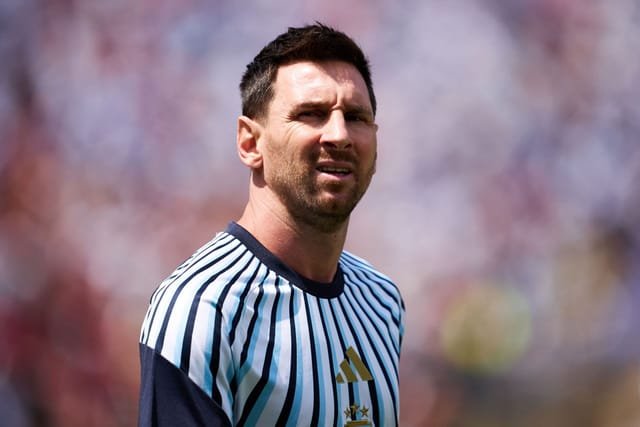
Lionel Messi’s heated conversation with referee Joao Pinheiro became one of the memorable off-field talking points from Argentina’s 2026 FIFA World Cup campaign. The incident occurred during Argentina’s quarter-final against Switzerland, when Messi appeared visibly frustrated while speaking to the Portuguese official.
Argentina eventually won the match 3-1 after extra time, but the exchange between Messi and Pinheiro attracted considerable attention because of the Argentine captain’s reaction. Messi appeared to point toward the referee during the conversation, creating the impression that tensions had escalated.
Pinheiro has now offered his version of events, explaining that the incident resulted from a misunderstanding rather than deliberate disrespect. According to the referee, Messi interpreted something he said differently from how it was intended.
The clarification is significant because interactions involving globally recognized players such as Messi can quickly become bigger stories than the actual incident. Pinheiro suggested that this particular exchange lasted only around 30 seconds and had no lasting effect on the remainder of the match.
What happened between Lionel Messi and Joao Pinheiro?
The incident occurred during Argentina’s quarter-final against Switzerland at the 2026 FIFA World Cup. Messi and Pinheiro became involved in a heated verbal exchange, with the Argentina star appearing to express his frustration directly toward the referee.
From the outside, the confrontation looked intense. Messi’s gestures and the tone of the interaction naturally attracted attention, particularly because the match was a high-pressure knockout fixture.
However, Pinheiro has now explained that there was no serious personal dispute between the two men. His account suggests that Messi believed the referee had spoken to him disrespectfully, while Pinheiro insists that this was not his intention.
The disagreement continued briefly because neither side accepted the other’s interpretation of the conversation. Pinheiro described it as a situation in which Messi believed he had been disrespected, while the referee maintained that he had done nothing improper.
Joao Pinheiro says Messi misunderstood his words
Pinheiro addressed the incident during an appearance on the Completamente podcast hosted by Dany Oliveira. Rather than portraying Messi as deliberately confrontational, the referee characterized the situation as a simple misunderstanding.
According to Pinheiro, Messi interpreted something he said in the wrong way and believed that the referee had disrespected him. Pinheiro said that he explained his intention, but Messi was not convinced by the explanation at that moment.
The disagreement therefore became a short verbal back-and-forth rather than a prolonged confrontation.
This distinction matters. In football, emotional exchanges between players and officials are common, particularly during major tournament matches. A visible argument does not necessarily mean that a deeper personal conflict exists.
Pinheiro also emphasized that the incident did not develop into a broader problem. Once the brief exchange ended, the match continued without another significant confrontation between the referee and Messi.
The referee insists the incident lasted only around 30 seconds
One of the most important details from Pinheiro’s explanation is the amount of time the disagreement actually occupied. He described it as a roughly 30-second moment during a match that eventually lasted 120 minutes.
That perspective changes how the incident can be viewed. A short disagreement can appear much more dramatic when captured by television cameras, replayed on social media and discussed by millions of football fans.
Pinheiro said that after the conversation, he had no further problems with Messi or any other player for the remainder of the match.
This is an important point for understanding match officiating. Referees regularly have to manage emotional players, disputed decisions and intense conversations. The ability to move past a disagreement and maintain control of the match is often more important than preventing every moment of frustration from occurring.
Why Messi’s involvement made the incident bigger
Pinheiro suggested that Messi’s global reputation contributed to the amount of attention surrounding the incident.
Messi is one of the most recognizable athletes in world football, so even a relatively ordinary exchange involving him can become international news. A similar conversation involving an unknown player might have received considerably less attention.
This creates an interesting challenge for referees. Officials have to treat players equally, but the public reaction to their decisions can be very unequal depending on the identity of the player involved.
Messi’s reputation, career achievements and enormous global following mean that every visible disagreement involving him is likely to be analyzed closely. Body language that might normally be ignored can quickly become the subject of headlines, social-media debates and television discussion.
Argentina’s 2026 World Cup campaign was filled with scrutiny
The Messi-Pinheiro incident did not occur in isolation. Argentina’s World Cup campaign was already attracting significant attention because of several controversial moments.
Messi had also been involved in an earlier officiating discussion during Argentina’s opening match against Algeria. His apparent escape from a sending-off situation generated debate over whether Argentina and its captain were receiving different treatment from officials.
Such debates can create a narrative around a team. Once fans begin questioning refereeing decisions involving a particular player, every subsequent incident can receive additional scrutiny.
That helps explain why the conversation between Messi and Pinheiro attracted such interest. It was not simply about two people exchanging words; it occurred against the backdrop of an entire tournament in which Argentina’s officiating had already been discussed.
Messi’s individual performance remained one of the tournament’s biggest stories
Despite the controversy surrounding some officiating decisions, Messi’s performance at the 2026 FIFA World Cup was one of the defining stories of Argentina’s run.
The Argentine forward scored eight goals and provided four assists during the tournament. At 39 years old, those numbers underlined his continued influence at the highest level of international football.
Messi played a major role in helping Argentina reach the final, producing important contributions throughout the competition. His performances also resulted in several records and renewed discussion about his place among the greatest players in World Cup history.
However, Argentina ultimately fell short of winning the trophy. Spain lifted the World Cup after defeating Argentina in the final, meaning Messi’s impressive individual campaign ended without another world title.
Did Lionel Messi deserve the 2026 World Cup Golden Ball?
Another major debate surrounding Messi’s tournament was the decision over the FIFA World Cup Golden Ball, awarded to the player judged to have been the tournament’s outstanding performer.
Messi had a strong statistical case. His eight goals and four assists demonstrated his direct contribution, while his creative influence was also central to Argentina’s progress to the final.
However, Spain captain Rodri ultimately received the Golden Ball after leading Spain to the World Cup title.
The decision illustrates one of football’s most difficult individual-award debates: should the prize primarily recognize statistics and individual influence, or should winning the tournament carry greater weight?
Messi’s campaign strengthens the argument that individual awards do not always have to follow the tournament winner. A player can be outstanding throughout most of a competition even if his team loses the final.
At the same time, Rodri’s award can be defended on the basis of his leadership and contribution to a championship-winning side. The disagreement is therefore less about whether either player had a strong tournament and more about how the award should be evaluated.
Messi’s age made his World Cup performance even more remarkable
At 39, Messi entered the tournament under an entirely different set of expectations from those surrounding him earlier in his career.
When Messi was younger, his ability to dominate matches physically and repeatedly produce explosive individual actions was often taken for granted. At this stage of his career, his value increasingly comes from experience, positioning, creativity, decision-making and his ability to influence the rhythm of attacks.
His eight-goal, four-assist tournament therefore offered another reminder that elite football intelligence can remain extremely valuable even as a player’s physical profile changes.
That is also why individual moments involving Messi receive so much attention. Every World Cup appearance at this stage of his career carries additional historical significance.
What the referee’s explanation tells us about football controversies
The Messi-Pinheiro episode offers a useful lesson about how football controversies develop.
A brief interaction inside a stadium can be transformed into a major storyline once cameras capture it. Without hearing what was actually said, viewers are forced to interpret facial expressions, gestures and body language.
That can create a gap between what appeared to happen and what actually happened.
Pinheiro’s explanation provides additional context by revealing that the incident was not part of a prolonged conflict. His claim that there were no further issues involving Messi during the remaining 120 minutes suggests that both sides were able to move beyond the disagreement.
This does not mean every referee-player confrontation is insignificant. Instead, it demonstrates why context matters before reaching conclusions about an incident that viewers only see for a few seconds.
The bigger lesson: reputation can shape how football moments are perceived
The most interesting angle in this story may be the role of reputation.
Messi’s enormous status means that his reactions are interpreted differently from those of most players. A frustrated gesture can become a headline, while the same action from a lesser-known player may barely attract attention.
That creates a complicated relationship between sporting reputation and media attention. Being famous brings enormous influence, but it also means that almost every public action receives greater scrutiny.
Pinheiro’s comments indirectly highlight this phenomenon. The referee acknowledged that the incident became a recurring question because it involved Messi, despite describing the actual disagreement as a brief moment that did not affect the rest of the match.
What happens to Messi after the 2026 World Cup?
The 2026 World Cup represented another major chapter in Messi’s international career. His individual numbers demonstrated that he could still play a decisive role on the biggest stage, but Argentina’s defeat in the final also ensured that the tournament would be remembered with mixed emotions.
At this stage, every future international appearance will naturally generate questions about longevity, workload and whether Messi will continue competing for Argentina.
His performances in 2026 have nevertheless strengthened the argument that his influence cannot be measured solely through age. The combination of goals, assists, experience and creativity allowed him to remain one of Argentina’s most important players.
Conclusion: A heated moment that became bigger than the incident itself
Lionel Messi’s confrontation with Joao Pinheiro during Argentina’s 2026 FIFA World Cup quarter-final against Switzerland appeared heated, but the referee’s explanation suggests it was ultimately a brief misunderstanding.
Pinheiro maintains that Messi believed he had been disrespected, while the referee insists that no disrespect was intended. The two exchanged opposing views for around 30 seconds before moving on, with no further problems reported during the rest of the match.
The incident became significant largely because of Messi’s global profile and the wider scrutiny surrounding Argentina’s refereeing decisions during the tournament.
More importantly, Messi’s individual campaign stood apart from the controversy. With eight goals and four assists at the age of 39, he remained one of the tournament’s most influential players, even though Spain ultimately lifted the trophy and Rodri received the Golden Ball.
The episode is a reminder that football stories can look very different once the people involved provide their own context. What appeared to be a major confrontation on camera was, according to Pinheiro, little more than a short disagreement that both men left behind as the match continued.
For breaking news and live news updates, like us on Facebook or follow us on Twitter and Instagram. Read more on Latest Football on thefoxdaily.com.




COMMENTS 0