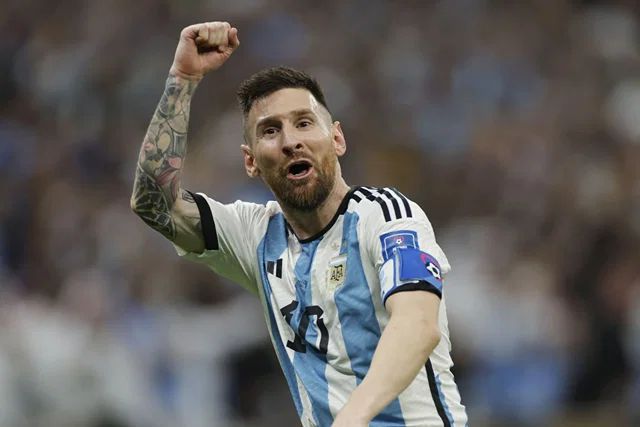
Fresh claims surrounding Argentina’s historic 2022 FIFA World Cup triumph have raised questions about a possible dressing-room leak before the final against France. Argentine journalist Fede Rodas has alleged that an unnamed member of Lionel Messi’s squad shared Lionel Scaloni’s starting lineup with him after becoming frustrated with his limited playing time. According to Rodas, the same individual also disclosed details of an incident involving an injured Argentina player during a training session in the build-up to the match in Qatar.
The allegation has attracted attention because Argentina’s journey to the world title was built around a close-knit squad, strong leadership and the ability to respond under pressure. Although the identity of the alleged source has not been revealed, Rodas described the player as an established international who was unhappy with his position in the team.
It is important to distinguish the journalist’s account from an independently established fact. No player has been publicly identified in the supplied report, and the allegation does not establish that the individual actually disclosed the information. Nevertheless, the claim offers a fresh talking point about squad selection, competition for places and the pressure surrounding a World Cup final.
Journalist alleges Argentina player leaked World Cup final lineup
Fede Rodas claimed that a senior member of Argentina’s 2022 World Cup squad contacted him with information about Scaloni’s selection for the final against France. According to the journalist, the player was unhappy because he believed he deserved more minutes on the pitch.
Rodas said the individual revealed the starting XI before Argentina faced France at Lusail Stadium on December 18, 2022. He also alleged that the player shared information about an incident involving an injured teammate during a training session.
In comments attributed to Rodas and circulated by the social media account @AlbicelesteTalk, the journalist described the alleged source as a top-class footballer who struggled to accept that other players were ahead of him in the selection hierarchy.
“There was a top-class player in Argentina’s squad who was unhappy because he wasn’t playing as much as he wanted.”
Rodas further claimed that the player provided him with the team lineup and details of the training-ground incident. He suggested that the alleged disclosure was connected to the footballer’s frustration at not being selected.
“That player leaked the starting XI for the World Cup final to me. He also leaked details of an incident involving an injured player during training.”
The journalist also offered his interpretation of the alleged player’s attitude, saying that the individual believed his quality should have guaranteed him a more prominent role.
“He was a great player, but there were others better than him, and he couldn’t accept it. His attitude was basically: ‘Oh, you’re not going to play me? Then I’ll leak your lineup.’”
These comments have fuelled speculation about who the unnamed footballer might have been. However, without a name, independent confirmation or a response from the individuals involved, identifying a particular Argentina player would be premature. The allegation remains Rodas’s account rather than a confirmed finding about the squad.
Why Argentina’s starting lineup for the final mattered
Team selection was one of the major talking points before Argentina’s meeting with France. Scaloni had guided his side through a challenging tournament, making adjustments depending on opponents, tactical requirements and the availability of players.
Argentina entered the final after defeating Croatia 3-0 in the semi-final. The team had found an effective balance between Messi’s creative influence, Julián Álvarez’s movement in attack and the work rate of the midfield. Scaloni nevertheless made one notable change to his starting lineup for the championship match.
Ángel Di María returned to the starting XI in place of Leandro Paredes. It was the only change from the team that had beaten Croatia in the semi-final.
The decision reflected Argentina’s attacking approach for the final. Di María offered pace, direct running and the ability to stretch France’s defensive structure. His presence also gave Messi another experienced attacking teammate capable of creating opportunities in important moments.
Paredes, meanwhile, had played an important role during Argentina’s tournament campaign. His absence from the starting lineup was a tactical decision rather than an indication that he lacked value to the squad.
World Cup finals often require difficult selection decisions. Coaches must balance individual quality with tactical suitability, fitness and the specific challenges presented by the opposition. Even experienced international players can find themselves outside the starting team when a manager believes another combination offers a better chance of winning.
How Argentina took control before France produced a dramatic comeback
The 2022 World Cup final began with Argentina looking confident and organised. Scaloni’s team pressed intelligently, controlled important areas of the pitch and repeatedly found ways to involve Messi in attacking situations.
Argentina opened the scoring in the 23rd minute when Messi converted a penalty. The spot kick followed a challenge involving Di María inside the French penalty area. Messi calmly sent the goalkeeper the wrong way, giving his country an early advantage.
The second goal arrived in the 36th minute and highlighted the attacking quality of Argentina’s first-half performance. A rapid team move involving Messi, Álvarez and Alexis Mac Allister created space for Di María, who finished past Hugo Lloris.
With a 2-0 lead, Argentina appeared to be moving towards a relatively comfortable victory. France, however, had other ideas. Didier Deschamps made changes before the interval as his side struggled to establish control, and the match transformed during the closing stages of normal time.
Kylian Mbappé reduced the deficit in the 80th minute by converting a penalty after Randal Kolo Muani was brought down in the box. Just two minutes later, Mbappé scored again with a spectacular volley following a combination with Marcus Thuram.
The two quick goals changed the atmosphere inside Lusail Stadium. Argentina had been close to lifting the trophy, but France had forced the contest back to 2-2 and created an entirely different challenge for Scaloni’s players.
Messi scored again, but Mbappé completed his hat-trick
Extra time brought another remarkable chapter in a final that had already delivered several major turning points. Argentina continued to create opportunities, while France remained dangerous whenever Mbappé found space in the attacking third.
Messi scored his second goal of the night in the 108th minute. After a move involving Lautaro Martínez, the ball fell to the Argentina captain, who followed up the attack and pushed the ball over the line. The goal appeared to put Argentina within touching distance of the championship.
France refused to surrender. In the 118th minute, Mbappé converted another penalty after a handball inside Argentina’s penalty area. The goal completed his hat-trick and made him the first player to score three times in a men’s World Cup final since Geoff Hurst in 1966.
The score was 3-3, leaving the world champions to be decided by a penalty shootout. The final had produced six goals, dramatic momentum swings and individual performances that would remain part of World Cup history.
For Argentina, the challenge was no longer about maintaining a lead. It was about managing the pressure of a shootout after more than two hours of football against the defending champions.
Emiliano Martínez helped Argentina win the penalty shootout
Argentina eventually won the shootout 4-2, with goalkeeper Emiliano Martínez playing a crucial role. His save from Kingsley Coman gave Argentina an important advantage, while Aurélien Tchouaméni subsequently sent his effort wide.
Messi, Paulo Dybala, Leandro Paredes and Gonzalo Montiel converted their penalties for Argentina. Montiel scored the decisive kick, completing a journey that had begun with a surprising defeat against Saudi Arabia in the opening group match.
Martínez’s contribution throughout the tournament was significant. His performances provided Argentina with confidence in difficult moments, and his presence in the final shootout became one of the defining images of the championship.
The victory delivered Argentina’s third men’s World Cup title, following their triumphs in 1978 and 1986. It also ended a 36-year wait for the country to lift the trophy again.
For Messi, the result represented the achievement that had eluded him during his previous four World Cup appearances. He had reached the final in Brazil in 2014 but lost to Germany. Eight years later, he finally became a world champion.
Messi’s outstanding individual performance at Qatar 2022
Messi finished the 2022 FIFA World Cup with seven goals and three assists in seven appearances. His contribution earned him the Golden Ball award, recognising him as the tournament’s outstanding player.
He scored in six of Argentina’s seven matches and found the net twice in the final against France. His goals, assists, passing and ability to control attacking situations made him central to the team’s success.
One of his most important moments came during Argentina’s second group-stage match against Mexico. After the opening defeat to Saudi Arabia, Argentina needed a response to keep its qualification hopes on track. Messi broke the deadlock with a low finish from outside the penalty area, helping his team secure a crucial 2-0 victory.
His influence was equally important in the knockout rounds. Against the Netherlands in the quarter-final, Messi produced a superb pass to Nahuel Molina, who scored Argentina’s opening goal. The captain later converted a penalty as the match eventually went to a shootout.
Argentina’s semi-final against Croatia provided another memorable display. Messi scored from the penalty spot before creating a brilliant opportunity for Álvarez with an individual run that demonstrated his ability to beat defenders even at the highest level of International Football.
By the time Argentina reached the final, Messi had become the central figure in a team that combined experienced internationals with younger players. His performances were not limited to scoring goals; he also helped create chances, dictate the tempo and provide leadership during difficult periods.
Squad competition and selection pressure behind the allegation
The claims made by Rodas have renewed discussion about the challenges that managers face when selecting a team for a major international final. A national squad may contain several players who regularly feature for leading clubs, but only 11 can begin a match.
That competition can become particularly intense during a World Cup. Players spend weeks together, train under the same coaching staff and understand that every match could determine their place in the starting lineup. Those who receive fewer opportunities must often accept supporting roles while remaining prepared to contribute when called upon.
Argentina’s 2022 campaign included several examples of players making important contributions without starting every match. Scaloni adjusted his team according to tactical demands, and substitutes also played meaningful roles during the tournament.
Di María’s return for the final demonstrated how a player’s specific qualities could influence a major selection decision. His attacking threat was particularly useful against France, while Paredes remained an important option in midfield.
From a team-management perspective, maintaining unity is essential. Players may disagree with selection decisions, but a successful tournament campaign requires individuals to place collective objectives above personal expectations.
However, the allegation that a player deliberately disclosed confidential information should be treated separately from the normal frustrations associated with competition for places. Being left out of a starting XI does not, by itself, establish that a footballer acted improperly.
Why the unnamed player’s identity remains unconfirmed
One of the biggest unanswered questions surrounding Rodas’s comments is the identity of the alleged source. The journalist described the individual as a high-level international but did not publicly identify him in the supplied account.
That lack of identification makes it difficult to assess the allegation independently. Argentina had several established players competing for positions during the tournament, and many members of the squad had experienced changes in their playing time.
Speculation based on the final lineup would not provide reliable evidence. A player who did not start against France cannot automatically be connected to the alleged leak. Nor does a player’s absence from the starting XI prove that he was unhappy with the coach or his teammates.
There is also an important distinction between knowing a lineup and deliberately leaking it. Team selections are discussed among players and staff before matches, but establishing whether information was intentionally passed to a journalist requires evidence beyond the fact that the journalist knew the starting team.
Until further details emerge, the identity of the alleged player should remain an open question. Neither the player nor Argentina’s coaching staff has been identified in the supplied report as having publicly confirmed the story.
Argentina’s 2022 triumph remains part of Messi’s legacy
Regardless of the new allegation, Argentina’s victory in Qatar remains one of the defining achievements of Messi’s international career. The tournament brought together a team capable of responding to setbacks and delivering under extraordinary pressure.
The defeat against Saudi Arabia tested the squad early in the competition. Argentina recovered with victories over Mexico and Poland before progressing through the knockout rounds. Wins against Australia, the Netherlands and Croatia took the team to the final, where it eventually overcame France.
Messi’s performances gave Argentina a clear attacking leader, but the championship was also built on contributions from players across the squad. Martínez’s goalkeeping, Álvarez’s goals, Di María’s attacking quality and the work of the midfield and defence all helped deliver the trophy.
The final itself captured the unpredictable nature of football. Argentina led by two goals, France came back, Messi restored the advantage in extra time and Mbappé completed his hat-trick before the shootout settled the contest.
What happens next after the World Cup leak claims?
Rodas’s comments have introduced a separate discussion about what may have happened behind the scenes before Argentina’s biggest match in Qatar. If additional information or independent confirmation emerges, it could provide more clarity about the alleged disclosure and the circumstances surrounding it.
For now, the central details remain unverified beyond the journalist’s account. The player’s identity has not been established, and the allegation should not be treated as a confirmed incident involving a named member of Argentina’s squad.
What is certain is that Scaloni’s selection for the final included Di María in place of Paredes, Messi delivered two goals, Mbappé scored three times and Argentina eventually won the World Cup on penalties. The triumph completed Messi’s long pursuit of football’s biggest international prize and secured a lasting place for the 2022 team in Argentina’s sporting history.
The alleged dressing-room leak may remain a subject of debate, but the outcome of the final is already part of football history. Argentina left Qatar as world champions, with Messi lifting the trophy after one of the most dramatic finals the tournament has ever witnessed.
For breaking news and live news updates, like us on Facebook or follow us on Twitter and Instagram. Read more on Latest Football on thefoxdaily.com.






COMMENTS 0