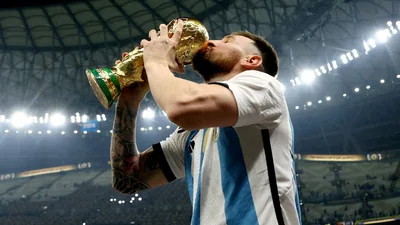
Lionel Messi Argentina retirement marks the end of one of the most remarkable international careers in football history. After two decades wearing Argentina’s famous No. 10 shirt, Messi has stepped away from international football following a career that moved through almost every possible emotion: expectation, criticism, disappointment, redemption and ultimately triumph.
Messi’s Argentina journey was never simply about goals or medals. It became a generational sporting story. Fans watched him grow from a teenage talent into the leader of a national team, saw him struggle through repeated final defeats and eventually witnessed him deliver the trophies that had once appeared beyond his reach.
The timing of his retirement also carries additional emotional weight. At 39, Messi had already experienced the defining achievements of his international career, including Copa América success, the Finalissima and the 2022 FIFA World Cup. His final years with Argentina demonstrated that his value was no longer dependent only on explosive athleticism. Experience, positioning, creativity and decision-making allowed him to remain decisive even as his role evolved.
Messi’s Argentina career was never an easy story
When Messi first entered the Argentina setup, expectations were enormous. He was quickly compared with Diego Maradona, and every performance carried the burden of that comparison.
Messi’s club career provided extraordinary evidence of his ability, but international football initially offered a very different experience.
He reached major finals with Argentina and repeatedly came close to winning the biggest prizes, only to leave without the trophy. Those defeats created a narrative that became increasingly difficult to escape: brilliant for Barcelona, but unable to reproduce the same level of success with his country.
That criticism often ignored an important reality. Football is a team sport, and reaching multiple international finals itself requires sustained excellence. Nevertheless, Messi carried the responsibility because he was the team’s most influential player.
The first major heartbreak changed everything
The 2014 World Cup was one of the clearest examples of Messi’s complicated relationship with Argentina success.
Argentina reached the final in Brazil, with Messi playing a central role throughout the tournament. The team eventually lost to Germany after extra time.
For Messi, the defeat was particularly painful because the World Cup represented the biggest prize missing from his collection.
Two consecutive Copa América final defeats followed in 2015 and 2016. Both came against Chile, with the latter ending in a penalty shootout.
After the 2016 defeat, Messi announced his international retirement. He was only 29.
The announcement seemed extraordinary in hindsight, but it reflected the emotional pressure surrounding the national team at the time.
Why Messi’s first retirement did not last
Messi returned to Argentina duty later in 2016.
That decision proved crucial because the greatest chapter of his international career had not yet been written.
The next major tournament, the 2018 World Cup in Russia, did not provide immediate redemption. Argentina exited in the Round of 16 after a turbulent campaign, while criticism surrounding the team and Messi remained intense.
Yet the difficult period eventually created the conditions for a transformation.
Lionel Scaloni helped change Argentina’s identity
One of the biggest turning points in Messi’s international career was the emergence of Lionel Scaloni as Argentina coach.
Instead of attempting to make Messi carry an entire team, Argentina gradually developed a collective structure around him.
The difference was enormous.
Messi no longer needed to solve every problem himself. Younger players brought energy, defenders became more reliable and the midfield developed a stronger balance between creativity and defensive work.
Just as importantly, Messi’s leadership evolved.
He became less concerned with proving himself through spectacular individual moments and more focused on influencing the team as its experienced leader.
2021 finally brought the breakthrough
The breakthrough arrived at the 2021 Copa América.
Argentina defeated Brazil in the final at the Maracanã, giving Messi his first senior major international trophy with Argentina.
The importance of that victory went far beyond the medal itself.
For years, Messi had been judged against the absence of an international title. Suddenly, the biggest criticism surrounding his career had lost much of its force.
The victory also changed the emotional relationship between Messi and Argentina supporters. The player who had once been questioned became the leader of a team capable of winning together.
The Finalissima strengthened the belief
Argentina followed the Copa América triumph by defeating Italy in the 2022 Finalissima.
While the competition did not carry the same significance as a World Cup or Copa América, the victory reinforced Argentina’s growing confidence.
The team was unbeaten across a remarkable stretch of matches and entered the 2022 World Cup with genuine belief.
That confidence would soon be tested.
Qatar 2022 completed the missing chapter
The 2022 FIFA World Cup became the defining chapter of Messi’s Argentina career.
Argentina suffered an unexpected defeat against Saudi Arabia in its opening group match, immediately raising fears that the old cycle of disappointment had returned.
Instead, the team responded.
Argentina progressed through the tournament, defeating opponents in the knockout rounds and eventually reaching the final against France.
The final became one of the most dramatic matches in World Cup history. Argentina and France produced a 3-3 draw after extra time before Argentina prevailed in the penalty shootout.
Messi finally lifted the World Cup.
For supporters who had spent years watching him fall short, the image of Messi holding the trophy represented more than a championship victory. It was the resolution of a story that had remained unfinished since his emergence as Argentina’s teenage prodigy.
Why the 2022 World Cup changed Messi’s legacy
Before Qatar, debates about Messi’s place among football’s greatest players often included one major qualification: he had not won the World Cup.
After Qatar, that argument changed fundamentally.
Messi was no longer simply the extraordinary Barcelona star who had struggled for international glory. He was a World Cup-winning Argentina captain who had played a central role throughout the tournament.
His performances also demonstrated that leadership did not necessarily have to look loud or confrontational.
Messi led through football.
His ability to create chances, control important moments and inspire teammates became increasingly evident as Argentina progressed through the competition.
Copa América 2024 added another layer
Messi’s international story could have ended after the 2022 World Cup and still been considered complete.
Instead, he continued.
Argentina won another Copa América in 2024, giving Messi another major international title during the later stages of his career.
That achievement mattered because it demonstrated that the 2022 triumph was not an isolated peak.
Argentina had developed a winning culture, and Messi remained part of it.
The remarkable final World Cup chapter
Entering the 2026 FIFA World Cup at 39, Messi faced a completely different challenge.
At an age when most players are already retired or far removed from international football, expectations were naturally more cautious.
Yet his tournament reportedly produced another remarkable statistical contribution, with eight goals and four assists.
Those numbers underline how unusual his longevity has been.
The important difference was that Messi no longer needed to play every minute like the explosive young forward who first emerged in the 2000s. His game had evolved.
He could conserve energy, choose his moments, operate between defensive lines and use his understanding of space to influence matches.
The final did not provide another perfect ending
Argentina’s 2026 World Cup campaign ultimately ended with defeat in the final.
For some players, such an ending might overshadow everything that came before it.
For Messi, it does not.
His international legacy had already been secured in Qatar and strengthened by subsequent achievements.
The 2026 final instead served as the closing scene of a career that had already reached its highest possible point.
There is an important distinction between ending a career with a defeat and having a career defined by defeat. Messi’s Argentina career belongs firmly in the second category only if the years of success are ignored.
Messi’s evolution from superstar to leader
Perhaps the most interesting part of Messi’s Argentina story is not the trophies but the evolution of his role.
Early in his international career, Messi was expected to be the young genius who produced miracles.
Later, he became the player responsible for rescuing Argentina whenever things went wrong.
Under Scaloni, that expectation changed.
Messi became the senior figure within a balanced team. Players around him understood their responsibilities, allowing him to focus on the areas where his ability could make the greatest difference.
This was arguably the most important tactical and psychological change of his career with Argentina.
Messi compared with the Maradona era
| Category | Diego Maradona | Lionel Messi |
|---|---|---|
| World Cup triumph | 1986 | 2022 |
| International role | Creative leader and captain | Creative leader and captain |
| Major Argentina legacy | World Cup hero | World Cup, Copa América and Finalissima winner |
| Era | 1980s–1990s | 2000s–2020s |
| Defining achievement | Leading Argentina to the 1986 World Cup | Completing an international trophy collection with the 2022 World Cup |
The Maradona comparison will probably remain part of football culture forever, but Messi’s achievements have established an independent legacy.
He does not need to be Maradona 2.0.
He became Messi.
The Asian fan connection was about more than club football
Messi’s popularity extended far beyond Argentina and Europe.
For millions of supporters across Asia, watching Argentina became closely connected with watching Messi. His club career could move from Barcelona to Paris Saint-Germain and later to Major League Soccer, but international tournaments offered something different.
Every World Cup appearance created a shared global event.
For younger fans especially, Messi was not simply one player among many. He was the footballer whose career unfolded alongside their own childhood, school years and transition into adulthood.
That helps explain why his retirement feels different from the retirement of an ordinary superstar.
The human side of Messi’s farewell
Football discussions often reduce legendary careers to numbers, but Messi’s final years with Argentina also carried a deeply personal dimension.
His family witnessed the difficult stages of his international career as well as the greatest victories.
The contrast between early disappointments and later celebrations made the eventual success even more meaningful.
Messi’s story therefore became about perseverance as much as talent.
The lesson is simple: being the best player on the field does not guarantee immediate success. Sometimes a career needs time, the right teammates, the right tactical environment and the willingness to continue after painful setbacks.
What Messi leaves behind for Argentina
Argentina will eventually have to find a way forward without its iconic No. 10.
That transition will not be easy.
Replacing Messi’s goals is one challenge, but replacing his creativity, experience and psychological influence is even harder.
The encouraging factor for Argentina is that the national team is no longer dependent on one player in the same way it once was. The structure developed during the Scaloni era should help the team continue competing at the highest level.
Still, there will inevitably be a Messi-shaped space in the lineup.
The legacy beyond statistics
Messi leaves international football with an extraordinary collection of achievements, including the World Cup, multiple Copa América titles, the Finalissima and Olympic gold.
He also established himself as Argentina’s leading scorer and most-capped player.
But statistics alone cannot fully explain his influence.
His legacy comes from the emotional journey attached to those numbers.
Fans remember the missed opportunities as vividly as the victories. They remember the criticism before the trophies. They remember the pressure after each final. And they remember the moment when the World Cup finally reached his hands.
That is why Messi’s Argentina career feels like a complete story rather than merely a successful résumé.
What comes next for Lionel Messi?
International retirement does not necessarily mean an immediate end to Messi’s football life.
His club career remains separate from his Argentina journey, and the next phase will be shaped by how long he wants to continue competing at club level.
But international football is different.
There will be no more qualifiers, tournament squads or World Cup campaigns carrying the Argentina No. 10 shirt into another cycle.
The future will belong to the next generation.
Conclusion
Lionel Messi Argentina retirement closes a chapter that once appeared destined to be remembered mainly for heartbreak.
He lost major finals, faced relentless comparisons with Maradona and even walked away from international football once before returning. Yet he eventually transformed that narrative completely.
The 2021 Copa América broke the trophy drought. The Finalissima added another international honour. The 2022 World Cup delivered the prize that had eluded him for most of his career, and the 2024 Copa América further strengthened Argentina’s golden era.
His final World Cup chapter added another extraordinary performance to an already remarkable international résumé, even though Argentina ultimately fell short in the final.
The No. 10 has now said goodbye to Argentina, but the story does not disappear with his retirement. For a generation of football fans, Messi’s career was part of growing up.
They watched him lose, return, win, lead and finally lift the trophy that seemed destined to remain outside his reach.
That is why Messi’s Argentina legacy is unlikely to fade. The shirt will eventually belong to someone else, but the memories created by its most famous wearer will remain.
For breaking news and live news updates, like us on Facebook or follow us on Twitter and Instagram. Read more on Latest Football on thefoxdaily.com.






COMMENTS 0