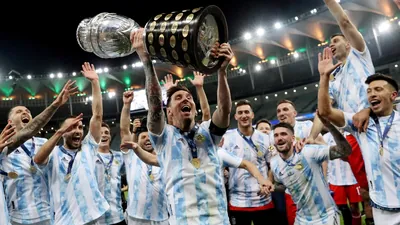
Lionel Messi retirement is not merely an Argentina story. His departure from international football represents a major turning point for South American football, a continent whose global identity has been closely connected to legendary players for generations. Messi spent almost two decades carrying Argentina’s No. 10 shirt, eventually transforming a career once defined by international disappointment into one decorated with major trophies.
Now that chapter is over. Argentina must learn how to compete without the player who repeatedly provided solutions in difficult moments, while South America faces the broader challenge of producing another superstar capable of commanding worldwide attention.
The continent will continue to produce talented footballers, and Argentina, Brazil and Uruguay remain powerful football nations. But replacing Messi’s influence is not simply a matter of finding another attacking player. His importance combined sporting excellence, longevity, leadership, commercial appeal and an emotional connection with supporters around the world.
Why Messi’s retirement matters beyond Argentina
South American football has always occupied a special place in the history of the sport.
Brazil, Argentina and Uruguay have produced generations of players who became global icons. Pelé, Diego Maradona, Ronaldo Nazário, Ronaldinho, Neymar, Luis Suárez and Messi all helped define different eras of international football.
Messi became the latest link in that chain.
His international career coincided with a period in which European club football became increasingly dominant financially and commercially. Yet whenever Argentina entered a World Cup, Messi provided South American football with a superstar whose performances could compete for global attention with the biggest European-based names.
His presence made Argentina matches major worldwide events.
That effect was particularly visible during the later stages of his career, when Argentina reached consecutive World Cup finals and established itself as one of international football’s strongest teams.
Messi carried more than Argentina’s expectations
The pressure on Messi was always larger than the responsibility attached to an ordinary national-team captain.
He was expected to win matches, create chances, score goals and produce moments of individual brilliance. At the same time, he was constantly compared with Maradona and judged against Argentina’s World Cup-winning history.
For years, that pressure became even greater because Argentina repeatedly reached major finals without winning them.
Messi eventually changed that narrative.
The 2021 Copa América victory ended the long wait for a senior international trophy. The 2022 World Cup then provided the defining achievement of his career, while another Copa América title in 2024 strengthened Argentina’s position at the top of international football.
By the time Messi reached the final stage of his career, his role had evolved from promising young superstar to experienced leader of a successful national team.
The 2022 World Cup changed the conversation
Before the 2022 World Cup, Messi’s international career was often discussed through the lens of what he had failed to win.
After Qatar, the conversation became almost entirely different.
Messi had finally lifted the World Cup with Argentina, removing the biggest missing achievement from his résumé.
The significance extended beyond the trophy itself. It demonstrated that Messi could lead Argentina to the biggest prize in international football after years of criticism and disappointment.
That victory also changed the way younger generations experienced Argentina football. Instead of watching another near-miss, they watched Messi become a World Cup champion.
For many supporters around the world, that was the moment the long-running debate about his international legacy effectively ended.
Argentina now faces the difficult part: moving forward
Argentina’s biggest challenge is not finding another Messi.
That would be impossible.
The real challenge is building a national team that does not depend on one player to solve every difficult situation.
Messi’s influence was so significant that Argentina frequently looked toward him whenever matches became complicated. His ability to create something from limited space gave the team an escape route that very few footballers in history could provide.
Without that option, the team will have to distribute responsibility across several players.
The midfield will need to create more consistently. Attackers will have to share the goalscoring burden. Younger players will have to become comfortable handling the pressure associated with Argentina’s shirt.
That transition could take time.
Argentina cannot simply copy the post-Messi Barcelona experience
There is an obvious comparison with Barcelona after Messi’s departure.
Barcelona had spent years structuring its attacking identity around the Argentine superstar. When he left, the club had to rebuild its footballing identity while dealing with the enormous expectations created by his era.
Argentina faces a different situation because international teams have fewer matches and cannot rebuild through the transfer market.
That makes succession planning more complicated.
The national team cannot purchase a replacement for Messi. It has to develop one through its own football system.
More importantly, Argentina should avoid searching for a player who behaves exactly like Messi. The better approach is to create a system in which several players collectively replace the functions that Messi performed individually.
The 2026 World Cup highlighted the challenge
Messi’s final World Cup campaign provided another illustration of his importance.
Even at 39, he reportedly produced eight goals and four assists during the tournament, demonstrating that his influence remained substantial despite his age.
His experience allowed Argentina to rely on his decision-making and ability to produce decisive moments.
But the final against Spain exposed the difficulty of depending heavily on one player.
When Messi did not produce his best performance, Argentina struggled to compensate for the difference.
That should not be interpreted as a criticism of Messi. Instead, it provides a useful lesson for Argentina’s future: a successful team must have multiple ways to win.
South America has another problem: the global spotlight
The impact of Messi’s retirement could extend beyond what happens on the pitch.
South American football has enormous domestic passion, but the global football economy is increasingly centred around European leagues and competitions.
Players such as Kylian Mbappé, Lamine Yamal, Erling Haaland and Jude Bellingham regularly command worldwide attention through their performances for elite European clubs and national teams.
Messi provided South America with a comparable global attraction.
His presence meant that fans in Europe, Asia and other parts of the world had another reason to follow Argentina and major South American competitions.
Without him, the continent will need new personalities capable of creating that same connection.
Neymar came closest, but Brazil’s story was different
For a period, Neymar appeared capable of sharing the global spotlight with Messi.
Both players were among the most technically gifted footballers of their generation, and their careers were closely connected during their time together at Barcelona.
However, Neymar’s international career with Brazil never reached the same level of trophy success that Messi eventually achieved with Argentina.
Injuries also disrupted important stages of Neymar’s career.
His talent was never seriously questioned, but consistency and availability became recurring challenges.
That difference is important when considering South America’s current situation. The continent still has elite talent, but having talented players is not the same as having a player who can combine extraordinary ability with longevity, international success and worldwide cultural influence.
Could Vinícius Júnior become South America’s next global face?
Vinícius Júnior is one of the obvious candidates to assume a larger role in South American football.
The Brazilian winger has established himself at the highest level of European club football and possesses the pace, technical quality and attacking influence required to become a global superstar.
However, international football presents a different challenge.
Brazil carries enormous expectations, and replicating the influence Messi had with Argentina would require more than individual club success. Vinícius would need to become a central figure in Brazil’s international achievements while maintaining consistency over several years.
That possibility makes Brazil’s future particularly interesting.
The next generation has a huge opportunity
Messi’s retirement does not mean South American football is running out of talent.
Quite the opposite.
The continent continues to produce technically gifted players, creative midfielders, exciting forwards and defenders capable of competing at the highest level.
The challenge is turning that talent into sustained international success.
Argentina has already built a strong football structure around its recent golden generation. Brazil continues to possess an enormous talent pool, while Uruguay has developed a reputation for producing competitive teams despite having a much smaller population.
Colombia, Ecuador and other South American nations also have players capable of influencing major competitions.
What is missing is the singular global figure.
What Messi’s departure means for Copa América
The Copa América could be one of the competitions most affected by Messi’s retirement.
Messi transformed the tournament into must-watch television for millions of supporters. His participation generated attention far beyond Argentina.
Without him, broadcasters and football authorities will have to rely more heavily on the tournament’s competitive quality and emerging stars.
This could ultimately be positive.
Instead of one superstar dominating the conversation, the tournament may provide a platform for several players to establish themselves.
A new era could emerge if younger South American stars recognize the opportunity created by Messi’s departure.
Messi’s legacy is impossible to reproduce
The temptation will be to ask who can replace Messi.
That is the wrong question.
There may never be another player who follows the exact same career path. Messi combined elite scoring, playmaking, longevity, club success and international achievement at an extraordinary level.
The better question is who can create a new identity for South American football.
The next generation does not need to imitate Messi. It needs to create its own stories.
Messi vs the next generation: what changes?
| Area | Messi era | Post-Messi challenge |
|---|---|---|
| Argentina leadership | Messi was the central figure | Leadership must be distributed across the squad |
| Global attention | Messi attracted worldwide interest | Multiple stars must share the spotlight |
| Creative responsibility | Messi could create chances individually | Midfielders and forwards must contribute collectively |
| International pressure | Messi absorbed much of the expectation | Younger players will face greater responsibility |
| South American identity | Messi was a global ambassador | A new generation must build its own global profile |
The prediction: South America may become more competitive, not less
There is an argument that Messi’s retirement could eventually benefit South American football in an unexpected way.
When one player dominates the global conversation for so long, other talents can naturally exist in his shadow.
Now the spotlight is open.
Young players from Argentina, Brazil, Uruguay, Colombia and elsewhere have an opportunity to become household names. The next major South American superstar may not be immediately obvious, but the absence of Messi creates space for someone new to emerge.
That transition will not happen overnight.
But football history repeatedly shows that eras eventually change. Pelé was followed by other Brazilian icons. Maradona was followed by another generation of Argentine stars. Messi himself eventually became the successor to an earlier footballing mythology.
There is no reason the cycle cannot continue.
Argentina’s immediate priority should be collective identity
For Argentina, the solution should begin with tactical flexibility.
Instead of searching for a direct No. 10 replacement, the team can develop different attacking patterns involving several players.
A stronger collective structure would reduce the pressure on any individual player and make Argentina less predictable.
The success of the Scaloni era provides an important foundation. The team already knows what it means to win major tournaments without relying solely on individual brilliance.
Now that philosophy has to survive without its most famous player.
South America’s football culture will survive
There is also a danger of overstating what Messi’s retirement means for the continent.
South American football is much bigger than one player.
The passion surrounding Argentina-Brazil matches will remain. Uruguay will continue to produce competitive teams. The Copa América will continue to attract huge audiences. Young footballers will still grow up dreaming of playing for their national teams.
What changes is the global face of that football.
Messi was a bridge between South America and the rest of the football world. Now the continent needs new bridges.
Conclusion
Lionel Messi retirement represents the end of an extraordinary international era, but its significance reaches far beyond Argentina.
Messi carried Argentina through years of heartbreak before helping deliver the Copa América, Finalissima and World Cup trophies that transformed his international legacy. His performances and personality also gave South American football one of the sport’s most powerful global ambassadors.
Argentina now faces the difficult task of developing a team that can function without its iconic No. 10. The objective should not be to find another Messi, because such a comparison would place unnecessary pressure on the next generation.
Instead, Argentina needs collective solutions.
For South America, the challenge is even broader. The continent still possesses enormous football talent, but it needs new stars capable of attracting global attention and creating fresh international stories.
Vinícius Júnior is one possible candidate, while other young players will have opportunities to emerge. The next era may not have one figure who dominates football in the same way Messi did.
That may ultimately be the most interesting part of what comes next.
Messi’s story has ended with Argentina, but South American football has not ended with Messi. The No. 10 leaves an enormous void, yet that empty space could become the stage on which the continent’s next generation creates something entirely new.
For breaking news and live news updates, like us on Facebook or follow us on Twitter and Instagram. Read more on Latest Football on thefoxdaily.com.






COMMENTS 0