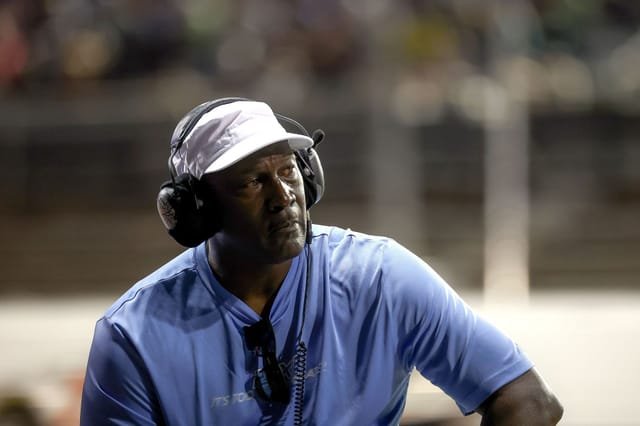
Michael Jordan’s NBC analyst stint appears to be coming to an end after just one season, closing a television chapter that had generated considerable anticipation among basketball fans. Jordan joined NBC as a special contributor for the 2025-26 NBA season, but his involvement was far more limited than many viewers expected.
The development prompted a sarcastic reaction from podcaster and frequent Jordan critic @CuffsTheLegend, a close associate of LeBron James. Responding to a social-media report about Jordan not being expected back for NBC’s next NBA season, he argued that the network had created expectations for regular basketball discussion before ultimately offering viewers only a small amount of Jordan content.
“Cigar Lungs and NBC really scammed us and had us thinking Mike was about to give us weekly basketball analysis and hoops talk on the couch..”
The criticism reflects a broader question surrounding Jordan’s NBC role: was the problem Jordan himself, or was it the way his contribution was structured and presented?
That distinction matters. Jordan remains one of the most influential figures in basketball history, but being an exceptional player does not automatically translate into becoming a compelling weekly television analyst. NBC’s decision to use him primarily through prerecorded material created a very different viewing experience from the regular studio role many fans had imagined.
Why Michael Jordan’s NBC Role Created So Much Excitement
Jordan’s arrival at NBC carried unusual significance because the network was returning to NBA broadcasting after a long absence. NBC had previously been one of the defining homes of NBA coverage before ending its partnership with the league in 2002.
Jordan also had not maintained a regular on-camera basketball commentary role for several years. His appearance during The Last Dance documentary in 2020 reminded audiences of his ability to attract enormous attention simply by discussing his playing career.
That combination created a natural expectation that Jordan could become one of NBC’s major basketball personalities.
Instead, his role was described as that of a special contributor. Rather than appearing every week for extensive live analysis, Jordan participated in a taped interview with Mike Tirico.
The difference between those two formats became central to the criticism.
What Viewers Actually Got From Jordan
Rather than providing regular live commentary, Jordan’s interview with Tirico was divided into several shorter segments. Those pieces covered general basketball topics, including issues such as load management and the experience of playing at Madison Square Garden.
The network effectively transformed one larger conversation into multiple pieces that could be distributed throughout its coverage.
From a production perspective, that approach allowed NBC to use Jordan’s appearance across its programming. From the perspective of fans expecting a recurring analyst, however, it produced a very different result.
Jordan was not sitting in the studio every week breaking down games, discussing tactical decisions or reacting immediately to major NBA developments.
That gap between expectation and reality explains why his NBC tenure became a subject of discussion even though Jordan himself remained a huge television draw.
LeBron James’ Associate Takes Aim at NBC’s Presentation
The strongest criticism came from @CuffsTheLegend, who has frequently expressed opinions about Jordan and his basketball legacy.
His reaction was not simply that Jordan was leaving. Instead, he mocked the structure of the broadcast role, suggesting that viewers had expected regular basketball conversations but received one interview that was divided into numerous smaller segments.
The comment was clearly sarcastic, but it highlights a genuine media question: how should a network use a legendary former athlete who does not necessarily want or need to become a traditional studio analyst?
Jordan’s celebrity status makes him valuable, but celebrity alone does not dictate the best broadcasting format.
Charles Barkley Had Already Criticized the Arrangement
The criticism surrounding Jordan’s limited appearances was not confined to social media.
According to reports cited in the source material, Charles Barkley also questioned NBC’s approach earlier in the season. Barkley reportedly described the arrangement as a poor look for the network.
Mike Tirico defended the decision, arguing that having Jordan appear in those segments was preferable to not hearing from him at all.
That exchange reveals the central disagreement surrounding Jordan’s role. One side sees the segments as a way to preserve access to an iconic basketball figure without requiring him to become a traditional analyst. The other sees the format as underusing a personality whose involvement was promoted as a major part of NBC’s return to NBA broadcasting.
Jordan Was Never a Conventional Basketball Analyst
There is another important factor that can be overlooked in the criticism: Jordan has never needed to build his career around television analysis.
During his playing career, his authority came from what he accomplished on the court. He became a six-time NBA champion, a 14-time All-Star and one of the most recognizable athletes in sporting history.
That legacy gives him a different relationship with broadcasting. Fans are interested in his perspective because he experienced the NBA at its highest level, but that does not necessarily mean he would enjoy dissecting games every week.
A successful analyst needs to be comfortable speaking frequently, explaining tactical details, reacting quickly and maintaining a consistent television presence. Those skills are separate from being an elite basketball player.
Jordan’s limited NBC role may therefore have reflected a deliberate decision to use his voice selectively rather than attempt to turn him into a conventional studio personality.
Why the NBC Decision Matters for NBA Broadcasting
NBC’s return to the NBA is itself a major development for basketball television. The network is entering a media environment where viewers have more ways than ever to consume games, highlights, analysis and player commentary.
That makes recognizable personalities extremely valuable.
Jordan is arguably one of the biggest names the network could attach to its coverage. His presence can generate attention even when his actual airtime is limited.
However, the situation also illustrates a potential lesson for sports broadcasters: big names need the right format.
A famous athlete appearing occasionally can create anticipation, while the same athlete appearing every week may create a completely different relationship with viewers. NBC’s experience with Jordan demonstrates the importance of aligning promotional expectations with the actual role.
What Happens to NBC’s NBA Coverage Without Jordan?
NBC is scheduled to open its next NBA season on October 20 with a tripleheader, and current plans do not include Jordan.
His absence means the network will need to establish its basketball identity without relying on the former Chicago Bulls superstar as a recurring contributor.
That does not necessarily represent a major problem. A television network’s long-term NBA strategy cannot depend on one personality, regardless of how famous that person is.
The bigger challenge will be creating a consistent combination of play-by-play commentators, analysts, studio personalities and former players who can provide different types of insight.
Jordan’s Broadcasting Exit Does Not Reduce His Basketball Influence
Although his NBC chapter appears to be ending, Jordan’s influence on basketball remains enormous.
His six championships with the Chicago Bulls, individual awards and global impact continue to shape how basketball history is discussed. His name also remains closely connected to the commercial side of the sport, where memorabilia associated with his career continues to attract enormous attention.
That was demonstrated again by the upcoming auction of a game-worn Jordan jersey from the 1998 NBA Finals.
1998 NBA Finals Jersey Could Become a Record-Setting Collectible
A game-worn white Michael Jordan jersey from the 1998 NBA Finals is scheduled to go to auction, creating another major moment for collectors of sports memorabilia.
The jersey was worn during Game 3 of the Bulls’ final championship run and carries the 1998 Finals patch. Its status as a home-white jersey from that series makes it particularly rare.
The auction is scheduled to run from September 15 through September 29. Estimates cited in the source material place the potential final price in the $10 million to $15 million range.
However, the jersey’s owner, investor Rob Gough, has suggested that the final price could be dramatically higher.
Gough believes the item could potentially become the first basketball jersey to reach $100 million.
Whether that prediction becomes reality remains to be seen, but the possibility illustrates how Jordan’s value extends far beyond television appearances.
Why Jordan Memorabilia Remains So Valuable
The potential value of the jersey is tied to more than the famous name on the back.
Collectors generally place significant importance on the connection between an item and a specific historic moment. A jersey worn during Jordan’s final championship run for the Bulls carries that historical association.
The 1998 season also occupies a special place in NBA history because it represented the conclusion of Chicago’s second three-peat.
That combination of player, team, season and championship context creates a unique collectible proposition.
| Jordan Development | Significance |
|---|---|
| NBC special contributor | Jordan returned to extended NBA television coverage after years away from regular commentary. |
| One-season broadcast role | His NBC involvement was limited compared with expectations of regular analysis. |
| 1998 Finals jersey | A game-worn item from Jordan’s final Bulls championship run is heading to auction. |
| Potential memorabilia value | The jersey has been estimated at $10 million-$15 million, while its owner believes it could reach $100 million. |
The Contrast Between Jordan’s TV Career and His Collectibles Market
There is an interesting contrast between the end of Jordan’s NBC role and the continuing strength of his memorabilia market.
On television, Jordan’s value depends on how effectively his personality and basketball knowledge can be incorporated into a broadcast format. Collectibles operate differently. A game-worn jersey does not need Jordan to appear on camera or provide analysis. Its value comes from its connection to history.
That makes the two markets almost opposites.
Broadcasting requires ongoing participation. Memorabilia becomes more historically significant with time.
Jordan’s decision to step away from regular television therefore does little to diminish his broader cultural relevance. If anything, rare artifacts from his playing career can become more desirable as the distance from his championship years increases.
Could Jordan Return to NBA Television in the Future?
The end of his NBC role does not necessarily mean Jordan will never appear on NBA television again.
His status as one of basketball’s most recognizable figures ensures that networks will continue to have reasons to seek his participation for major events, interviews and special programming.
The more uncertain question is whether Jordan would ever want a regular weekly role.
His NBC experience suggests that selective appearances may be a more natural fit. Occasional interviews or special features allow the audience to hear from him without requiring him to maintain the workload of a full-time analyst.
That could ultimately prove more valuable. Scarcity can make appearances feel more significant, particularly when the person involved is someone as recognizable as Jordan.
The Bigger Lesson for Sports Networks
The Jordan-NBC situation provides a useful lesson about celebrity-driven sports broadcasting.
Hiring a legendary athlete creates immediate headlines, but the network still needs to define exactly what that person contributes. If promotional messaging suggests regular analysis while the actual format consists mostly of prerecorded interviews, audiences may feel that the product does not match the expectation.
At the same time, forcing a retired superstar into a role that does not suit his personality can be equally counterproductive.
The better strategy may be to design the format around the athlete rather than simply placing the athlete inside a conventional analyst role.
Jordan’s limited segments may have worked better if viewers had clearly understood from the beginning that his contribution would be occasional and interview-based.
Conclusion: Jordan’s NBC Chapter Ends, But His Basketball Legacy Continues
Michael Jordan’s NBC analyst stint appears to be ending after one season, with the network’s next NBA coverage plans reportedly not including the six-time champion.
The decision has attracted criticism because fans expected more regular basketball analysis from one of the greatest players in NBA history. Instead, Jordan’s contribution largely came through a taped interview with Mike Tirico that was divided into multiple segments.
LeBron James’ associate @CuffsTheLegend mocked that format, while Charles Barkley had also questioned the arrangement earlier in the season. The debate ultimately highlights the challenge of turning an iconic athlete into a television personality.
Yet Jordan’s influence clearly extends far beyond broadcasting. His legacy continues to drive interest in NBA history and sports memorabilia, with a game-worn 1998 NBA Finals jersey potentially becoming one of the most valuable basketball collectibles ever sold.
For NBC, the next challenge is building a sustainable NBA identity without depending on Jordan. For Jordan, meanwhile, there is little need to chase television relevance. His playing legacy has already secured his place in basketball history.
The broadcast may be ending quietly, but the Jordan brand remains anything but quiet.
For breaking news and live news updates, like us on Facebook or follow us on Twitter and Instagram. Read more on Latest Basketball on thefoxdaily.com.





COMMENTS 0