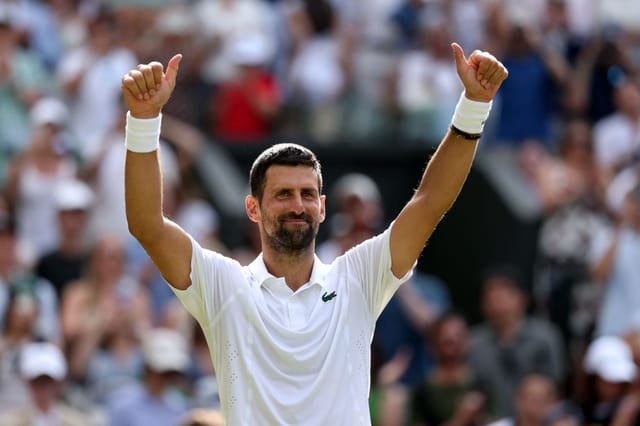
Novak Djokovic has already established himself as one of the most accomplished players in Tennis history, yet filmmaker Jason Hehir believes the Serbian still shares a powerful psychological trait with basketball icon Michael Jordan: an almost relentless need to prove doubters wrong.
Hehir, the Emmy Award-winning director behind The Last Dance, recently discussed the similarities between Djokovic and Jordan during an appearance on Andy Roddick’s Served podcast. The conversation focused not on statistics or trophies, but on the mentality that has helped both athletes remain extraordinarily competitive deep into their careers.
At the center of Hehir’s comparison is the Serbian cultural concept of inat, which he described as a proud and defiant form of stubbornness. According to the filmmaker, that mentality has obvious parallels with Jordan’s approach to competition, particularly during the later stages of the basketball legend’s career.
The comparison comes at an intriguing moment for Djokovic. At 39, the Serbian has already won 24 Grand Slam singles titles and holds numerous major records, yet he is preparing for another attempt to make history at the US Open 2026. His recent Cincinnati Open campaign, however, raised questions about his physical condition heading into New York.
What is the connection between Novak Djokovic and Michael Jordan?
Hehir’s argument is based primarily on psychology rather than sporting technique. Djokovic and Jordan compete in completely different sports, but both developed reputations for using adversity as fuel.
According to Hehir, the two champions are particularly similar in the way they respond to hostile environments, criticism and perceived disrespect.
When asked whether Djokovic or Jordan was more extreme in drawing energy from difficult surroundings, Hehir did not choose between them. Instead, he rated both at the highest level.
That response is revealing because it suggests the similarities extend beyond simple competitiveness. Hehir sees a shared mindset in which pressure does not merely have to be tolerated; it can become an additional source of motivation.
For Djokovic, that mentality has been visible throughout his career. He has frequently competed against players who were younger, more physically explosive or backed by large sections of the crowd, yet he repeatedly found ways to remain psychologically engaged.
Jordan developed a similarly intense competitive identity during his NBA career. He became famous for turning perceived slights and challenges into motivation, sometimes creating additional psychological battles for himself to maintain his competitive edge.
What does ‘inat’ mean in Serbian culture?
Inat is central to Hehir’s explanation of Djokovic’s mentality. In broad terms, it describes a form of proud defiance: the determination to do something precisely because someone else believes it cannot be done.
It is not simply ordinary stubbornness. In the context of elite sport, the concept can become a psychological mechanism through which criticism and doubt are converted into motivation.
That idea fits particularly well with Djokovic’s career because he has often operated in an environment where expectations surrounding him have been complicated.
Hehir argued that while inat is strongly associated with Serbian culture, the underlying competitive instinct can also be seen in Jordan.
The important point is that the concept does not require an athlete to actually have something left to prove. Instead, the athlete can behave as though a challenge still exists even after achieving virtually everything possible.
Why the mentality can become both a strength and a weakness
Hehir described this mindset as both a blessing and a curse. That observation is particularly relevant when discussing athletes who have already reached the highest level of their sport.
For most competitors, motivation is relatively straightforward. They want to win a first major title, break into the top rankings, defeat a rival or establish themselves as elite.
For someone like Djokovic, many of those objectives have already been accomplished.
That creates a unique psychological problem: what motivates an athlete who has already achieved almost everything?
One possible answer is to create new challenges. A rival’s comments, a hostile crowd, a ranking battle, a record or even doubts about physical ability can become a new source of motivation.
The danger is that constantly searching for something to prove can also make it difficult for an athlete to recognize when enough has already been accomplished.
Michael Jordan’s famous ‘proving people wrong’ mentality
Hehir recalled a conversation with Michael Jordan that illustrated the mentality he sees in both athletes.
While discussing what Jordan missed about the NBA playoffs, Hehir said the six-time NBA champion gave a remarkably simple answer: proving people wrong.
That answer became an important part of Hehir’s comparison because Jordan had already achieved extraordinary success. By the later stages of his career, there was little left for him to demonstrate statistically.
Yet the desire to respond to doubters remained powerful.
Hehir believes Djokovic operates in a similar way. The Serbian does not need to establish that he belongs among the greatest players in tennis. His achievements have already answered that question.
Instead, the challenge may now be internal: can he continue to compete at the highest level despite age, physical limitations and a generation of younger players attempting to take control of men’s tennis?
Djokovic’s motivation is particularly interesting at 39
The comparison becomes even more compelling because of Djokovic’s current stage of his career.
At 39, Djokovic is no longer in the same physical phase as he was during his peak years. The emergence of younger stars has also changed the competitive landscape of men’s tennis.
Yet his ambitions remain enormous.
Djokovic is targeting a record 25th Grand Slam singles title at the 2026 US Open. Reaching that landmark would add another extraordinary chapter to a career that has already produced an unprecedented collection of major achievements.
That pursuit is a perfect example of the mentality Hehir described. Djokovic does not need another major title to establish himself as an all-time great, but the opportunity to create another piece of history can provide the kind of challenge that keeps an elite competitor motivated.
Djokovic’s Cincinnati setback changed the US Open conversation
The buildup to the US Open has not been straightforward for Djokovic.
After reaching the Wimbledon semifinals, he took an extended break before returning at the Cincinnati Open. The tournament was intended to provide valuable match preparation ahead of the final Grand Slam of the season.
Instead, Djokovic suffered an early defeat against Argentina’s Thiago Agustin Tirante.
Djokovic won the opening set but subsequently struggled physically in Cincinnati’s intense heat and humidity. Tirante took advantage of the situation and completed an upset.
The result naturally raised questions about Djokovic’s readiness for the US Open, particularly because he later explained that his difficulties were connected to a long-term health condition that becomes worse in hot and humid conditions.
That context makes Hehir’s comments about Djokovic’s mentality even more interesting. Mental strength can help an athlete respond to adversity, but it cannot completely eliminate physical limitations.
The biggest difference between Djokovic and Jordan
Although the comparison is compelling, there is one major difference between the two legends: their sporting environments.
Jordan competed in basketball, a team sport in which teammates, coaches and opponents influence the outcome of every game. Djokovic competes primarily as an individual, meaning that the psychological responsibility is concentrated much more heavily on the player himself.
| Factor | Novak Djokovic | Michael Jordan |
|---|---|---|
| Sport | Tennis | Basketball |
| Competitive format | Individual | Team-based |
| Motivational theme highlighted by Hehir | Defiance and proving doubters wrong | Proving people wrong |
| Career stage discussed | Late-career pursuit of more Grand Slam success | Late-career competitive drive |
| Major challenge | Age, younger opponents and physical demands | Maintaining elite standards and competitive intensity |
This difference actually makes the comparison more fascinating. Djokovic cannot rely on a teammate to rescue him during a difficult five-set match. If momentum disappears, he has to find a way to rebuild it himself.
Jordan, meanwhile, could influence a game enormously but still depended on teammates to execute the broader team strategy.
Why Djokovic’s hostile-environment mentality matters
Djokovic’s ability to use an unfriendly environment as motivation has been one of the recurring psychological themes of his career.
Unlike athletes who rely heavily on crowd support, Djokovic has often appeared comfortable embracing an atmosphere that is against him. Instead of treating hostility as purely negative, the mentality described by Hehir suggests that Djokovic can convert it into emotional energy.
That can become particularly valuable during Grand Slam matches, where the atmosphere can change dramatically depending on the opponent, location and stage of the tournament.
The key insight is that elite performance is not always about eliminating pressure. Sometimes the best competitors learn how to use pressure without allowing it to control their decision-making.
Jason Hehir has another connection to Djokovic
Hehir’s comments carry additional weight because his connection with Djokovic goes beyond this comparison.
The filmmaker also directed Novak Djokovic: The Wolf in Winter, a documentary exploring the Serbian’s life and career.
The project is scheduled for a global premiere on Prime Video on August 20, giving Hehir an unusually close perspective on Djokovic’s personality and competitive mindset.
That experience helps explain why Hehir is able to draw comparisons between Djokovic and Jordan. His work on The Last Dance required him to explore the psychology behind Jordan’s extraordinary competitive drive, while his Djokovic documentary gave him an opportunity to examine another athlete whose personality has become an important part of his sporting legacy.
Djokovic’s 25th Grand Slam pursuit could become another chapter in the story
The 2026 US Open presents Djokovic with a challenge that is both statistical and psychological.
Winning a 25th major would give him another record to add to his already extraordinary résumé. But the bigger question is whether he can overcome the physical challenges that surfaced in Cincinnati and navigate a field increasingly filled with younger contenders.
His recent setback therefore should not automatically be interpreted as evidence that his competitive ability has disappeared. At the same time, the Cincinnati defeat is a reminder that late-career greatness requires managing the body as carefully as the mind.
This is where the Jordan comparison becomes particularly relevant. Both athletes reached a point where the motivation could no longer simply be about becoming great. They had already reached that destination.
The challenge became staying there.
The unique lesson from Djokovic and Jordan
The most valuable insight from Hehir’s comparison may be that greatness does not necessarily eliminate insecurity, doubt or the desire for validation.
In fact, the opposite can sometimes happen.
An athlete who has achieved everything can become more motivated by small challenges because major goals have already been completed. A criticism that another competitor might ignore can become a source of energy for someone with an intensely competitive personality.
That does not mean every elite athlete needs to manufacture enemies or constantly seek confrontation. Rather, it shows how individual competitors develop personal systems for maintaining motivation once conventional goals have been achieved.
For Djokovic, the pursuit of another major title offers a concrete objective. For Jordan, proving doubters wrong served a similar purpose during the later stages of his career.
What to expect from Djokovic at the US Open
Djokovic’s Cincinnati exit means his preparation for New York will attract significant attention. His ability to manage hot conditions, physical demands and younger opposition could be just as important as his technical level.
If he can recover fully and produce his best tennis, his experience remains an enormous asset in a Grand Slam environment.
The pressure, however, will be different from earlier stages of his career. Djokovic is not chasing legitimacy. He is chasing another record.
That distinction could make the psychological side of his US Open campaign particularly fascinating.
Conclusion: Djokovic’s greatest motivation may be the challenge itself
Jason Hehir’s comparison between Novak Djokovic and Michael Jordan goes beyond a simple comparison of two sporting legends. It focuses on the psychological engine that can keep extraordinary competitors performing long after they have achieved enough to secure their legacy.
The Serbian concept of inat, as explained by Hehir, provides a useful framework for understanding that mentality: the urge to respond when someone says something cannot be done.
Jordan famously used the desire to prove people wrong as motivation, despite having little left to prove. Hehir believes Djokovic possesses a remarkably similar instinct.
That mentality could become especially important as Djokovic prepares for the 2026 US Open. His recent Cincinnati defeat exposed legitimate physical concerns, but his career suggests that setbacks can also become fuel.
Whether Djokovic wins another major or not, the comparison with Jordan highlights something more enduring than any single trophy: the mindset of an athlete who refuses to let achievement become an excuse to stop competing.
For breaking news and live news updates, like us on Facebook or follow us on Twitter and Instagram. Read more on Latest Sports on thefoxdaily.com.






COMMENTS 0