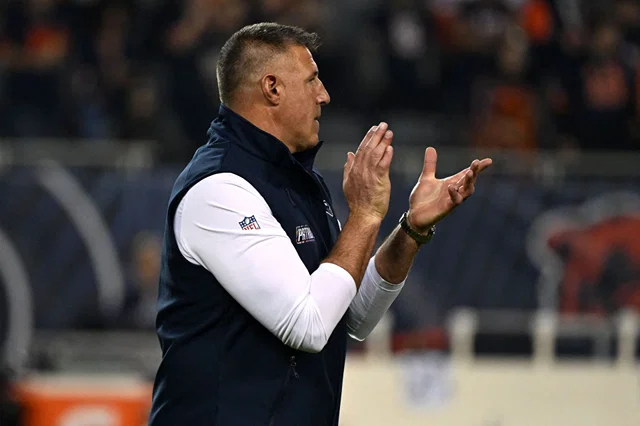
New England Patriots head coach Mike Vrabel drew attention during his Monday media availability after refusing to discuss a reported $250,000 fine connected to his conduct toward NFL officials. Vrabel said the matter was supposed to remain confidential and directed reporters toward the league, but his repeated refusal to answer questions quickly became a talking point among fans.
The reaction also revived online references to the controversy involving former NFL insider Dianna Russini. Several social media users used the moment to make sarcastic comments about privacy and leaked information, turning a discussion about sideline discipline into a wider conversation about Vrabel’s public image.
According to the supplied report, Vrabel was among three NFL head coaches who received penalties of the same reported amount. Philadelphia Eagles coach Nick Sirianni and New York Jets coach Aaron Glenn were also named. The penalties were reportedly placed in abeyance, meaning they could potentially be rescinded if the coaches demonstrated improved conduct.
Vrabel declined to clarify the circumstances surrounding the reported fine, whether he believed it could be reversed, or what conditions the league had established. Instead, he maintained that the matter was confidential and that questions should be directed to the NFL.
Mike Vrabel Refuses to Discuss Reported NFL Fine During Media Availability
The exchange began when a reporter asked Vrabel about the reported $250,000 penalty. Rather than discuss the league’s decision, the Patriots coach said he had no comment because the details were supposed to remain private.
“I don’t have any comments,” Vrabel said after being asked about the fine. “Those things are supposed to be held in strict confidence. Confidentiality, so I’m not gonna comment.”
When the reporter attempted to ask a follow-up question, Vrabel interrupted to reinforce his position. He did not offer further details about the penalty or explain what information he believed should remain confidential.
“Again, I’m not gonna comment,” Vrabel said. “I can’t, not supposed to.”
The reporter subsequently asked whether Vrabel understood that the fine could be rescinded if he improved his conduct. The question addressed a key part of the reported arrangement: the possibility that the penalty might not remain in place if the coach met the league’s expectations.
Vrabel again declined to answer, suggesting that the NFL was the appropriate source for further information.
“I can’t comment,” Vrabel said. “I think it’s best just to talk to the lead. They seem to have plenty to say already about it.”
His response left several questions unresolved. He did not confirm the reported conditions attached to the penalty, explain whether he expected it to be rescinded, or provide additional context about his interactions with officials.
That lack of detail helped the exchange gain attention. When a coach declines to discuss a disciplinary matter, reporters and fans are often left to interpret the limited information available. In this case, the reported size of the fine and the suggestion that it could be reconsidered made the questions particularly noteworthy.
Fans Bring Up Dianna Russini as Vrabel’s Comments Circulate Online
Vrabel’s refusal to discuss the fine quickly prompted reactions from fans, many of whom connected his emphasis on confidentiality to the earlier controversy involving Dianna Russini, a former NFL insider. Rather than focusing exclusively on the reported disciplinary action, some social media users turned the exchange into an opportunity for sarcasm about information that becomes public despite expectations of privacy.
One fan directly referenced Russini while questioning whether the coach could be certain that she had not reported the story.
“Is he sure Dianna Russini didn’t report it?” a fan wrote.
Another commenter suggested that the situation was particularly ironic given the previous controversy surrounding the coach.
“Yeah, a lot of things about Vrabel were supposed to be private but ended up not being. Seems to be a pattern,” another fan wrote.
Other reactions were similarly sarcastic, with commenters suggesting that the reported fine was not the only matter Vrabel might have preferred to keep out of the public eye.
“Not the worst thing that he’s had leaked,” another fan wrote.
“This is rich coming from him,” a fan commented.
“He has a real hard time keeping things private, doesn’t he?” another fan commented.
“I’m sure it’s not the only thing Vrabel hoped would remain private,” another fan commented.
The comments reflect the way an earlier controversy can influence public reactions to an unrelated news event. In this instance, the reported fine concerned sideline conduct and interactions with officials, while the online jokes focused on Vrabel’s previous headlines and his insistence that the disciplinary matter remain confidential.
That distinction matters. The comments are reactions from individual social media users, not evidence that the reported fine is connected to the earlier controversy. The available statements also do not establish that Russini was involved in reporting or disclosing information about the penalty. Her name entered the discussion because fans chose to make the comparison.
Nevertheless, the reaction illustrates the difficulty public figures can face when a new incident recalls an earlier episode. A statement that might otherwise have been treated as a routine refusal to discuss league discipline can attract a different response when audiences associate the speaker with previous headlines.
Why the Reported $250,000 Fine Matters for the Patriots
The reported penalty is significant because it concerns a head coach’s conduct toward game officials. Coaches are expected to challenge decisions when necessary, but they must also operate within the league’s rules governing sideline behavior and interactions with referees.
According to the supplied report, Vrabel received the same reported fine as Sirianni and Glenn. The penalties were reportedly held in abeyance, with the possibility of rescission if the coaches improved their conduct. If that description is accurate, the arrangement would make future behavior an important part of the situation rather than treating the penalty as a purely completed disciplinary matter.
However, Vrabel did not confirm the terms when asked about them. His refusal means that the exact conditions, timetable and process for any potential rescission remain unclear based on the media exchange provided.
There is also a difference between a reported fine and an officially explained disciplinary decision. Without further clarification from the NFL, it would be premature to draw conclusions about the precise conditions attached to Vrabel’s penalty or whether the league has determined that his conduct has improved.
For the Patriots, the issue is relevant beyond the financial figure. A head coach’s relationship with officials can become a recurring subject of discussion when frustration on the sideline leads to penalties or public confrontations. Such incidents can shift attention away from game preparation and performance, particularly when the coach’s comments become a separate news story.
That does not mean every disagreement with an official is inappropriate. Coaches regularly have legitimate reasons to question calls, request explanations or express disagreement. The challenge is managing those disagreements without allowing emotions to create additional problems for the team.
Vrabel’s comments about officiating later in the same media availability suggested that he recognizes this balance. Although he would not discuss his own reported fine, he offered a broader defence of the difficulty of officiating and emphasized the importance of how coaches, players and referees respond to mistakes.
Vrabel Praises NFL Officials Despite Refusing to Discuss the Fine
While Vrabel declined to answer questions about his reported penalty, he was willing to discuss officiating in general. He described refereeing as an exceptionally demanding part of the game and acknowledged that officials, like coaches and players, can make mistakes.
“I would say this about the officiating, and I’ve said this numerous times: the second hardest thing to do on Sundays is officiate,” Vrabel said. “And they do a great job, and it’s not easy. And we have to understand, you know, they’re part of the game.”
He continued by explaining that mistakes are an inevitable part of football. Coaches can make poor decisions, players can execute plays incorrectly, and officials can occasionally miss a call. In his view, the response to those situations is an important part of the game.
“I think that they do, like everybody else, the best that they possibly can. There’s going to be bad calls by coaches. There’s going to be bad plays by players. And then once in a while, an official is going to miss one. So, again, how we respond to those things is critical.”
The remarks offered a more measured perspective on the relationship between teams and referees. Football decisions are often made in real time, under pressure, and with players moving quickly across the field. Officials must interpret rules while following complex plays, and coaches must decide how to respond when they believe a call has affected their team.
Vrabel’s comments also highlighted a distinction between questioning a decision and reacting in a way that attracts disciplinary attention. Disagreement is part of professional sport, but a coach’s response can influence whether an incident remains a brief exchange or becomes a larger issue.
His general praise for officials does not, by itself, resolve questions about the reported fine. Nor does it establish whether the league considers his conduct improved. It does, however, provide context for how he publicly described officiating while avoiding direct discussion of his own disciplinary situation.
Earlier Sideline Frustration Is Part of the Reported Disciplinary Context
The supplied report links Vrabel’s fine to visible frustration with officials, including an unsportsmanlike conduct penalty earlier in the season for language directed at a referee. That incident provides context for why the league’s reported action has drawn attention to his sideline behaviour.
For coaches, maintaining control during emotionally charged moments is a practical part of managing a team. Close games, disputed penalties and high-pressure decisions can generate strong reactions, but coaches must still be aware of the rules governing their conduct. An unsportsmanlike conduct penalty can also affect a team’s position on the field, making the consequences more than a matter of public perception.
The reported arrangement placing the fines in abeyance adds another layer to the story. If improved conduct is a condition for rescission, the coaches involved would have a reason to demonstrate that their responses to officiating decisions can remain within acceptable limits. The exact terms, however, should be confirmed by the league rather than inferred from the coaches’ media comments.
Vrabel’s decision not to discuss the issue leaves observers with limited information about his own understanding of the situation. He did not say whether he agreed with the league’s assessment, whether he had changed his approach, or whether he expected the penalty to be withdrawn.
His general comments about responding appropriately to mistakes may be relevant to the broader subject, but they should not be treated as a direct admission about the reported fine. The coach kept the two matters separate during the media availability: he declined to address his individual disciplinary situation while discussing officiating as a general part of football.
What the Situation Could Mean for Mike Vrabel and New England
The immediate story centres on the reported fine and the reactions to Vrabel’s refusal to discuss it. The longer-term significance will depend on the league’s official position, the terms of the reported disciplinary arrangement and how future interactions with officials unfold.
If the reported penalties can be rescinded after improved conduct, subsequent sideline behaviour could become an important factor in determining what happens next. However, there is no confirmation in the supplied exchange that any decision has been made about rescinding Vrabel’s penalty.
For the Patriots, consistency in handling disputes with officials can help keep attention on football rather than disciplinary controversies. Coaches must be able to advocate for their teams while ensuring that their reactions do not create avoidable distractions. Vrabel’s own comments acknowledged the importance of responding appropriately when mistakes occur, even though he would not discuss the reported fine directly.
There is also a media dimension to the situation. A coach may choose not to discuss confidential league matters, but that decision does not necessarily prevent public scrutiny. When details of a reported penalty are already circulating, a refusal to comment can leave reporters seeking clarification from the league and fans filling the information gap with their own interpretations.
In this case, the online reaction was shaped by more than the reported dollar amount. Fans brought up the earlier Russini controversy and used it to frame Vrabel’s emphasis on privacy as an apparent contradiction. Those comments show how public perception can follow a figure from one news cycle to another, although social media reactions should not be mistaken for verified information about either incident.
What Happens Next With the Reported Fine?
The main unanswered question is whether the NFL will provide further clarification about the reported penalties and the conditions under which they could be rescinded. Vrabel directed reporters toward the league, but his comments did not provide an official explanation of the disciplinary process.
Until more information becomes available, the reported $250,000 fine and its possible rescission should be treated according to the limited details provided. The exchange does not establish whether Vrabel’s penalty has been formally confirmed by the league, what specific conduct requirements apply, or whether the coach has satisfied any such requirements.
For now, Vrabel has made his position clear: he does not intend to discuss the reported fine publicly. His comments about officiating, meanwhile, emphasize the difficulty of the officials’ job and the importance of responding constructively when mistakes occur.
The online mockery surrounding the exchange may continue to attract attention because of the references to the earlier controversy involving Russini. But the two subjects remain distinct, and the social media jokes do not establish a connection between them.
Ultimately, the situation raises familiar questions about sideline discipline, confidentiality and the public scrutiny faced by NFL coaches. The league’s clarification, if one follows, will be more useful in establishing the terms of the reported penalty than speculation on social media. Until then, Vrabel’s refusal to answer questions has left the central details unresolved while giving fans another reason to debate his handling of the spotlight.
For breaking news and live news updates, like us on Facebook or follow us on Twitter and Instagram. Read more on Latest NFL on thefoxdaily.com.





COMMENTS 0