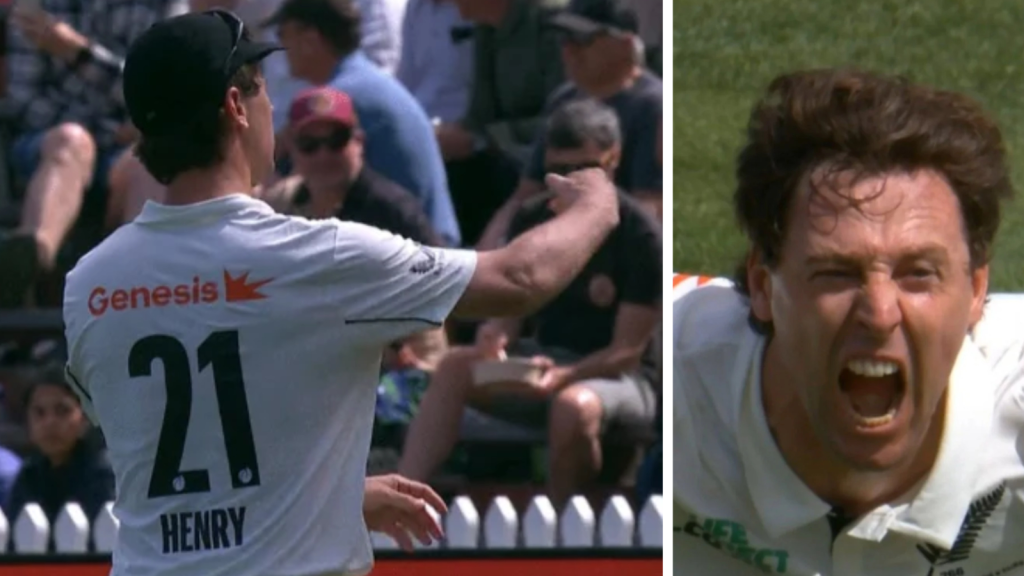
New Zealand endured a frustrating passage of play against India as confusion surrounding the Decision Review System (DRS) and a series of missed opportunities left their bowlers visibly disappointed. The most dramatic moment came when captain Tom Latham declined to review a leg-before-wicket appeal against KL Rahul, only for the replay to show that Kyle Jamieson’s delivery would have hit the middle and off stumps.
The incident became even more frustrating because New Zealand had already been involved in confusion over an earlier review. A decision in the fourth over appeared to leave the hosts with their review intact, but officials later confirmed that it had been lost. That uncertainty may have influenced Latham’s decision when Matt Henry produced another convincing appeal against Rahul.
Henry was so frustrated after watching the replay that he threw his sweater beyond the boundary. Jamieson also reacted emotionally as New Zealand created several chances but struggled to turn their pressure into wickets before tea.
New Zealand’s DRS Confusion Begins With KL Rahul Review
The confusion started during the final delivery of Kyle Jamieson’s fourth over. The New Zealand fast bowler delivered a fullish ball that moved back into Rahul and struck him on the pads. Jamieson was convinced that the batter had been trapped in front and urged captain Tom Latham to request a review.
Latham agreed to challenge the on-field decision, but the review process did not provide a clear answer. The first stage, known as the UltraEdge or sound-based technology check, could not establish whether the ball had made contact with Rahul’s bat before hitting his pad.
With no conclusive evidence from that stage, third umpire Paul Reiffel did not proceed to ball-tracking. The on-field umpire was informed that the available evidence was inconclusive, and Rahul remained not out.
However, the television broadcast displayed the ball-tracking graphic anyway. It indicated that the ball would have made impact outside the line of off stump. That information suggested New Zealand would have lost the review if the full assessment had been completed.
Despite this, the initial communication during the broadcast indicated that New Zealand had retained their review because the process had stopped before ball-tracking was officially considered.
A few minutes later, the information changed. Reiffel was asked to clarify the situation and confirmed that New Zealand had in fact lost the review. The reversal created further uncertainty at a crucial stage of the innings.
Tom Latham Declines Matt Henry’s Crucial Appeal
The earlier review confusion became especially important when Matt Henry produced another strong appeal against Rahul. The New Zealand bowler delivered a ball that moved back sharply into the batter, striking him on the pads.
There were two sounds as the delivery reached Rahul, apparently coming from the front pad and back pad, while there was no indication of contact with the bat. Henry immediately appealed and raised his finger towards umpire Kumar Dharmasena.
Dharmasena remained unmoved, leaving the decision not out. Henry clearly believed the delivery had struck Rahul in front of the stumps and looked towards Latham for support.
The New Zealand captain paused before making his decision. With the review situation already complicated, Latham looked towards the screen as the countdown approached its final second. He ultimately chose not to challenge the umpire’s call.
The replay later showed exactly why Henry had been so confident. The ball-tracking technology indicated that the impact was in line with the off stump and that the delivery would have gone on to hit the middle and off stumps. All three ball-tracking indicators were red, meaning the decision would have been overturned and Rahul would have been out.
Henry watched the giant screen as the result appeared. His reaction suggested that he was deeply frustrated, particularly because he had trusted his reading of the delivery and wanted the captain to send the decision upstairs.
Did the First Review Influence Latham’s Decision?
The two incidents raised an important question about whether the earlier DRS confusion affected Latham’s judgment. Captains regularly face difficult decisions when deciding whether to challenge an umpire’s call, especially when their team has a limited number of reviews available.
In this case, New Zealand had already lost a review after the first appeal against Rahul. Latham may therefore have been reluctant to use another opportunity without complete confidence that the decision would be overturned.
The first review had involved an unclear sequence of communication. The initial indication that the review was retained was later reversed, leaving New Zealand with one fewer opportunity than they might have expected.
Although it is impossible to know exactly what was going through Latham’s mind, the timing made the connection difficult to ignore. The captain had just experienced a confusing review situation, and minutes later he declined to challenge an appeal that ball-tracking ultimately showed would have resulted in a wicket.
The cost was significant. New Zealand missed the opportunity to remove Rahul at a time when their fast bowlers were generating considerable pressure. The episode also highlighted how important clear communication is when teams are making decisions under the DRS time limit.
Matt Henry Throws His Sweater in Frustration
Henry’s reaction became one of the most visible moments of New Zealand’s difficult spell. After seeing the ball-tracking result, the fast bowler shook his head towards the giant screen before throwing his sweater beyond the boundary.
His frustration was understandable in the context of the missed opportunity. Henry had produced a delivery that beat Rahul’s defence and appeared to trap him directly in front. The technology subsequently confirmed that the ball was hitting the stumps, but New Zealand could not benefit because the captain had not requested a review.
Jamieson also showed his disappointment during the same passage of play. Earlier, he had been convinced that Rahul was out and had pushed Latham to use the first review. When the second opportunity against Rahul was not taken, the bowler was left watching another potential wicket disappear.
The emotional reactions reflected a period in which New Zealand’s bowlers were doing much of what was required to put India under pressure. They were finding movement, creating edges and beating the bat, but the rewards were not arriving consistently.
New Zealand’s Bowlers Create More Chances Before Tea
The missed review was not the only frustrating moment for New Zealand. Their fast bowlers produced a series of dangerous deliveries during the period before tea, repeatedly troubling India’s batters with bounce, movement and unpredictable carry.
Jamieson was particularly effective in extracting extra bounce from a length. During his fourth over, the ball climbed sharply towards Rahul, who had little room to escape. The Indian batter turned partly away, dropped his hands and took the delivery on his chest.
The incident demonstrated the difficulty of facing Jamieson when he finds the right length. His height and ability to generate bounce made it challenging for Rahul to play the ball comfortably, even when the delivery did not threaten the stumps directly.
Henry was equally threatening from the other end. One of his deliveries in the third over moved sharply back towards Yashasvi Jaiswal, passing extremely close to the off stump. The ball missed the target by a narrow margin, leaving Henry covering his face in disbelief.
Jaiswal also had a moment of fortune when he attempted an aggressive shot against a full delivery from Henry. The ball flew off the bat and lobbed over mid-on, avoiding the fielders and preventing New Zealand from creating another straightforward wicket opportunity.
Edges Fall Short as India Survive New Zealand’s Pressure
New Zealand’s frustration increased because several edges also failed to produce catches. Jamieson had three slips and a gully in place as he continued to attack India’s batters, but the fielding opportunities did not fall into New Zealand’s hands.
One edge dropped short of the third slip, denying the hosts a chance to take a catch. Another travelled between third slip and gully, forcing Henry Nicholls to dive in an attempt to reach the ball. He could not complete the effort.
A further edge went towards Phillips at gully. Phillips managed to get his fingertips to the ball, but he could not hold on as it escaped his grasp and ran away to the boundary.
That particular chance was especially painful for Jamieson, who reacted with a loud cry after watching the ball evade the fielder. The bowler had created the opportunity through his movement and pressure, but the result was another missed chance rather than a wicket.
The sequence summed up New Zealand’s difficult spell. The bowlers were finding ways to challenge Rahul and Jaiswal, but the DRS confusion, a declined review and missed catching opportunities combined to keep India in the contest.
DRS Decisions and Fielding Errors Shape the Contest
Cricket often turns on small moments, and New Zealand experienced several of them within a short period. The review confusion against Rahul was particularly costly because it affected the captain’s ability to make a decision on the next appeal.
The DRS system is designed to help teams correct clear umpiring errors, but it also requires accurate communication and quick decisions. Captains must understand how the review process is progressing while remaining aware of the time limit and the number of challenges available.
For New Zealand, the first incident created uncertainty at precisely the wrong time. The later confirmation that the review had been lost may have made Latham more cautious when Henry appealed again.
At the same time, the missed catches showed that New Zealand needed more than good bowling to convert their pressure into wickets. The bowlers repeatedly created opportunities, but the fielding unit could not consistently finish the job.
These moments can be especially damaging against a batting side capable of surviving difficult spells. When chances are missed, the batters receive additional time to settle, build partnerships and put pressure back on the bowling team.
Conclusion: A Frustrating Spell for New Zealand
New Zealand’s passage of play before tea was defined by missed opportunities and confusion. The earlier DRS incident against KL Rahul left the hosts uncertain about their remaining review, and that uncertainty was followed by Tom Latham’s decision not to challenge Matt Henry’s next appeal.
Ball-tracking later showed that Henry’s delivery would have hit the middle and off stumps, making it a missed opportunity for New Zealand. Henry’s decision to throw his sweater beyond the boundary captured the frustration of a bowler who believed he had earned a wicket.
Jamieson and Henry continued to create problems through bounce and movement, but edges repeatedly fell short or escaped the fielders. New Zealand had India under pressure for a spell, yet the combination of review confusion and missed chances prevented them from fully capitalising.
The episode served as a reminder that Test Cricket can be shaped by decisions made in seconds. For New Zealand, the cost of the confusion was not simply a lost review; it was the possibility of a crucial wicket slipping away at a moment when their bowlers were threatening to take control.
For breaking news and live news updates, like us on Facebook or follow us on Twitter and Instagram. Read more on Latest Cricket on thefoxdaily.com.






COMMENTS 0