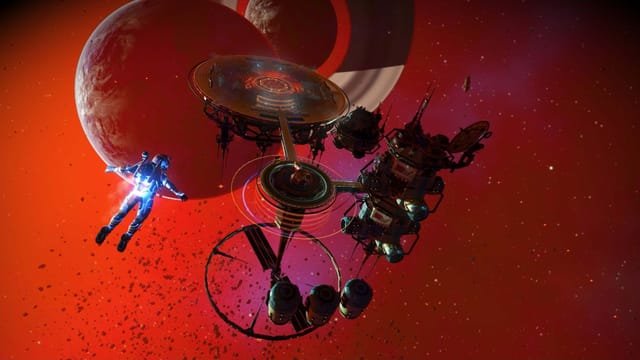
No Man’s Sky 7.0 Cosmos patch notes introduce one of the most ambitious expansions to the space exploration experience, adding new systems that give Travellers more control over the universe around them. The anniversary update expands exploration beyond conventional planetary surfaces with deep-space points of interest, orbital construction and a new Space Station Directorship system.
The update also introduces Galactic Alliances, allowing players to establish or join organised groups, while enhanced spacewalking gives exploration outside a ship considerably more freedom. Meanwhile, extensive rendering and optimisation changes aim to improve visual quality, loading times and overall performance across supported platforms.
Cosmos is particularly significant because it arrives as No Man’s Sky marks its 10th anniversary. Rather than simply adding cosmetic anniversary content, Hello Games has used the update to expand several core gameplay systems, from space exploration and construction to social interaction and technical performance.
What is new in No Man’s Sky 7.0 Cosmos?
The biggest additions in No Man’s Sky 7.0 can broadly be divided into five areas: deep-space exploration, space station management, orbital construction, player alliances and anniversary content.
- Deep-Space Mapping: Players can map celestial bodies and discover new locations throughout their star systems.
- Space Station Directorship: Eligible players can become directors and customise their stations.
- Galactic Alliances: Players can create or join organised player alliances.
- Orbital Construction: Bases can now be constructed in open space and around natural asteroid platforms.
- Expanded Spacewalking: Players receive six degrees of freedom while outside their ships.
- Anniversary Expedition: Expedition Twenty-Three celebrates a decade of No Man’s Sky.
- Visual improvements: Textures, clouds, water, terrain, lighting and particle effects have been upgraded.
- Performance improvements: Numerous CPU, memory, loading and multiplayer optimisations have been implemented.
Deep-Space Mapping changes exploration
One of the most important features in the Cosmos update is the new Deep-Space Mapping system. Players can access a map of their local star system directly from the Quick Menu.
The map displays local celestial bodies, space stations and other deep-space points of interest. This makes navigating a busy star system more straightforward and gives players a better understanding of what exists beyond the usual destinations.
The update adds rocky and icy asteroid belts, inhabited and infested deep-space outposts, procedurally generated space hulks, debris fields and asteroid platforms.
Players can also travel towards the star or stars at the centre of a system. The feature adds another destination for adventurous Travellers who want to explore areas that previously had little direct gameplay interaction.
New resources and salvage opportunities
Deep-space locations are not merely visual additions. Several can be explored for valuable resources, including comet dust, gelatinous fibres and contaminated metal.
Raw materials can be processed at deep-space outposts and converted into more valuable products. These can then be sold through the Galactic Trade Network or used in space station construction.
Outposts are also managed by alien quartermasters who trade maps and salvaged materials. Their salvage and delivery terminals provide deep-space contracts, giving players additional reasons to visit these locations.
Space hulks bring risk and reward
Space hulks are among the more dangerous additions in the update. These structures can contain valuable items, but they are unstable.
Disrupting their structural integrity can trigger a dangerous chain of events, potentially forcing players to escape before the hulk breaks down completely.
This creates an interesting risk-versus-reward loop. Instead of simply travelling to a location and collecting resources, players must also manage the danger associated with remaining inside unstable structures.
The update also adds a Tractor Beam Corvette utility part. It allows players to pull physical cargo into their Corvette hold and can be purchased through the Corvette Workshop at space stations.
Space Station Directorship lets players reshape stations
Space Station Directorship is arguably the most transformative construction feature in No Man’s Sky 7.0. Players who prove themselves to local authorities can become directors of a space station.
Directors receive the ability to modify the station’s external decorations and reshape portions of its interior. They can remove existing decorations, adjust the station and use the game’s wider collection of base-building parts to create a more personalised environment.
Directors can also expand the main hangar by adding additional rooms. These new areas can then be decorated according to the player’s preferences.
The feature effectively moves space station customisation closer to the freedom traditionally associated with planetary bases.
Galactic Alliances add a new social system
The Cosmos update also introduces Galactic Alliances, giving multiplayer-focused Travellers a new way to organise themselves.
Station directors can establish their own alliance and invite other players who share their interests. Players can join alliances by visiting stations owned by those groups.
There is also a practical benefit: members can quickly access alliance-controlled systems through the teleporter network.
Players can belong to as many as three alliances. Alliances are graded according to member activity, while the largest and most active groups appear on a leaderboard at the space station core.
This system could make large-scale player communities easier to discover and potentially encourage more long-term multiplayer activity.
Orbital Construction expands base building into space
No Man’s Sky’s construction system receives another major expansion through Orbital Constructions.
Players can now construct orbital bases in space. Natural asteroid platforms can serve as starting points, while players can also claim empty areas of space for their own constructions.
New corridor parts have been introduced specifically for orbital construction, and many additional station decoration components can be unlocked through the Construction Research Terminal aboard the Space Anomaly.
The combination of orbital bases and station customisation gives builders considerably more creative freedom. Instead of treating space as simply a route between planets, the update turns it into another potential building environment.
Spacewalking gets a major overhaul
Spacewalking has also been expanded substantially. Non-Corvette starships now have an eject button accessible through the Quick Menu, making it easier to leave a ship while in space.
More importantly, spacewalking now supports true six-degrees-of-freedom movement, including rolling. This should make movement outside ships feel considerably more flexible.
The update also improves transitions when landing on or taking off from objects with gravity in space. Explosions can now knock players backwards, adding another physical hazard to deep-space activities.
Players must also monitor their exosuit’s cold protection while spacewalking. The protection technologies gradually drain unless the player is close to another environmental hazard that changes the conditions.
Our Journey Continues Expedition celebrates 10 years
Expedition Twenty-Three, titled Our Journey Continues, is designed specifically to celebrate No Man’s Sky’s decade-long journey.
The expedition is scheduled to run for approximately six weeks and takes players through different stages of the game’s evolution since launch.
A particularly notable feature is developer commentary from Sean Murray. Commentary is attached to expedition milestones and becomes permanently accessible in the Collected Knowledge section of the Catalogue after being unlocked.
The anniversary rewards follow a strong nostalgia theme. Players can earn commemorative artwork, decals and titles, alongside special rewards inspired by earlier versions and promotional material.
- Golden edition of the original Rasamama 36 starship
- Astronaut bobblehead
- Starbound v0.27 multi-tool
- Vintage Interceptor ship
- Diplodocus pet from early trailers
- Framed commemorative artwork
- Anniversary-themed decals and titles
Twitch Drops bring more rewards
A new Twitch Drops campaign is also planned as part of the update. Players who connect their platform accounts and watch eligible Twitch content can receive additional rewards.
The rewards include exotic base parts, high-tech starships, fireworks and appearance modifications. This gives players another route to collect exclusive items while participating in the anniversary celebration.
No Man’s Sky 7.0 gets major graphics upgrades
The visual side of No Man’s Sky has received extensive attention in the Cosmos update. Hello Games has rewritten the block compression encoder for textures, reducing visual artefacts and colour banding in procedurally generated models.
Terrain tessellation has also been improved, increasing the visual detail of planetary surfaces. Clouds viewed from space receive updated textures, lighting, ambient tint and shape detail.
Water has been improved as well. The update addresses issues involving water foam, reflections, underwater lighting and transitions between space and planetary atmospheres.
Planetary fog, gas giant atmospheres and the appearance of planets from space have all received additional improvements.
Asteroids and deep-space effects
The asteroid system has been substantially reworked, with improvements to draw distance, visual distribution and performance.
New particle effects have also been created for deep-space locations. These include electrical fields, mist, stardust, smoke, debris trails and biological slime.
Deep-space hulks receive volumetric fog and particle effects to make their environments more atmospheric.
DLSS 4.5 and XeSS 3 support
PC players receive several notable technology upgrades. No Man’s Sky 7.0 adds support for Intel Xe Super Sampling 3, designed to improve performance while maintaining image quality.
The update also supports NVIDIA DLSS 4.5, including Frame Generation 5x and 6x. These technologies use AI-assisted rendering techniques to improve frame rates and image quality on compatible hardware.
PCVR players also receive support for foveated rendering. With eye-tracking technology, rendering resources can be concentrated around the player’s central field of vision, potentially improving visual detail where it matters most.
Performance and optimisation improvements
Cosmos is not only about new content. A substantial portion of the patch focuses on making No Man’s Sky run more efficiently.
One notable optimisation improves console file handling and reduces load times by approximately 6–9%. Mesh data has also been optimised, reducing mesh file sizes by around 13%.
Other changes target multiplayer performance, inventory systems, HUD markers, terrain generation, base loading and memory management.
| Area | Update 7.0 improvement |
|---|---|
| Console loading | File-handling optimisation reduces load times by around 6–9% |
| Mesh data | Optimisation reduces mesh file size by about 13% |
| Multiplayer | Reduced latency between players |
| Settlements | Additional CPU optimisation |
| HUD markers | Improved performance when many markers are displayed |
| Base systems | Faster querying and asynchronous updates |
| Memory | Multiple optimisations and fixes for memory leaks and crashes |
The developers have also made changes to procedural generation, animation systems, texture loading and terrain tessellation. These improvements are designed to reduce frame-rate interruptions and improve consistency when players move between different environments.
Corvette improvements and bug fixes
Corvette-class ships receive a collection of fixes and quality-of-life improvements. Issues involving recolouring, displayed statistics, flight judder and technology positioning have been addressed.
The update also fixes problems involving Corvette ramps and landing at the Space Station and Space Anomaly.
Players can now exit the pilot seat when cruising very close to large space objects, while hull collision accuracy has also been improved.
Outside Corvettes, the patch addresses a wide range of issues involving missions, creatures, settlements, exocraft, multiplayer, planetary resources, space stations, VR and interface elements.
More quality-of-life changes in Cosmos
The patch contains a long list of smaller improvements designed to make everyday gameplay smoother.
For example, depleted planetary terrain deposits no longer remain visible in the Analysis Visor after being completely exhausted. Several mission progression problems have also been corrected.
Creature behaviour has been refined, including navigation around settlements and responses involving offspring. Frigate rewards, expedition difficulty calculations and several base-building issues have also been addressed.
The update additionally fixes several VR problems, visual glitches, incorrect HUD positioning, controller issues and text localisation problems across supported platforms.
Why No Man’s Sky 7.0 Cosmos is important
The scale of the Cosmos update makes it more than a traditional anniversary patch. Its biggest contribution is that it expands what players can actually do in space.
Previously, space often functioned primarily as the connective tissue between planets, stations and other destinations. With deep-space locations, orbital construction, spacewalking and station directorship, space itself becomes a more substantial gameplay environment.
There is also a clear progression from individual exploration to community-based activity. A player can explore deep-space locations alone, become a station director, build an orbital base and eventually participate in a Galactic Alliance.
That combination gives No Man’s Sky 7.0 a broader gameplay loop: explore, salvage, build, manage and collaborate.
No Man’s Sky 7.0 Cosmos patch notes: Key takeaways
- Players can access a local star-system map from the Quick Menu.
- New deep-space locations provide exploration and resource-gathering opportunities.
- Space hulks introduce high-risk salvage gameplay.
- Players can become Space Station Directors and customise stations.
- Galactic Alliances support organised multiplayer communities.
- Orbital bases can be built in open space and around asteroid platforms.
- Spacewalking now features six degrees of freedom.
- Expedition Twenty-Three celebrates No Man’s Sky’s 10th anniversary.
- DLSS 4.5 and Intel XeSS 3 support expand PC graphics options.
- Major optimisation work targets loading, memory, multiplayer and CPU performance.
- Corvette ships receive multiple fixes and quality-of-life improvements.
Final Verdict
No Man’s Sky 7.0 Cosmos is a substantial anniversary update that expands the game well beyond a collection of cosmetic additions. Deep-space mapping, station directorship, Galactic Alliances and orbital construction all introduce new reasons to spend time away from traditional planetary exploration.
The update’s technical work is equally important. Better textures, terrain, clouds, water, lighting and particle effects improve the visual presentation, while extensive optimisation targets loading times, memory usage, multiplayer performance and frame-rate stability.
Most importantly, Cosmos changes the role of space itself. Players are no longer limited to travelling through star systems on their way to another planet or station. They can explore dangerous locations, salvage resources, construct bases, manage stations and join player-led alliances.
For a 10th-anniversary update, that approach fits No Man’s Sky particularly well: instead of simply looking back at the game’s history, Cosmos adds new systems that give Travellers more reasons to keep exploring its universe.
For breaking news and live news updates, like us on Facebook or follow us on Twitter and Instagram. Read more on Latest Esports on thefoxdaily.com.

COMMENTS 0