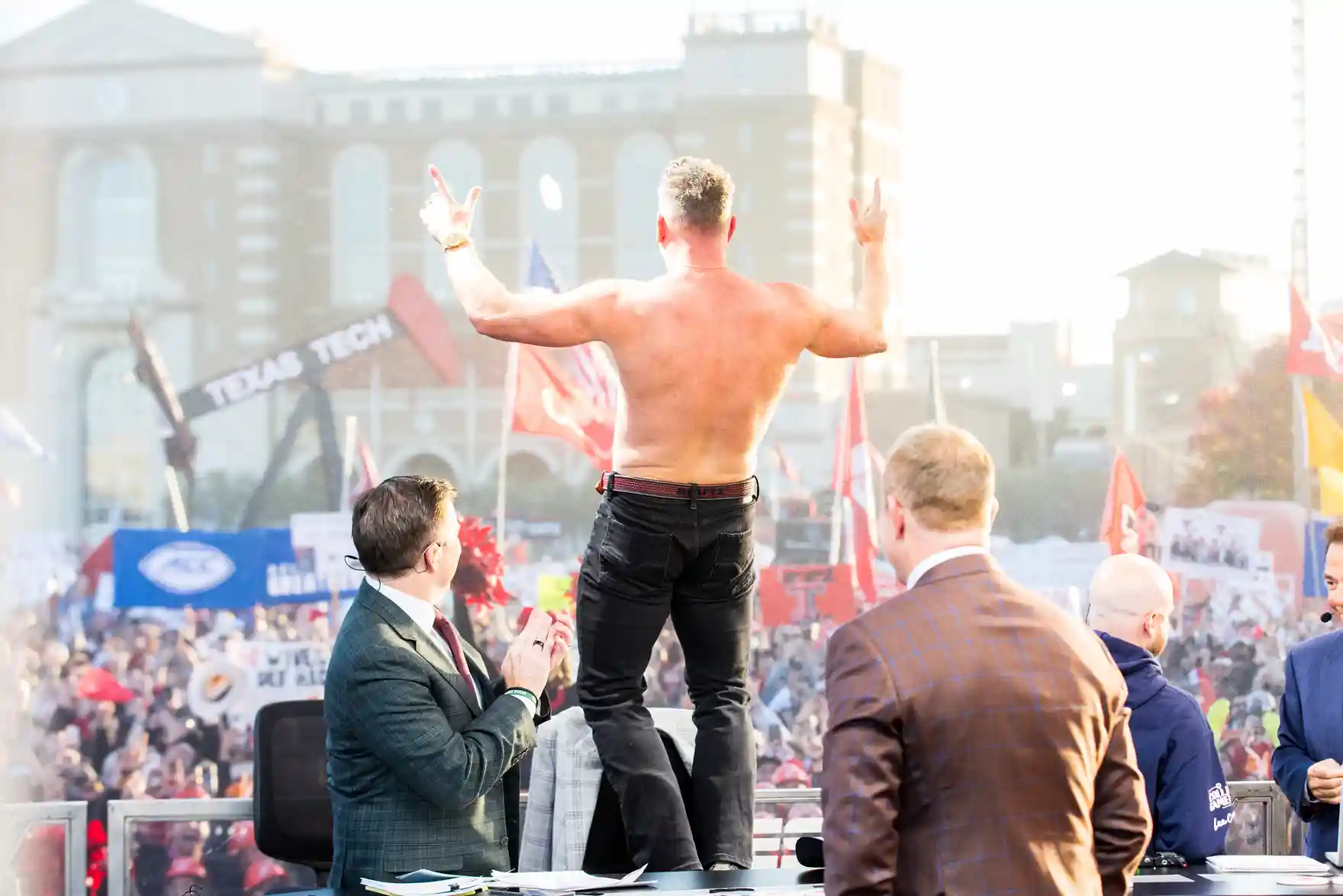
Pat McAfee has built his television career around being impossible to ignore. The former NFL punter brings loud commentary, unpredictable antics and a confrontational sense of humour to ESPN, where his personality has become a central part of the network’s College Football coverage. But a recent dispute involving students at the University of Utah has raised an uncomfortable question about the limits of criticism when a broadcaster makes provocation part of his public image.
The controversy began ahead of ESPN’s College GameDay broadcast at the University of Utah on October 24, 2026. The university published a social media video featuring students impersonating McAfee. Some of their remarks described his presentation as “corny” and “creepy,” while another student jokingly asked him to keep his shirt on during broadcasts.
McAfee subsequently criticised the university on his own programme, saying the post made him feel unwelcome as he prepared to appear before a large crowd. He also referred to the fatal 2025 shooting of conservative activist Charlie Kirk at Utah Valley University while explaining his concerns about hostility towards public figures at college events.
The university removed the video and apologised, while ESPN publicly supported McAfee’s concerns about safety and security. The dispute quickly became a wider argument about celebrity, institutional responsibility, online criticism and the increasingly blurred boundaries between entertainment and sports journalism.
There is an important distinction at the centre of the story: McAfee’s discomfort is a genuine part of his account, but the publicly described video itself featured criticism and jokes rather than an explicit threat. The available information does not establish that the students involved intended to threaten him or that the video formed part of a coordinated campaign to force him out of ESPN.
What happened between Pat McAfee and the University of Utah?
The immediate dispute centred on a video published through the University of Utah’s official social media account before College GameDay arrived on campus. The content invited students to imitate McAfee, whose energetic delivery, colourful language and habit of removing his shirt during broadcasts have become familiar parts of his television persona.
The students’ impressions were not uniformly hostile. One criticised McAfee’s style as corny, while another made fun of his tendency to remove his shirt. The latter also expressed affection for the presenter while joking that viewers did not want to see him go shirtless.
That mixture of teasing and familiarity matters. The video was recognisably directed at a public personality whose appeal partly depends on exaggerated behaviour and audience reactions. Its tone, as reflected in the published comments, was closer to campus banter than an explicit threat of physical violence.
McAfee nevertheless objected to the fact that the university itself had distributed the material. He explained that he would have been more comfortable with students posting their own impressions independently, rather than seeing the remarks on an official institutional account shortly before he appeared on television.
His concern was therefore not simply that students had criticised him. It was that the criticism appeared to carry the university’s institutional endorsement at a moment when he was expected to represent the school during a nationally televised sporting event.
That distinction offers a more precise explanation of the disagreement than the idea that a group of students had launched an attack on McAfee. The central issue was who published the jokes, how the timing affected his perception of the situation and whether an official university account should have shared that particular content.
Why McAfee brought up the Charlie Kirk shooting
McAfee’s reaction became more controversial when he discussed the video on his programme on October 26. He described feeling uncomfortable before walking in front of thousands of spectators and connected his unease to the fatal shooting of Charlie Kirk at Utah Valley University in September 2025.
Kirk, a prominent conservative activist, was killed while speaking at a university event in Orem, Utah. The incident became a major national story and raised serious questions about the security of public appearances, particularly those involving politically controversial figures.
McAfee alluded to that tragedy while questioning whether a university should publish material highlighting reasons people might dislike him. His remarks suggested that the wider climate surrounding threats against public personalities affected how he interpreted the social media post.
It is reasonable for public figures and broadcasters to take credible threats seriously. A television personality appearing before a large crowd may have legitimate security concerns that audiences cannot fully assess from a short online video.
However, the existence of a serious security incident elsewhere does not, by itself, establish that a particular joke signals a comparable danger. The shooting at Utah Valley University and the University of Utah’s decision to publish a mocking video were separate events. The available reporting does not establish a direct connection between the students’ comments and any threat against McAfee.
This distinction is important because references to real violence can change how audiences interpret otherwise ordinary criticism. Once a joke is discussed in the context of a fatal attack, a disagreement about taste and institutional judgement can become a much more serious debate about personal safety.
McAfee’s account explains why he felt uncomfortable, but it does not establish that the students intended to put him in danger. Both points can be acknowledged without dismissing legitimate security concerns or exaggerating what the video showed.
The University of Utah apologises and removes the video
The university responded by removing the video from its social media channels and issuing an apology. Its statement acknowledged that the intended light-hearted engagement surrounding McAfee’s visit had missed the mark.
The institution also accepted responsibility for the decision to publish the content, noting that university staff were responsible for reviewing and posting material on its official accounts. University officials contacted McAfee to express regret and emphasised that he and the College GameDay crew remained welcome on campus.
The response addressed the institutional dimension of the dispute. A university’s official social media account is not identical to an individual student’s personal profile. Material published through an official channel can reasonably be interpreted as representing the organisation, even when the people who created it intended only to entertain followers.
Universities regularly use social media to promote sporting events, engage students and make their campuses appear welcoming to visiting audiences. Humour can help achieve those goals, especially when a major broadcast brings national attention to a school.
But official accounts also require judgement. A joke about a visiting broadcaster may be harmless in isolation while still creating an unnecessary disagreement if it appears immediately before that person is due to represent the institution on television.
The university’s apology effectively acknowledged that distinction. It did not need to establish that the students had intended harm to accept that the decision to publish the video had produced an unwelcome outcome.
The episode also illustrates a broader communications problem: deleting a post can stop further distribution, but it cannot reverse the attention the original content has already attracted. Once a public figure responds on a widely watched programme, the institution’s social media decision can become a national story in its own right.
Why ESPN defended McAfee’s safety concerns
ESPN also issued a statement supporting McAfee, emphasising that the safety and security of its on-air personnel, production crew and fans were paramount at College GameDay.
The network said it took threats against its team seriously and recognised McAfee’s concerns about safety and security as real and valid. The statement placed the dispute within ESPN’s broader responsibility to protect people working at and attending its broadcasts.
That response should be distinguished from an independent finding that the Utah students had threatened McAfee. ESPN’s public statement addressed the network’s security responsibilities and its support for an employee; it did not establish that the video itself contained a credible threat.
For a broadcaster staging a live programme before a large crowd, security planning is a practical necessity. The production involves on-air talent, guests, technical staff and spectators, all of whom can be affected if a genuine threat emerges.
ESPN therefore has legitimate reasons to take safety concerns seriously, even when the immediate dispute originates in social media content that appears relatively mild. At the same time, a clear distinction between criticism and threatening behaviour helps prevent routine disagreements from being treated as evidence of danger without supporting facts.
The network’s challenge is to protect its employees while preserving the lively atmosphere that makes college football coverage appealing. College GameDay thrives on audience participation, strong opinions and the unpredictable reactions of students who gather to support their teams.
Those elements can coexist with professional security procedures. The difficulty arises when the line between enthusiastic crowd interaction and genuine hostility becomes blurred, especially in the aftermath of a high-profile act of violence.
Pat McAfee’s ESPN success explains why the controversy matters
The dispute has attracted attention partly because McAfee is no longer simply a former professional athlete offering occasional television commentary. He has become one of ESPN’s most recognisable personalities, with a style that differs sharply from the restrained presentation traditionally associated with many sports broadcasters.
McAfee’s programme, The Pat McAfee Show, moved to ESPN in 2023 under a reported five-year agreement worth $85 million. His presence on College GameDay subsequently made him an increasingly prominent part of the network’s college football coverage.
His appeal rests on a combination of sports knowledge, improvisation, humour and a willingness to provoke reactions. Instead of presenting every discussion in a conventional studio format, McAfee often treats sports television as a live entertainment performance, encouraging audience participation and leaning into his own larger-than-life character.
That approach can be commercially valuable because it gives viewers a distinct personality to follow in a crowded media market. A presenter who attracts strong reactions may generate conversation beyond the broadcast itself, extending the reach of a programme through clips, memes and social media discussion.
But the same style carries an obvious trade-off. A personality who regularly uses exaggeration, mockery and confrontation to entertain audiences is likely to become the target of similar behaviour.
That does not mean a broadcaster must accept harassment or credible threats as a condition of employment. It does mean that ordinary criticism of a public persona is an inevitable part of the attention that comes with a high-profile media career.
The Utah episode therefore raises a question about the expectations attached to McAfee’s public identity. If his presentation depends partly on being provocative and unconventional, how should he respond when members of his audience turn that same approach back on him?
The answer does not have to be that he should welcome every insult. Rather, the nature of the criticism matters. A joke about a television routine, a negative opinion about a presenter’s performance and a credible threat of violence are different categories of behaviour and should not be treated as interchangeable.
Is ESPN becoming too dependent on one personality?
The controversy has also fuelled a wider debate about ESPN’s editorial direction and its investment in personality-driven programming.
McAfee represents a broadcasting model in which the presenter’s individual character is a major part of the product. The format is less dependent on the formality of traditional studio analysis and more reliant on conversation, humour, strong reactions and moments that audiences may want to share online.
That model can attract viewers who prefer a less conventional style of sports coverage. It can also help a programme stand out in a market where highlights, scores and basic match analysis are widely available through competing television channels and digital platforms.
Yet a network that gives a presenter substantial prominence must also consider how it responds when that personality becomes the centre of a public dispute.
Supporting an employee who reports feeling uncomfortable is not inherently evidence of excessive dependence. Broadcasters have legitimate responsibilities to their staff, and public criticism alone is not a reason to withhold support.
The more useful question is whether networks can separate employee welfare from disagreements about taste, criticism and public image. An organisation can take safety seriously without suggesting that every negative comment constitutes a threat.
In McAfee’s case, ESPN’s statement emphasised the importance of security and acknowledged the concerns he had raised. It did not require the network to endorse every aspect of his interpretation of the video.
There is also a commercial consideration. Personality-led programming can generate attention, but attention is not always positive. A controversy may increase the visibility of a presenter while distracting from the sport the programme is intended to cover.
For ESPN, the long-term challenge is to ensure that distinctive personalities strengthen its sports coverage rather than making every disagreement involving a presenter into a larger institutional confrontation.
Does the Utah incident prove there is a campaign against McAfee?
The idea that a coordinated group of college students is trying to bring McAfee down is not established by the available evidence.
The documented incident involved a university social media video featuring students making jokes about his presentation style. The university removed the video and apologised, while McAfee publicly explained why he had found the episode uncomfortable.
Those facts establish a dispute, but they do not establish an organised campaign to end his career, force ESPN to dismiss him or undermine his position within the network.
That distinction matters because viral controversies often encourage audiences to infer a larger motive from a relatively limited set of events. A social media post can become the starting point for arguments about political identity, media culture or the supposed intentions of entire groups, even when the original evidence supports only a narrower conclusion.
McAfee’s position as a polarising public figure may make the episode particularly attractive to commentators who already have strong views about his broadcasting style or politics. Supporters may interpret the criticism as unfair treatment, while detractors may see his response as disproportionate.
Neither reaction establishes what the students intended beyond the content they actually published. Nor does the controversy provide evidence that ESPN’s executives are facing an internal campaign against McAfee.
The most defensible interpretation is that a social media decision created a public disagreement, McAfee responded forcefully, and both the university and ESPN issued statements addressing the resulting concerns.
The difference between public criticism and personal safety
One of the most useful lessons from the incident is the need to distinguish criticism from harassment and threats.
Public figures routinely encounter criticism of their appearance, behaviour, opinions and professional performance. Some of it is thoughtful, some is unfair, and some is intended to provoke a reaction. None of those categories automatically amounts to a threat of physical violence.
Harassment can become more serious when behaviour is persistent, targeted or intended to intimidate. Threats require particular attention because they can create risks that go beyond the ordinary consequences of being a recognisable public figure.
However, a person calling a presenter corny or joking about his television habits does not, without additional evidence, demonstrate an intention to cause physical harm.
For audiences, this distinction encourages a more proportionate response to controversial public statements. For universities and broadcasters, it supports clearer decisions about moderation, institutional messaging and security planning.
The University of Utah could acknowledge that its post was poorly judged without accepting that the students had intended violence. ESPN could support McAfee’s security concerns without establishing that the video was itself a credible threat. Both positions can coexist.
That approach is more useful than forcing the incident into a simple contest between people who believe McAfee is being unfairly targeted and those who believe he is overreacting.
What happens next for McAfee, ESPN and College GameDay?
The immediate dispute has already produced the principal institutional responses: the University of Utah removed its video and apologised, while ESPN publicly supported McAfee’s concerns about safety.
Whether the incident has lasting consequences for McAfee’s relationship with the university remains to be seen. McAfee expressed strong dissatisfaction with the visit and suggested that he did not want to return, but the longer-term implications for future College GameDay broadcasts are not established by the available information.
The episode is unlikely to settle the larger debate over McAfee’s broadcasting style. His appeal depends in part on a willingness to depart from conventional sports television, and his critics are likely to continue scrutinising the balance between entertainment, analysis and provocation.
For ESPN, the more enduring issue is how to manage the responsibilities that accompany personality-driven coverage. Protecting employees and responding to credible threats must remain priorities, but so must the ability to distinguish legitimate security concerns from ordinary criticism.
Universities face a related challenge when using official social media accounts to engage with visiting personalities. Humour can build excitement around a major sporting event, but a joke distributed through an institutional channel carries different implications from the same joke shared by an individual student.
The incident also offers a reminder that public attention can magnify relatively small disagreements. A handful of remarks in a campus video became a national sports-media story because of the personalities involved, the timing of the post and McAfee’s subsequent reaction.
The bottom line: A social media dispute, not proof of a conspiracy
Pat McAfee’s dispute with the University of Utah exposes the tensions surrounding modern sports broadcasting, where entertainment personalities can attract enormous attention while remaining vulnerable to criticism of the very behaviour that makes them distinctive.
McAfee said the university’s video left him uncomfortable before College GameDay and connected his concerns to the wider reality of threats against public figures. The university accepted responsibility for publishing the material and apologised, while ESPN affirmed its commitment to safety.
Those responses deserve to be considered alongside the nature of the original video, which featured students making jokes about McAfee’s television persona. The available evidence does not establish that the students threatened him or that a coordinated campaign exists to bring down ESPN’s prominent broadcaster.
The deeper question is not whether McAfee should be immune from criticism or whether every joke about a public figure is harmless. It is how broadcasters, universities and audiences can distinguish a poorly judged joke from genuine intimidation without exaggerating either.
McAfee has built a career around being loud, unpredictable and willing to provoke a reaction. The Utah controversy shows that the attention generated by that approach can quickly become a story about the presenter himself, rather than the football programme he was there to help deliver.
For ESPN, the challenge is to protect its people while maintaining a proportionate response to public criticism. For the University of Utah, the episode is a reminder that official social media posts carry institutional weight. And for McAfee, the incident has highlighted an unavoidable feature of public life: a distinctive media persona can attract admiration, ridicule and disagreement at the same time.
For breaking news and live news updates, like us on Facebook or follow us on Twitter and Instagram. Read more on Latest Sports on thefoxdaily.com.



COMMENTS 0