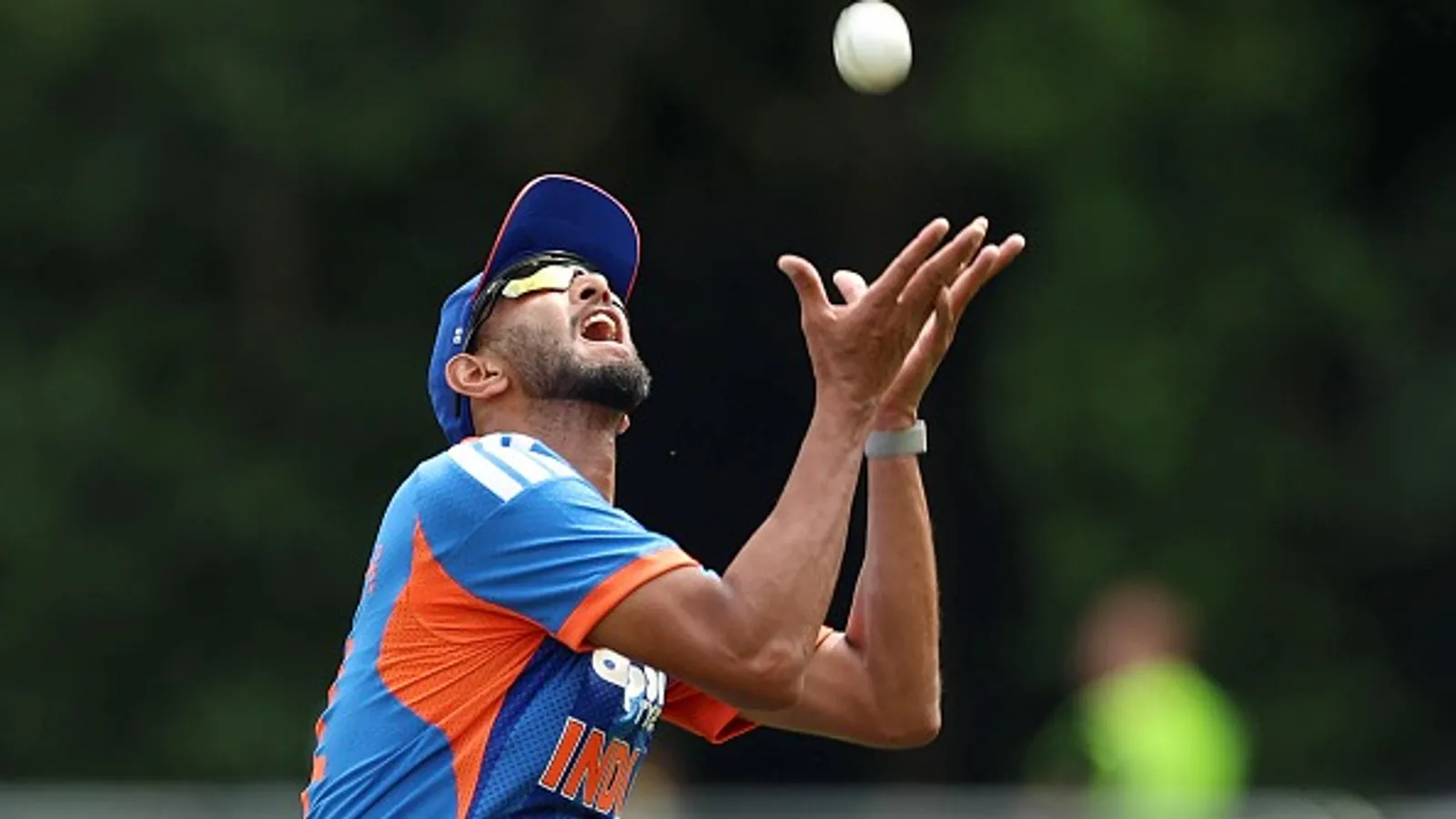
India’s preparations for the upcoming ODI Series against New Zealand have reportedly suffered a setback, with fast bowler Prasidh Krishna expected to miss the white-ball assignment while completing his rehabilitation. According to a Press Trust of India (PTI) report cited in the supplied information, Jammu and Kashmir pacer Auqib Nabi is among the leading contenders to replace him in India’s squad.
The five-match ODI series is scheduled to begin on November 4. Krishna’s reported unavailability presents a selection challenge for the Indian team management, which must balance the need for an effective pace attack with the importance of ensuring that injured players return only when fully fit.
Krishna sustained a hamstring strain during India’s home ODI series against the West Indies. Although his recovery has reportedly progressed well, he is not yet considered ready for international match conditions. The decision to hold him back would allow the medical team to assess his fitness before the subsequent two-match Test series against New Zealand.
For Nabi, the reported opportunity could represent another chance to establish himself at international level. The Jammu and Kashmir seamer has built a strong reputation through domestic cricket and recent performances for India A. However, his potential selection should be distinguished from an officially confirmed replacement announcement.
Why Prasidh Krishna Could Miss the New Zealand ODI Series
Prasidh Krishna’s reported absence is linked to the hamstring injury he sustained during India’s home ODI series against the West Indies. The injury interrupted his international schedule and required him to undergo rehabilitation before returning to competitive cricket.
According to a BCCI source quoted in the supplied report, Krishna was progressing well but still needed to complete his fitness assessment and match-simulation exercises at the Centre of Excellence in Bengaluru.
“Prasidh is recovering well and he has his match simulation and fitness test lined up at the Centre of Excellence in Bengaluru on November 1 and 2. In any case, the team management as well as national selection committee believes that Prasidh should be fully ready for Tests where he is required more than ODIs.”
The assessment dates mentioned in the report are November 1 and 2, immediately before the scheduled start of the ODI series on November 4. That timing leaves little room for an extended evaluation period before the opening match.
Even if a player makes progress during rehabilitation, being medically fit to train does not automatically mean he is ready to handle the intensity of international cricket. Fast bowlers must be able to run in repeatedly, deliver at high intensity and recover between spells without aggravating an existing injury.
Match simulation provides an opportunity to assess whether a player can reproduce the physical demands of competition. Fitness testing can also help the medical team evaluate his readiness to return. The results of those assessments would be important in determining Krishna’s immediate availability.
Holding him back from the ODI series would also give India an opportunity to prioritise his recovery ahead of the two-match Test series against New Zealand. The supplied report identifies Test cricket as the format for which the team management considers him particularly important.
However, Krishna’s final availability depends on his recovery, the results of his assessments and the team’s official decision. Until those details are confirmed, his absence from the ODI series should be treated as a reported development rather than a completed selection decision.
Why Prasidh Krishna Is Important to India’s Pace Attack
Krishna offers India a particular type of fast-bowling option. His height and ability to generate steep bounce from a good length allow him to challenge batters without depending exclusively on swing or changes of pace.
That approach can be useful in ODI cricket, where bowlers must balance wicket-taking opportunities with the need to control scoring. A delivery that rises sharply from a length can make it harder for batters to play comfortably through the front foot, particularly when the bowler maintains accuracy and varies his angle.
Krishna’s reported record in 2026 also underlines why his availability matters. The supplied figures credit him with 16 ODI wickets in nine appearances, making him India’s leading wicket-taker in the format during that calendar year at the time covered by the report.
His overall ODI record is listed as 53 wickets from 30 innings, with a bowling strike rate of 27.2 balls per wicket. The strike rate indicates the average number of deliveries required to take a wicket, rather than the number of runs conceded.
These figures point to his potential value as a wicket-taking bowler. Nevertheless, past performance cannot guarantee future results, and his immediate contribution will depend on his fitness and the conditions in which India play.
Managing Jasprit Bumrah’s Workload
Another consideration is India’s management of Jasprit Bumrah’s workload. The supplied report highlights the importance of maintaining a reliable group of fast bowlers while preparing for the longer-term demands of international cricket, including the 2027 ODI World Cup.
Having several dependable pace options gives the team more flexibility when managing individual workloads. It can also reduce the pressure on a small group of frontline bowlers across a busy international schedule.
Krishna’s reported absence would therefore make squad depth particularly relevant. India would need its available fast bowlers to share responsibilities according to their roles, fitness and effectiveness in the conditions.
That does not mean one replacement can automatically reproduce everything Krishna offers. His height, bounce and established ODI record represent a specific combination of attributes. The selection challenge is to find a bowler who can strengthen the attack while fitting into the team’s wider plans.
Why Bounce and Hard Lengths Matter
Krishna’s bowling style could also be valuable on surfaces that provide extra bounce. The supplied report specifically identifies future tours such as South Africa as environments in which his ability to hit the pitch hard could become useful.
Fast bowlers who extract bounce can force batters to make difficult decisions about whether to play off the front foot, defend from the crease or attempt an attacking stroke. When combined with consistent line and length, this can create opportunities for catches and mistimed shots.
However, the effectiveness of that approach depends on the surface, the batter’s technique and the bowler’s control. A replacement for Krishna would not necessarily need to possess identical physical attributes, but would need to provide a useful contribution within India’s overall bowling strategy.
Auqib Nabi Emerges as a Reported Replacement Option
Jammu and Kashmir fast bowler Auqib Nabi has emerged as a reported contender to replace Krishna in India’s ODI squad. His domestic performances and recent involvement with India A have strengthened his case for consideration.
Nabi is a right-arm medium-pacer whose strengths, according to the supplied report, include accuracy, movement and the ability to maintain pressure over extended spells. Those qualities have helped him establish himself as an important member of Jammu and Kashmir’s bowling attack.
The report also points to his performances during the first unofficial red-ball match between India A and New Zealand A in Lincoln. His ability to move the ball late, maintain consistent lines and break partnerships reportedly attracted attention during the fixture.
Although those performances came in red-ball cricket, they provide context for his development as a bowler. The challenge for any potential ODI selection would be translating those strengths into a format that requires different tactical decisions, particularly during the middle overs and at the death.
In limited-overs cricket, bowlers have to consider fielding restrictions, scoring opportunities and the importance of preventing boundaries. Accuracy and movement remain valuable, but success also depends on adapting lengths, controlling the scoring rate and executing plans against attacking batters.
Nabi’s domestic experience across formats could therefore be relevant if the selectors decide that he is the best available option. His potential inclusion would also provide an opportunity to assess how his bowling translates to a sustained role in international white-ball cricket.
Nabi’s International Debut: A Difficult First Test
Nabi has already made his ODI debut during India’s recent home assignment against the West Indies, according to the supplied report. His first appearance, however, was challenging.
He finished that outing without a wicket, conceding 84 runs in 8.5 overs. Those figures represent an expensive introduction to international ODI cricket, but they also illustrate why a single performance should not be treated as a complete assessment of a young bowler’s potential.
International cricket offers a different level of pressure from domestic competition. Batters are generally better equipped to identify patterns, capitalise on loose deliveries and exploit fielding restrictions. Bowlers must adjust quickly when their initial plans are not working.
For Nabi, another opportunity would provide a chance to demonstrate whether he can make those adjustments. He would need to show improved control, build pressure through consistent deliveries and identify effective ways to take wickets against an experienced batting lineup.
At the same time, the circumstances of his debut should not be ignored. The figures alone do not establish whether his performance resulted from technical issues, difficult conditions, opposition tactics or a combination of factors. Further performances would provide a clearer picture of his progress.
If selected for the New Zealand series, Nabi would face a fresh test of his adaptability. The focus would be on his ability to learn from his first appearance and deliver a more effective performance within India’s bowling plans.
Auqib Nabi’s Domestic Record Strengthens His Case
Nabi’s reported domestic achievements are a major part of the argument for considering him as a replacement. He has established himself as a productive seamer for Jammu and Kashmir, contributing across first-class, List A and T20 cricket.
The supplied report credits him with more than 170 first-class wickets at a bowling average below 19. Such a record, if assessed over the stated career period, indicates a strong history of taking wickets while restricting the runs conceded per dismissal.
His red-ball performances have reportedly included a career-best spell of seven wickets for 24 runs against Rajasthan. The report also highlights a Duleep Trophy appearance in which he took four wickets in four consecutive deliveries, an exceptional sequence that drew attention to his wicket-taking ability.
These performances help explain why a domestic bowler can enter discussions for national selection. Consistent results at the domestic level give selectors evidence of a player’s ability to perform under competitive conditions, even when that player has limited international experience.
Nabi’s white-ball record is another consideration. The supplied information credits him with more than 50 List A wickets at an average of 27.38. List A cricket uses the 50-over format, making those performances particularly relevant when assessing his potential suitability for ODIs.
His reported experience in the Vijay Hazare Trophy and Syed Mushtaq Ali Trophy has also exposed him to different limited-overs demands. The Vijay Hazare Trophy is the domestic 50-over competition, while the Syed Mushtaq Ali Trophy is played in the T20 format.
Performing across these formats requires adjustments in bowling strategy. In longer games, bowlers can build pressure over sustained spells. In ODIs, they must balance wicket-taking with run prevention across different phases of an innings. T20 cricket places an even greater emphasis on execution under severe scoring pressure.
Nabi’s domestic experience does not guarantee success at international level, but it gives selectors a body of performances to consider alongside his first ODI appearance and recent India A involvement.
How Nabi Compares With Other Replacement Options
The supplied report identifies Punjab fast bowler Gurnoor Brar as another possible alternative. His height and pace could make him a like-for-like option if the selectors want a bowler with physical attributes similar to Krishna’s.
Nabi, meanwhile, presents a different selection case built around his domestic wicket-taking record, control and experience across formats. Choosing between the two would involve more than comparing their reputations or individual statistics.
The selection panel would need to consider the role required within the ODI attack, the available bowlers, fitness and the conditions expected during the series. A replacement who can perform a specific tactical role may be more valuable than one whose attributes simply resemble those of the injured player.
There is also a distinction between replacing an individual and replacing his contribution. Krishna’s absence could affect India’s ability to extract bounce and take wickets at important stages. The team would need to distribute those responsibilities among the available bowlers rather than expect a new selection to reproduce his entire role immediately.
As the supplied report does not confirm a final replacement decision, Nabi and Brar should be viewed as reported possibilities rather than officially named selections.
What Prasidh Krishna’s Injury Means for India’s New Zealand Campaign
The immediate effect of Krishna’s reported unavailability would be a change in India’s available pace-bowling resources ahead of the five-match ODI series. The team management would need to decide how best to balance experience, wicket-taking ability and workload management.
For India, the challenge is not limited to finding a bowler for one vacant place. It also involves ensuring that the remaining fast bowlers are used effectively and that the squad has enough flexibility to respond to different match situations.
A replacement would need to contribute in the specific conditions of ODI cricket, where bowlers face different challenges during the powerplay, middle overs and closing stages of an innings. The ability to maintain discipline while creating wicket-taking opportunities would be central to that task.
For Nabi, a call-up would bring an opportunity to move beyond his domestic reputation and build a more substantial international record. For the selectors, it would be a decision about whether his current strengths and recent performances match the team’s immediate requirements.
Krishna’s longer-term recovery remains equally important. Returning before he is ready could put his rehabilitation at risk, while a carefully managed recovery could help him resume his international career with greater confidence in his fitness.
What Happens Next?
The next key development is expected to depend on Krishna’s rehabilitation, the fitness and match-simulation assessments mentioned in the report, and the selectors’ decision on squad composition.
If Krishna is not cleared for the ODI series, India will need to finalise an alternative from the available options. Nabi’s domestic record and recent performances for India A make him a reported contender, while Brar is another name identified in the supplied information.
The subsequent two-match Test series adds another consideration to India’s planning. The team management will want to ensure that any decision about Krishna’s return reflects his physical readiness rather than the pressure of an approaching fixture.
For Nabi, the potential opportunity is significant but not yet a confirmed selection. A second chance in international cricket could allow him to respond to the difficulties of his debut and demonstrate the qualities that have made him successful in domestic competition.
Until the BCCI or the selectors announce the final decision, the reported replacement remains subject to confirmation. India’s immediate priority will be to assemble a fit and effective pace attack for the New Zealand ODIs while protecting Krishna’s recovery and longer-term value to the team.
Frequently Asked Questions
Why is Prasidh Krishna reportedly set to miss the India vs New Zealand ODI series?
Krishna is recovering from a hamstring strain sustained during India’s home ODI series against the West Indies. According to the supplied report, he is not yet ready for international competition and must complete further fitness assessments.
Who could replace Prasidh Krishna in India’s ODI squad?
Jammu and Kashmir fast bowler Auqib Nabi is reportedly in contention to replace Krishna. Punjab pacer Gurnoor Brar is also mentioned as a possible alternative. The supplied report does not confirm an official replacement announcement.
When does the India vs New Zealand ODI series begin?
The supplied report states that the five-match ODI series is scheduled to begin on November 4.
When is Prasidh Krishna expected to undergo fitness assessments?
The report quotes a BCCI source as saying that Krishna’s match simulation and fitness test are scheduled for November 1 and 2 at the Centre of Excellence in Bengaluru.
What is Prasidh Krishna’s reported ODI record?
The supplied figures credit Krishna with 53 ODI wickets from 30 bowling innings and a bowling strike rate of 27.2 balls per wicket. He is also credited with 16 ODI wickets in nine appearances during 2026 in the report.
How did Auqib Nabi perform on his ODI debut?
According to the supplied report, Nabi went wicketless and conceded 84 runs in 8.5 overs during his ODI debut against the West Indies.
What makes Auqib Nabi a potential replacement?
Nabi’s reported domestic record includes more than 170 first-class wickets at an average below 19 and more than 50 List A wickets at an average of 27.38. His performances for Jammu and Kashmir and India A have reportedly strengthened his case for consideration.
Will Prasidh Krishna be available for the Test series against New Zealand?
The supplied report indicates that the team management would prefer Krishna to be fully fit for the subsequent two-match Test series. His actual availability will depend on his recovery, fitness assessments and the team’s final decision.
For breaking news and live news updates, like us on Facebook or follow us on Twitter and Instagram. Read more on Latest Cricket on thefoxdaily.com.






COMMENTS 0