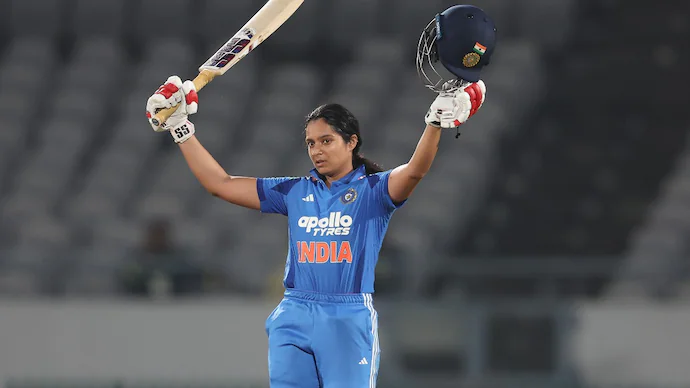
Pratika Rawal delivered a memorable performance on her return from an injury-disrupted period, scoring her third One Day International century as India Women crushed Zimbabwe Women by nine wickets in Vadodara on Friday, October 23, 2026. The emphatic result came in the teams’ historic first-ever Women’s ODI encounter and gave India a 1-0 lead in the three-match series.
After restricting Zimbabwe to 197 all out in 49.5 overs, India chased down the target with remarkable ease, reaching 201 for one in just 27.1 overs. Rawal remained unbeaten on 100 from 96 deliveries, striking 15 boundaries, while Shafali Verma produced a blistering unbeaten 64 from 33 balls to complete the chase in style.
Although Rawal’s century dominated the headlines, India’s victory was built on an outstanding bowling performance led by left-arm spinner Shree Charani. She claimed career-best ODI figures of four wickets for 23 runs in 10 overs, including three maidens, preventing Zimbabwe from establishing a competitive total.
Smriti Mandhana, leading India as full-time captain, also continued her encouraging start in the role. The victory marked India’s fourth consecutive win under her leadership, adding another positive result to the team’s recent run of performances.
For Zimbabwe, 17-year-old Beloved Biza offered resistance with a composed 62, but the visitors struggled to cope with India’s disciplined attack. The result leaves India firmly in control of the series ahead of the second ODI, scheduled for Sunday, October 25.
India Dominate Zimbabwe in a Historic Women’s ODI
The first ODI between India and Zimbabwe represented a historic occasion for both teams. Playing at the BCA Stadium in Vadodara, the sides met in a Women’s ODI for the first time, creating a new chapter in their international cricketing relationship.
India made the most of the occasion with a comprehensive performance in all departments. The bowlers restricted Zimbabwe to a total of 197, and the batters then dismantled the target with 22.5 overs remaining. The nine-wicket margin reflected the difference between the teams on the day, with India maintaining control for most of the contest.
The victory was particularly encouraging because it combined a strong collective bowling effort with individual brilliance from the top order. Charani’s four-wicket haul ensured Zimbabwe never built sustained momentum, while Rawal and Mandhana gave India a solid start before Shafali accelerated the chase.
India’s performance also demonstrated the value of having multiple contributors. Charani was the standout bowler, Rawal produced the innings of the match and Shafali supplied a rapid finish. Their efforts meant India did not need a prolonged middle-order contribution to complete the chase.
With the opening match secured, India now have the opportunity to build on their momentum and move closer to a series victory. Zimbabwe, meanwhile, will need to improve their batting performance and find ways to challenge India’s top order if they are to level the contest.
Shree Charani Leads India’s Bowling Charge
India’s dominance began with the ball after they were asked to bowl first. The hosts struck at regular intervals, preventing Zimbabwe from developing a strong opening partnership or establishing a platform for a late acceleration.
Kranti Gaud provided the first breakthrough by dismissing Kelis Ndhlovu. Charani then made an immediate impact, removing Chipo Mugeri-Tiripano and Modester Mupachikwa to put Zimbabwe under pressure during the early stages of the innings.
Those wickets disrupted Zimbabwe’s plans and forced the remaining batters to rebuild rather than attack freely. India continued to apply pressure through disciplined bowling and sharp control of the scoring rate, making it difficult for the visitors to recover.
Deepti Sharma contributed to the pressure by dismissing Sharne Mayers. Her spell helped keep Zimbabwe’s scoring opportunities limited and ensured the visitors could not use a settled partnership to regain control of the innings.
Charani Records Career-Best ODI Figures
Charani was India’s most effective bowler, finishing with figures of four for 23 from her 10 overs. She also bowled three maidens, highlighting her ability to restrict scoring while consistently threatening the batters.
The left-arm spinner combined accuracy with variation, forcing Zimbabwe’s batters to work hard for runs. Her spell was central to India’s success because it removed key players and prevented the visitors from building the sort of partnerships needed to post a challenging total.
Four wickets for just 23 runs represented a career-best performance for Charani in ODI cricket. The achievement gave India a major advantage before the chase began and underlined the importance of controlling the middle overs in the 50-over format.
Charani’s contribution was especially valuable because Zimbabwe still had the opportunity to build a substantial score with almost 50 overs available. Instead, regular wickets meant the visitors were repeatedly forced to restart their innings.
Jintimani Kalita Makes Her India Debut
The match also marked the international ODI debut of Jintimani Kalita. The Assam pacer received her maiden India cap from Harmanpreet Kaur, making the fixture a personal milestone in her cricketing career.
Kalita delivered a disciplined performance, conceding 23 runs in five overs. Although she did not take a wicket, her economical spell helped maintain pressure on Zimbabwe and supported the efforts of India’s other bowlers.
For a debutant, contributing to a comprehensive team victory provides an encouraging beginning. Kalita’s performance offered India another bowling option, while her first appearance at this level marked an important step in her development.
India’s ability to combine Charani’s wicket-taking impact with economical contributions from other bowlers helped keep Zimbabwe below the 200-run mark. The collective effort laid the foundation for the comfortable chase that followed.
Beloved Biza Provides Zimbabwe’s Biggest Resistance
Zimbabwe struggled to establish momentum against India’s disciplined bowling, but teenager Beloved Biza emerged as a major positive for the visitors. The 17-year-old scored 62 from 92 deliveries, hitting five fours and showing impressive composure as wickets fell around her.
Biza’s innings provided Zimbabwe with a measure of stability during a difficult period. Rather than allowing the innings to collapse quickly, she remained at the crease and attempted to rebuild through careful shot selection and patience.
Her performance stood out because the other batters found it difficult to settle against India’s attack. With wickets falling at regular intervals, Biza had to balance the need to preserve her wicket with the responsibility of keeping the scoreboard moving.
Michelle Mavunga provided useful support, scoring a brisk 29 as Zimbabwe attempted to recover. Her more aggressive approach offered a temporary change in momentum and gave Biza a partner capable of scoring at a faster rate.
India Regain Control in the Middle Overs
Zimbabwe’s hopes of producing a late recovery suffered when Gaud dismissed Mavunga before ending Biza’s resistance. The two wickets removed the batters who had offered the visitors their best chance of rebuilding the innings.
The dismissals left Zimbabwe without a strong platform for the final overs. India’s bowlers continued to exploit the situation, limiting the opportunities for the lower order to accelerate and push the total toward a more challenging figure.
Zimbabwe were also without captain Josephine Nkomo, who missed the match because of a niggle. Her absence was another challenge for the visitors, although the supplied match information does not establish how significantly it affected their overall performance.
Deepti eventually completed the innings by bowling Tendai Makusha in the final over. Zimbabwe were all out for 197 in 49.5 overs, leaving India with a target of 198 to win the opening match of the series.
Despite Biza’s determined half-century, Zimbabwe were unable to convert their recovery efforts into a total that could seriously test India’s batting lineup. Charani’s four-wicket haul and the contributions of India’s other bowlers had already put the hosts in a commanding position.
Pratika Rawal Sets the Tone in India’s Chase
India’s response began with an attacking approach from Rawal, who immediately looked comfortable against Zimbabwe’s bowling. The opener found gaps, punished loose deliveries and ensured the required scoring rate never became a concern.
Rawal’s innings carried additional significance because she had been working her way back from an injury-disrupted period over the previous 12 months. Returning to the spotlight with a century in the opening match gave her a memorable opportunity to re-establish herself at the international level.
Her confident strokeplay put Zimbabwe on the defensive early in the chase. Rather than allowing the bowlers to build pressure through tight overs, Rawal consistently found scoring opportunities and helped India maintain a pace well above what was required.
She also demonstrated patience when necessary, mixing boundaries with controlled rotation of the strike. That balance allowed her to build a substantial innings without placing unnecessary pressure on her opening partner.
Mandhana and Rawal Build a 94-Run Opening Stand
India captain Smriti Mandhana provided strong support at the other end as the pair put together a 94-run opening partnership. The stand gave India an excellent start and ensured that the chase was well established before Zimbabwe managed to take a wicket.
While Rawal continued to find boundaries, Mandhana gradually increased her scoring rate. Their partnership combined controlled batting with attacking intent, preventing Zimbabwe from settling into a rhythm or building sustained pressure.
The 94-run stand was particularly important because it reduced the target substantially without India losing a wicket. By the time Zimbabwe made their first breakthrough, the hosts had already taken a commanding position in the chase.
Mandhana was eventually dismissed for 32 when she attempted to attack Olinder Chare and was caught by Biza at long-on. The wicket briefly gave Zimbabwe a reason to celebrate, but the visitors still faced the challenge of dismissing a well-set Rawal and containing the incoming batter.
Mandhana’s contribution also extended beyond her innings. The victory marked India’s fourth consecutive win under her leadership as full-time captain, continuing a positive beginning to her tenure in the role.
Shafali Verma Turns the Chase Into a One-Sided Contest
After Mandhana’s dismissal, Shafali Verma joined Rawal and ensured that Zimbabwe’s hopes of a comeback quickly faded. The pair combined Rawal’s composed approach with Shafali’s aggressive strokeplay, pushing India closer to the target at a rapid pace.
Shafali wasted little time in taking the attack to Zimbabwe’s bowlers. She targeted the spinners and scored freely, putting the fielding side under immediate pressure as India moved toward the finish line.
Her half-century came off just 29 balls, highlighting the speed of her innings. The rapid scoring reduced the number of overs India needed and prevented Zimbabwe from using the remaining wickets as an opportunity to create pressure.
Shafali’s innings was a contrast to Rawal’s more measured approach, but the two styles complemented each other effectively. Rawal continued to build her century while Shafali supplied the acceleration required to complete the chase well before the end of the allotted overs.
Rawal Completes Her Third ODI Century
As India moved closer to victory, Rawal continued to select her scoring opportunities carefully. With her century approaching, she struck consecutive boundaries off Tendai Makusha to reach three figures.
Her unbeaten 100 came from 96 deliveries and included 15 fours. The innings was a major personal achievement after her injury-related interruption and demonstrated her ability to combine patience with effective boundary hitting.
Reaching the milestone in a winning cause made the performance even more memorable. Rawal not only guided India toward the target but remained at the crease until the match was effectively settled, giving her a complete contribution to the team’s victory.
The century was the third of her ODI career and provided a strong statement on her return to international action. Her ability to anchor the chase meant Shafali could play aggressively without the team needing to worry about losing control of the innings.
Shafali Finishes the Match in Style
Shafali completed the victory by striking a boundary down the ground off Nyasha Gwanzura. India reached 201 for one in 27.1 overs, securing a nine-wicket win with 22.5 overs remaining.
Shafali finished unbeaten on 64 from 33 deliveries, with five fours and four sixes. Her strike rate and attacking intent made her innings a decisive contribution, especially once India had established a strong opening partnership.
Rawal ended the chase on 100 not out, while Shafali’s rapid scoring ensured the hosts did not need to take the contest deep into the innings. The pair’s unbroken partnership after Mandhana’s dismissal completed a dominant batting performance.
India’s final score of 201 for one reflected the control the hosts had maintained throughout the match. After their bowlers restricted Zimbabwe to 197, the top order completed the chase with minimal difficulty.
Smriti Mandhana Continues an Encouraging Start as Captain
The result was another positive milestone for Mandhana, who has begun her tenure as India’s full-time captain with four consecutive victories. The win over Zimbabwe added to that run and provided further encouragement as India continue their international campaign.
Mandhana’s 32 helped establish the opening partnership with Rawal, giving India a platform from which to control the chase. Although she did not remain at the crease until the finish, her contribution ensured the team was well placed before Shafali joined the innings.
Leadership in international cricket involves balancing individual performance with team planning and decision-making. India’s coordinated bowling effort and confident chase offered a positive result under Mandhana’s captaincy, although one match alone cannot determine how a team will perform over a longer period.
The opening victory also gave India a chance to test combinations and assess players in a historic contest against Zimbabwe. Kalita’s debut, Charani’s career-best figures and Rawal’s century all provided encouraging developments for the team.
India will now look to maintain that momentum in the second ODI. A strong start to a three-match series can ease pressure on the team, but Zimbabwe will have an opportunity to respond and attempt to level the contest in the next game.
India’s All-Round Performance Provides a Strong Foundation
India’s nine-wicket win was built on contributions from several players rather than one outstanding innings alone. Charani’s four wickets limited Zimbabwe’s scoring opportunities, Gaud and Deepti provided important breakthroughs, and the remaining bowlers helped keep the visitors below 200.
The batting unit then turned that advantage into a comfortable victory. Rawal’s unbeaten century anchored the chase, Mandhana helped build the opening partnership, and Shafali’s rapid half-century brought the contest to an early conclusion.
Such a combination of disciplined bowling and aggressive batting can be particularly valuable in ODI cricket. A strong first innings reduces the pressure on the batters, while a confident chase can prevent the opposition from building momentum through wickets or tight spells.
The match also offered individual milestones. Charani recorded her career-best ODI figures, Kalita made her international debut, Rawal reached her third ODI century and Mandhana extended her winning start as captain.
For Zimbabwe, Biza’s 62 was a significant positive, showing that the team has players capable of resisting India’s attack. Mavunga’s 29 also provided some support, but the visitors will need more substantial contributions across the batting order to challenge India in the remaining fixtures.
What the Result Means for the Three-Match Series
India’s victory gives them a 1-0 lead in the three-match ODI series, putting them in a strong position ahead of Sunday’s second match. Another win would secure the series for the hosts, while a Zimbabwe victory would level the contest and make the final game decisive.
The first ODI provides India with several positives to carry forward. Rawal has produced a century after an injury-disrupted period, Charani has delivered an outstanding bowling performance, and the team has demonstrated the ability to dominate both innings.
Zimbabwe will need to address the collapse of their batting lineup if they are to respond. Biza’s half-century showed determination, but the visitors must find ways to protect wickets and build partnerships while still maintaining a scoring rate capable of challenging India’s strong batting order.
Improving their performance against spin could also be important after Charani’s decisive spell. However, Zimbabwe’s response will depend on their overall preparation and execution, rather than one aspect of the game alone.
India’s focus will be on maintaining the standards shown in Vadodara while avoiding complacency after a comfortable opening win. The second ODI will provide another opportunity to assess the balance of the side and build on the confidence gained from the historic first meeting.
Second ODI Offers India a Chance to Strengthen Their Position
The second match of the series is scheduled for Sunday, October 25, following India’s nine-wicket victory in the opener. The hosts will enter the contest with a 1-0 advantage and the confidence of having produced an effective all-round performance.
Rawal’s form will be one of the key talking points heading into the next match. Her century was not only the defining batting contribution of the opening ODI but also a significant personal milestone after a difficult period disrupted by injuries.
Charani’s bowling will also attract attention after her four-wicket haul. Her ability to control scoring while taking wickets gave India a major advantage, and Zimbabwe will need to find ways to counter her accuracy and variation.
At the same time, Shafali’s explosive innings provides another reason for India’s confidence. Her 64 not out from 33 balls demonstrated how quickly the team can close out a chase when the opening batters establish a strong foundation.
Zimbabwe, however, still have an opportunity to respond. The opening defeat leaves them needing a better batting performance, but the series remains alive, and the next fixture will give them a chance to adjust their approach.
Conclusion: Rawal’s Century Headlines India’s Historic Victory
Pratika Rawal’s unbeaten century led India to a dominant nine-wicket victory over Zimbabwe in the first-ever Women’s ODI between the two teams in Vadodara. Her 100 not out from 96 deliveries, supported by Shafali Verma’s explosive 64 from 33 balls, helped India reach 201 for one in just 27.1 overs while chasing 198.
The result was set up by Shree Charani, whose career-best figures of four for 23 restricted Zimbabwe to 197 all out. Beloved Biza’s determined 62 provided the visitors with their main resistance, but India maintained control through regular wickets and disciplined bowling.
Mandhana’s continued winning start as full-time captain, Kalita’s international debut and the contributions of the top order made the opening fixture a memorable day for India. The victory gave the hosts a 1-0 lead in the three-match series and established a strong platform for the remaining games.
India will now aim to carry their momentum into the second ODI on October 25, while Zimbabwe will look to recover from the opening defeat. For now, the standout story belongs to Rawal, whose third ODI century transformed her return from an injury-disrupted period into a decisive performance in a historic international contest.
For breaking news and live news updates, like us on Facebook or follow us on Twitter and Instagram. Read more on Latest Cricket on thefoxdaily.com.





COMMENTS 0