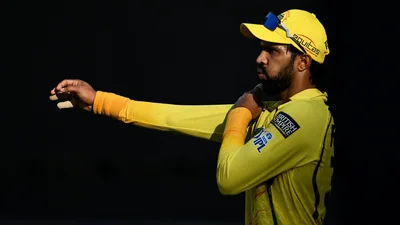
Ruturaj Gaikwad on CSK coach succession has offered an important glimpse into Chennai Super Kings’ thinking after the franchise ended its long association with Stephen Fleming. Rather than rushing into a major appointment, CSK appear ready to use the time before the next IPL season and mini-auction to evaluate their options carefully.
Fleming’s departure is a significant moment for CSK. The former New Zealand captain had been part of the franchise from its earliest days and eventually became the central figure in its coaching structure. His tenure helped establish a distinctive team culture built around continuity, calm decision-making and long-term planning.
Now, with Fleming no longer in charge, the five-time IPL champions face the difficult task of deciding what comes next. For captain Ruturaj Gaikwad, however, there is no reason to make that decision simply for the sake of making it quickly.
CSK Have No Reason to Rush Fleming’s Replacement
Ruturaj Gaikwad made it clear that the franchise is already thinking about the next head coach. However, he also stressed that there is sufficient time before the next IPL season, meaning CSK can take a more measured approach.
“There is no rush to make a decision,” Gaikwad said while discussing the coaching situation.
The statement is important because replacing Fleming is not an ordinary coaching vacancy. His relationship with CSK lasted for many years, and the franchise’s methods became closely associated with his leadership.
Instead of immediately appointing a high-profile name, CSK can assess what the squad currently needs. The coaching decision can potentially be aligned with the team’s recruitment strategy, leadership structure and plans for the next phase of the franchise.
Why Stephen Fleming’s Exit Is Such a Major Change
Fleming joined CSK as a player during the inaugural IPL season in 2008 before becoming head coach in 2009. His coaching tenure subsequently became one of the longest and most successful partnerships between a franchise and a head coach in T20 cricket.
Under Fleming, CSK developed a reputation for stability. The franchise frequently resisted dramatic changes, instead placing considerable value on experience, role clarity and familiarity with the team’s environment.
That approach produced remarkable consistency across different IPL cycles. CSK repeatedly remained competitive while other franchises went through frequent changes in coaches, captains and squad combinations.
His departure therefore creates more than a vacant position. It creates a question about whether CSK will continue with the same philosophy or gradually develop a new coaching identity.
IPL 2026 Exposed a Different Side of CSK
The timing of Fleming’s departure also comes after a difficult IPL 2026 season for Chennai Super Kings. The franchise finished eighth in the points table after winning only six of its 14 league matches.
For a team accustomed to challenging near the top of the standings, that campaign represented a clear setback.
The result does not erase the success of previous seasons, but it does highlight the scale of the rebuilding challenge facing CSK. The franchise must now consider how to refresh its squad without losing the qualities that made it successful for so long.
This is where the appointment of Fleming’s successor becomes particularly important.
A new coach will not simply be expected to manage training sessions. The next head coach could influence player development, tactical planning, recruitment discussions and the way CSK approaches the transition from an older core to a younger group.
Ruturaj Gaikwad’s Role Has Changed Dramatically
While CSK search for a new coach, Gaikwad himself is experiencing a major transition. He took over the captaincy from MS Dhoni, one of the most influential leaders in IPL history.
Replacing a player of Dhoni’s stature naturally brings additional expectations. Gaikwad acknowledged that his life has changed significantly since becoming captain, but he does not appear overwhelmed by the responsibility.
“Taking over from MS Dhoni comes with a lot of responsibility because of his immense success,” Gaikwad said.
The challenge for Gaikwad is not simply to imitate Dhoni. That would create an unrealistic benchmark. His more important task is to develop his own leadership style while maintaining the core values that have traditionally defined CSK.
Gaikwad Does Not Want Captaincy to Become a Burden
One particularly revealing part of Gaikwad’s comments was his attitude toward the pressure of captaincy. He indicated that he is happy to continue in the role as long as he enjoys the challenge.
That mindset could become important during CSK’s rebuilding phase.
Captaincy in a successful franchise can become increasingly demanding when results decline. Every tactical decision receives greater scrutiny, while the captain is often expected to provide stability when the team is going through uncertainty.
For Gaikwad, maintaining clarity will be crucial. The team’s transition should not become a personal battle to prove that he can replicate everything Dhoni achieved.
The Dhoni Comparison Will Continue, But CSK Must Move Forward
Dhoni’s enormous success means comparisons with his successor are inevitable. However, the two captains have taken over the team at very different stages of its evolution.
Dhoni inherited and developed a franchise that eventually became one of the strongest teams in IPL history. Gaikwad is now leading CSK through a period in which the squad requires fresh energy and potentially a new tactical direction.
| Area | CSK Under Fleming | CSK’s Next Phase |
|---|---|---|
| Leadership | Long-term continuity | New leadership structure |
| Coaching | Stephen Fleming | Successor yet to be decided |
| Captaincy | Dhoni-led era followed by transition | Ruturaj Gaikwad |
| Recent result | Historically consistent | 8th place in IPL 2026 |
| Primary challenge | Maintaining consistency | Rebuilding while preserving identity |
This distinction matters. CSK do not necessarily need another Fleming or another Dhoni. They need a combination of coaching and leadership that fits the squad they are building now.
Why the Mini-Auction Could Influence the Coaching Decision
Gaikwad’s reference to the mini-auction is significant because CSK’s coaching decision and recruitment strategy could be closely connected.
An auction gives franchises an opportunity to address weaknesses, strengthen specific roles and introduce new players into the squad. The incoming head coach will likely want a clear understanding of the team’s requirements before committing to a long-term tactical plan.
Waiting therefore has a potential advantage.
CSK can assess their existing squad, identify priority areas and then select a coach whose philosophy matches those requirements. A rushed appointment could create a situation where the coaching philosophy and player recruitment strategy do not align.
What Kind of Coach Could CSK Need Next?
The biggest question is not simply who replaces Fleming, but what CSK expect from that person.
The franchise may want someone capable of preserving the calm environment that has traditionally been associated with CSK while also introducing fresh tactical ideas. The next coach could need to balance experienced players with younger talent and help the team adapt to the demands of modern T20 cricket.
There are several qualities that could become particularly valuable:
- Strong player-development skills: A rebuilding squad needs players to grow into important roles.
- Tactical flexibility: Modern T20 cricket increasingly rewards teams capable of adapting quickly.
- Leadership partnership: The coach must work effectively with Gaikwad rather than overshadowing the captain.
- Understanding of CSK culture: Continuity remains an important part of the franchise’s identity.
- Long-term planning: The next coach may need to prepare the squad for several seasons rather than focus only on one campaign.
CSK Fans Are Being Asked to Be Patient
Gaikwad also addressed the relationship between CSK and its supporters. The franchise has enjoyed an extraordinary level of backing since entering the IPL in 2008, including through periods when it was unavailable from the competition.
That history has created expectations that CSK should always be among the contenders.
But Gaikwad acknowledged that the franchise is currently experiencing a difficult period and asked supporters to remain behind the team.
His message reflects an important reality: successful teams eventually have to rebuild.
The challenge is particularly difficult for a franchise whose identity has been built around continuity. Rebuilding inevitably means making decisions that may be unpopular in the short term but necessary for long-term competitiveness.
CSK’s Greatest Strength Could Also Become Its Biggest Challenge
For years, continuity has been one of CSK’s defining strengths. The franchise’s willingness to trust experienced players and established systems helped create stability.
However, continuity can become difficult when the competitive environment changes.
T20 cricket evolves quickly. Strategies around powerplay batting, death bowling, match-ups, fielding and player roles continue to change. A successful franchise therefore has to preserve its identity while remaining willing to adapt.
CSK’s next coach will have to navigate exactly that balance.
What Happens Next for Ruturaj Gaikwad and CSK?
The immediate future is likely to involve evaluation rather than dramatic announcements. CSK have time to study potential coaching candidates, assess their existing squad and prepare for the mini-auction.
For Gaikwad, the next phase will be about establishing himself as the team’s long-term leader.
His comments suggest that he understands the scale of the responsibility but is not trying to run away from it. That could be an important quality for a captain leading a team through transition.
The new coach will also have a major role in supporting that transition. If the appointment is carefully matched to CSK’s needs, it could help the franchise move beyond the disappointment of IPL 2026.
Why Patience Could Actually Benefit CSK
There is a temptation in professional sport to respond to disappointing results with immediate changes. But a coaching appointment made under pressure does not automatically solve structural problems.
CSK have the opportunity to take a different route.
They can first understand why the 2026 campaign went wrong, determine which parts of the squad require change and then select a coach capable of addressing those weaknesses.
That approach would also give Gaikwad a clearer leadership environment. Instead of adapting simultaneously to a new coach, a drastically rebuilt squad and enormous expectations, CSK can attempt to coordinate those changes.
The Bigger Question: Can CSK Build Another Successful Era?
Fleming’s departure closes one of the most important chapters in CSK history. But it does not necessarily signal the end of the franchise’s competitive ambitions.
The next era will be judged differently.
CSK cannot simply rely on the formula that worked for the previous generation. The franchise now has to identify its next group of leaders, develop younger players and maintain its competitive edge in a rapidly changing IPL.
Gaikwad will be central to that process. So will the head coach eventually chosen by the management.
The fact that CSK are not rushing the decision may therefore be a positive sign rather than an indication of uncertainty. The franchise has learned what long-term stability can achieve. Its next challenge is to combine that patience with the willingness to evolve.
Conclusion: CSK’s Next Coach Could Define Its New Identity
Ruturaj Gaikwad on CSK coach succession has made one thing clear: Chennai Super Kings are prepared to wait for the right replacement for Stephen Fleming rather than make a hurried appointment.
That patience could prove valuable after an eighth-place finish in IPL 2026 and the beginning of a new leadership era under Gaikwad. The franchise now needs to balance its historic culture of stability with the realities of rebuilding.
Fleming’s legacy will be difficult to match, and Dhoni’s influence will remain part of CSK’s identity. But the next chapter cannot simply recreate the past.
For Gaikwad and CSK, the real challenge is to build something new while retaining the qualities that made the franchise successful in the first place.
For breaking news and live news updates, like us on Facebook or follow us on Twitter and Instagram. Read more on Latest Cricket on thefoxdaily.com.






COMMENTS 0