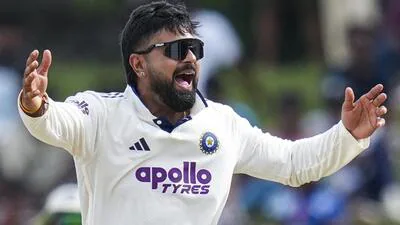
Saransh Jain’s Test debut became a story of persistence rather than instant success as the India off-spinner recovered from a wicketless opening spell to make important breakthroughs on Day 4 of the second Test against Sri Lanka in Colombo. At 33, Jain entered international cricket much later than many of India’s established spinners, but his long domestic career proved valuable when conditions demanded patience.
The debutant initially struggled to find his rhythm on the slow Sinhalese Sports Club surface. For his first 18 overs, he went without a wicket and did not appear to be producing the level of control expected from an experienced first-class spinner.
However, the pressure of international cricket did not overwhelm him. Instead, Jain gradually adjusted his pace and trajectory, eventually removing Prabath Kumara and the in-form Sonal Dinusha to help India finish Sri Lanka’s first innings and enforce the follow-on.
His contribution became even more important in the second innings when Sri Lanka threatened to fight back. Jain produced another crucial moment by dismissing left-handed batter Niroshan Dickwella with an arm ball, helping India regain momentum alongside Manav Suthar’s breakthroughs.
Why Saransh Jain’s slow start was not a major concern
Wicketless spells can quickly create pressure for a debutant, particularly in Indian Cricket where competition for places is intense. Jain knew that established options such as Washington Sundar and Kuldeep Yadav could return when available, making every opportunity important.
Yet his first 18 overs should be viewed through the context of the Colombo pitch. The surface was slow and did not offer dramatic turn, meaning the spinner had to rely on accuracy, subtle changes in pace and variations rather than expecting the pitch to produce wickets automatically.
This is where Jain’s first-class experience became significant. Having played 54 first-class matches before receiving his Test cap, he had already encountered long spells on surfaces where patience is often more valuable than aggression.
Instead of searching for a miracle delivery, Jain continued bowling and gradually increased the pressure on Sri Lanka’s batters.
Saransh Jain’s domestic experience finally paid off
Jain’s journey to Test Cricket was considerably longer than that of many international debutants. His experience in domestic cricket exposed him to precisely the type of challenge he encountered in Colombo: slow pitches, defensive batting and the need to create wickets through sustained pressure.
That background helped him avoid becoming frustrated after failing to strike early.
International cricket often rewards players who can remain mentally composed when their immediate results are not encouraging. Jain demonstrated that quality by continuing to attack the stumps and vary his deliveries until the conditions began working in his favor.
His eventual impact was therefore not simply about the wickets themselves. It was about the process that produced them.
How Saransh Jain broke through in Sri Lanka’s first innings
India needed wickets quickly because the team’s objective was to enforce the follow-on and maintain pressure on Sri Lanka.
Jain was brought into the attack early with the second new ball, a tactical decision designed to challenge Sri Lanka’s left-handed batters. The unusual combination of a new ball and an off-spinner gave India an opportunity to attack the stumps and create uncertainty among the lower order.
His first major opportunity came against Sonal Dinusha, but the Decision Review System prevented India from celebrating. An appeal against the batter was reviewed and the ball was projected to be going over the stumps.
That could easily have affected a debutant’s confidence. Jain instead continued building pressure.
The wicket of Prabath Kumara changed Jain’s spell
Jain eventually got his reward when Prabath Kumara attempted an aggressive shot against a floated off-break.
The ball was struck toward point, where Dhruv Jurel completed the catch.
The wicket was important for two reasons. First, it ended an innings that had helped Sri Lanka build a partnership. Second, it appeared to give Jain greater confidence in his bowling rhythm.
He had found the right pace and trajectory, and the breakthrough demonstrated that he did not need extravagant turn to create chances.
Sonal Dinusha provided the classic off-spinner’s wicket
Jain soon produced another important dismissal when Dinusha was caught at slip.
The wicket represented the type of dismissal traditional off-spin aims to create against a left-handed batter. The ball challenged the outside edge and eventually found a fielder in the cordon.
For India, the timing was ideal. Jain had moved from being wicketless for an extended period to becoming a key reason Sri Lanka’s first innings ended quickly enough for India to enforce the follow-on.
His celebration was understated, reflecting the approach that had defined his spell. There was no need for excessive emotion. The job was to take wickets, and he had done it.
Why the follow-on mattered for India
India’s decision to push for the follow-on reflected the broader match situation. Rather than allowing Sri Lanka to reset after their first innings, India wanted to keep the hosts under sustained pressure.
The quick wickets from Jain therefore had value beyond the individual dismissals.
Every wicket reduced Sri Lanka’s ability to dictate the tempo of the match and helped India maintain control. Jain’s contribution was particularly useful because the Indian attack included relatively inexperienced spin options.
Sri Lanka’s second innings tested India’s inexperienced spin attack
The second innings presented a different challenge.
With the pitch continuing to offer limited assistance, Sri Lanka’s middle order launched a counterattack. The hosts began putting pressure back on India, creating doubts about whether the relatively inexperienced spin attack could continue taking wickets consistently.
This was arguably a more meaningful examination of Jain and his fellow spinners than the first innings.
Taking wickets after a batting side has collapsed is one thing. Breaking partnerships when the opposition is actively attacking requires greater control and tactical awareness.
India needed someone to change the momentum again.
Manav Suthar and Saransh Jain restored India’s momentum
Manav Suthar’s twin breakthroughs in the final session helped India regain control, but Jain then supplied another crucial moment.
His dismissal of Niroshan Dickwella came through an arm ball, a variation that moves differently from a conventional off-spinner’s delivery.
The arm ball is particularly useful against left-handed batters because it can challenge their expectations. A batter preparing for the ball to turn may instead receive a delivery that continues straight, creating the possibility of an lbw dismissal or an edge if the line is correct.
Jain’s use of the variation showed that his bowling was not dependent solely on conventional off-spin.
The arm ball could become one of Jain’s biggest weapons
Jain’s second-innings dismissal offers an important insight into his potential at Test level.
His conventional off-spin is still developing, particularly his ability to generate consistent overspin and maximum bounce. However, his ability to change the trajectory and use the arm ball gives him another method of attacking batters.
Against a left-hand-heavy batting lineup, that variation can become particularly valuable.
Instead of relying on the pitch to provide substantial turn, Jain can create uncertainty through changes in angle and movement. On a slow surface, those small variations can be enough to produce mistakes.
What Sairaj Bahutule said about Saransh Jain
India’s spin-bowling coach Sairaj Bahutule praised Jain’s character after his difficult start.
Bahutule emphasized the amount of work Jain had put into domestic cricket and suggested that the spinner had earned his opportunity through sustained effort.
That perspective is important because Jain’s debut was not an overnight breakthrough. It was the result of years of domestic cricket and waiting for an opportunity at the highest level.
Bahutule also acknowledged that playing an international match brings different pressures from domestic cricket. Despite not taking early wickets, Jain continued to compete and eventually made the contribution India needed.
Saransh Jain’s debut was effective rather than spectacular
It would be misleading to describe Jain’s debut as flawless.
His bowling still has areas that require improvement, particularly his ability to generate consistent overspin at Test level. He did not dominate Sri Lanka from the beginning, and the conditions were not exactly designed to produce an instant highlight reel.
But that is precisely what makes the performance valuable.
A successful Test debut does not necessarily require five wickets or a match-winning spell. Sometimes the more revealing performance is one in which a player faces adversity, adjusts his approach and eventually contributes at important moments.
Jain did exactly that in Colombo.
Why Jain’s late entry into international cricket could benefit him
At 33, Jain is entering international cricket at an age when many players are already approaching the latter stages of their careers.
But being older can also provide an advantage.
Jain has already spent years learning how to bowl long spells, manage difficult pitches and respond to setbacks. He does not need to learn those lessons entirely through international cricket.
The challenge now is adapting those domestic skills to the greater pressure and quality of Test cricket.
His debut suggests that the transition is possible.
India’s spin depth gives Jain little room for error
The competitive environment around India’s Test spin department remains one of the biggest challenges Jain faces.
When players such as Kuldeep Yadav and Washington Sundar are available, selection becomes significantly more difficult. India also have several younger spinners competing for opportunities.
That means Jain cannot rely on one successful performance to establish a permanent place.
His best route forward is consistency. If he can demonstrate that he can control scoring, take wickets on slow pitches and offer different tactical options against both left- and right-handed batters, his experience could become a major asset.
What Jain’s performance means for India’s Test plans
India’s long-term Test strategy requires a reliable supply of quality spin options, particularly for matches on Asian pitches.
Jain’s emergence provides another possible option in that group.
His experience, combined with his ability to bowl to left-handers and use variations such as the arm ball, gives India another tactical possibility.
He may not immediately displace established names, but a strong debut can alter how selectors view a player. Instead of being an emergency option, Jain can now be considered a genuine Test-level candidate.
Saransh Jain’s debut offers a lesson in patience
The biggest lesson from Jain’s performance is that early failure does not necessarily determine the outcome of a match.
For 18 overs, he had little to show on the scoreboard. A less experienced player might have responded by searching for wickets and losing control.
Jain did the opposite. He continued bowling, adjusted his pace and waited for opportunities.
That patience eventually produced multiple breakthroughs and helped India maintain control.
Conclusion: Saransh Jain turns adversity into an important Test debut
Saransh Jain’s Test debut may not have been spectacular from the opening over, but it became increasingly valuable as the match progressed.
The 33-year-old spinner went wicketless for his first 18 overs before finding his rhythm and removing Prabath Kumara and Sonal Dinusha. Those wickets helped India finish Sri Lanka’s first innings and enforce the follow-on.
When Sri Lanka fought back in the second innings, Jain again delivered with the dismissal of Niroshan Dickwella using his arm ball. Alongside Manav Suthar’s breakthroughs, his contribution helped India regain momentum.
There is still room for improvement in Jain’s bowling, particularly his overspin and ability to extract maximum bounce. But his debut demonstrated qualities that cannot easily be taught: patience, experience and the ability to respond when things are not going according to plan.
For India, that could ultimately be the most encouraging part of Saransh Jain’s first Test. He did not need everything to go perfectly. He simply needed to stay in the contest long enough to make his opportunity count.
For breaking news and live news updates, like us on Facebook or follow us on Twitter and Instagram. Read more on Latest Cricket on thefoxdaily.com.






COMMENTS 0