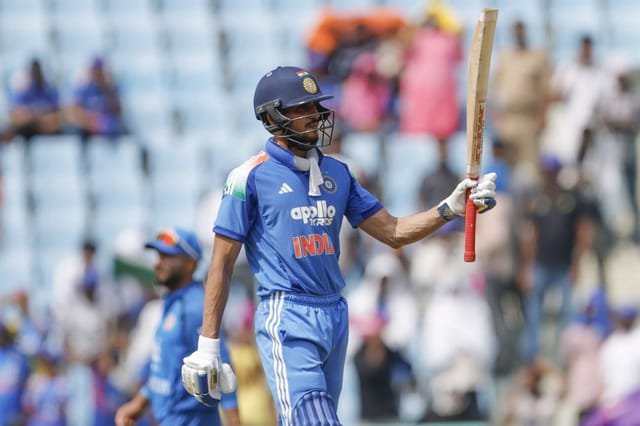
India’s transition towards the 2027 ICC ODI World Cup received another major boost as captain Shubman Gill produced a commanding innings in the second ODI against Afghanistan at the Ekana Cricket Stadium in Lucknow on June 17, 2026.
The right-handed opener reached his half-century in just 38 deliveries, showcasing a blend of composure, timing, and controlled aggression that has become his trademark in the 50-over format.
With India aiming to secure an unassailable lead in the three-match series, Gill’s fluent knock not only anchored the innings after an early setback but also highlighted why he is increasingly viewed as the face of India’s next-generation ODI setup.
Shubman Gill Reaches 50 in Style
Gill brought up his 19th ODI half-century in emphatic fashion on the opening delivery of the 17th over. Afghanistan spinner Nangeyalia Kharote delivered a short-of-length ball outside off stump, but the Indian skipper quickly adjusted to the pace of the surface and dispatched the delivery over wide long-on for a six.
The stroke perfectly encapsulated Gill’s batting approach—calm under pressure, technically sound, and capable of accelerating effortlessly when required.
By reaching the milestone in just 38 balls, Gill maintained an impressive strike rate while ensuring India stayed ahead of the game on a pitch that has historically challenged batters.
India Recover Quickly After Early Setback
India’s innings did not begin according to plan. Opener Yashasvi Jaiswal departed early for just four runs, leaving the hosts under pressure in the second over.
However, the experienced Rohit Sharma and Gill responded with positive intent. The duo attacked loose deliveries, rotated strike effectively, and prevented Afghanistan’s bowlers from settling into consistent lines and lengths.
The pair added 87 runs off just 67 balls for the second wicket, helping India race to 80/1 by the end of the powerplay.
Rohit looked set for a half-century of his own before falling for 48 off 39 balls to Rashid Khan. His innings included six boundaries and two sixes, underlining his continued importance in India’s ODI plans.
Following Rohit’s dismissal, Ishan Kishan joined Gill in the middle and ensured there was no loss of momentum.
Gill’s ODI Numbers Continue to Impress
Gill’s consistency in one-day cricket has been extraordinary. Playing his 63rd ODI, the Indian captain has already accumulated an impressive record that places him among the format’s elite batters.
| Statistic | Shubman Gill (After 63 ODIs) |
|---|---|
| Matches | 63 |
| Centuries | 8 |
| Half-centuries | 19 |
| Highest Score | 208 |
| Role | Opening Batter & Captain |
Few batters in modern cricket have adapted to ODI cricket as seamlessly as Gill. His ability to switch between anchoring an innings and accelerating when needed makes him uniquely valuable in contemporary one-day cricket.
Why Gill’s Form Matters for India’s 2027 World Cup Strategy
India’s current ODI cycle is focused squarely on the 2027 World Cup in South Africa, Zimbabwe, and Namibia. The team management faces several critical questions regarding squad composition, leadership succession, and balancing youth with experience.
Gill’s emergence as captain and consistent performer addresses multiple concerns simultaneously.
At just 26 years old, he offers long-term stability at the top of the order while also bringing leadership qualities that align with India’s future vision.
His partnerships with players like Yashasvi Jaiswal, Ishan Kishan, and established stars such as Rohit Sharma and Virat Kohli provide India with flexibility as selectors evaluate different combinations.
Moreover, Gill’s game is particularly suited to overseas conditions. His solid technique against pace, ability to play late, and growing confidence against spin make him a strong candidate to lead India’s batting unit in challenging environments.
Ekana Stadium: A Challenging Venue for Batters
The Ekana Cricket Stadium in Lucknow has earned a reputation for producing slower surfaces that test batting line-ups.
Unlike the high-scoring venues often associated with modern ODI cricket, Ekana rewards patience, intelligent shot selection, and the ability to manipulate field placements.
Gill’s innings demonstrated exactly how batters can succeed on such pitches. Rather than relying solely on power, he focused on timing, placement, and strike rotation.
His willingness to attack selectively prevented Afghanistan’s spinners from building pressure, a tactic that could prove valuable in future tournaments.
Afghanistan Continue to Show Promise Despite Challenges
While India controlled large portions of the contest, Afghanistan once again showcased flashes of their growing potential in ODI cricket.
Led by experienced campaigners such as Rashid Khan and supported by emerging talents, Afghanistan remain a dangerous side capable of competing with top teams.
Their decision to bowl first reflected confidence in their spin-heavy attack and their ability to chase under lights.
However, containing India’s deep batting line-up remains a difficult challenge, particularly when players like Gill find rhythm early.
Afghanistan’s bowlers struggled to build sustained pressure after the powerplay, allowing India to dictate the tempo.
The Evolution of Shubman Gill as a Leader
Gill’s transformation from a promising youngster into India’s ODI captain has been one of the most significant developments in Indian cricket over the past few years.
Known initially for his elegant stroke play and calm temperament, he has gradually added leadership responsibilities to his repertoire.
What stands out is his ability to lead through performance.
Captains often face increased scrutiny, but Gill has consistently responded with impactful innings. His decision-making on the field, combined with his maturity at the crease, suggests India may have found a long-term leader capable of carrying the team into a new era.
Importantly, he appears comfortable balancing his responsibilities as captain without compromising his batting rhythm.
What This Means for India’s ODI Future
India’s batting depth remains one of the strongest in world cricket, but clarity around roles will be crucial heading into the next World Cup cycle.
Gill’s performances are helping simplify those discussions.
His place at the top of the order is firmly established, and his leadership credentials continue to strengthen with every series.
With experienced players like Rohit Sharma and Virat Kohli entering the latter stages of their careers, India need younger players capable of carrying the team’s expectations.
Gill appears ready for that challenge.
His consistency also provides India with the flexibility to experiment with middle-order combinations and all-round options without compromising stability at the top.
Can Gill Become India’s Next ODI Great?
Comparisons with previous Indian batting icons are inevitable, but Gill’s early numbers suggest he is on a trajectory that could place him among the country’s finest ODI batters.
What separates him from many of his contemporaries is his adaptability.
He can dominate on flat tracks, absorb pressure on difficult surfaces, and accelerate without appearing rushed.
Modern ODI cricket increasingly demands versatility, and Gill possesses the complete package.
If he maintains his current trajectory, he could become the cornerstone of India’s batting line-up for the next decade.
Conclusion: Another Statement Performance from India’s Captain
Shubman Gill’s 38-ball half-century against Afghanistan was more than just another milestone—it was a reminder of his growing influence on Indian cricket.
In a team navigating transition while chasing future success, Gill continues to provide both stability and inspiration.
His ability to combine elegance with aggression, along with his evolving leadership skills, makes him indispensable to India’s plans for the 2027 ODI World Cup.
As India edge closer to sealing the series against Afghanistan, the bigger picture is becoming increasingly clear: the future of Indian ODI cricket is being built around Shubman Gill, and performances like this suggest that future is in safe hands.
For breaking news and live news updates, like us on Facebook or follow us on Twitter and Instagram. Read more on Latest Sports on thefoxdaily.com.






COMMENTS 0