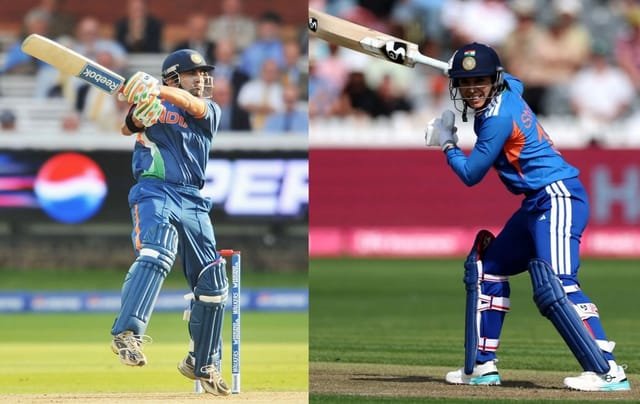
Why This Comparison Actually Matters
At first glance, comparing a current women’s cricketer with a retired men’s coach might seem like an exercise in novelty. But there is a deeper reason this particular comparison carries real weight heading into the 2026 Women’s T20 World Cup.
Gautam Gambhir is not just any former cricketer. He was one of the most reliable and technically sound openers India produced in the T20 World Cup era, anchoring India’s campaign during their triumphant 2007 T20 World Cup run under MS Dhoni. His record across 20 T20 World Cup innings represents a credible, historically significant benchmark.
Smriti Mandhana, on the other hand, is arguably the most complete batter in women’s cricket today. As India’s vice-captain and their most experienced batting presence at the top of the order, she enters the 2026 Women’s T20 World Cup in England carrying the weight of a nation’s T20 trophy ambitions. India have never won the Women’s T20 World Cup. They came closest in 2020, reaching the final in Melbourne before being hammered by Australia by 85 runs.
The Women in Blue changed that narrative in 50-over cricket by winning the Women’s ODI World Cup on home soil in 2025. The T20 title remains the final frontier. Mandhana’s performances could define whether India finally cross it.
So how does she measure up against Gambhir’s benchmark after 20 innings in the tournament? The answer is nuanced, competitive, and genuinely revealing.
Overall Stats After 20 T20 World Cup Innings: Gambhir Edges It, But Not by Much
The headline numbers show Gambhir ahead across most categories, but the margins are closer than many might expect.
After 20 T20 World Cup innings, Mandhana had accumulated 447 runs at an average of 23.52 and a strike rate of 119.51, with three half-centuries and a highest score of 87. Gambhir, across his 20 T20 World Cup innings, scored 524 runs at an average of 26.20 and a strike rate of 118.01, with four half-centuries and a highest score of 75.
| Player | Innings | Runs | Average | Strike Rate | Highest Score | 100s | 50s |
|---|---|---|---|---|---|---|---|
| Smriti Mandhana | 20 | 447 | 23.52 | 119.51 | 87 | 0 | 3 |
| Gautam Gambhir | 20 | 524 | 26.20 | 118.01 | 75 | 0 | 4 |
The first thing that stands out is the strike rate comparison. Mandhana’s strike rate of 119.51 is actually marginally higher than Gambhir’s 118.01. This matters enormously in modern T20 cricket, where the tempo an opener sets in the powerplay can define a team’s entire innings. Mandhana scores at a faster rate. Gambhir scored more runs overall across the same number of innings.
The average gap, 23.52 versus 26.20, is meaningful but not dramatic. It reflects Gambhir’s greater consistency in converting starts into substantial scores. He registered four half-centuries to Mandhana’s three, suggesting a slightly superior ability to cash in once set. However, Mandhana’s highest score of 87 eclipses Gambhir’s 75, indicating she is capable of the kind of match-defining individual innings Gambhir never quite produced in the format.
The key takeaway from the overall comparison is that Mandhana and Gambhir are far closer in T20 World Cup output than most people would instinctively assume. Gambhir scores more. Mandhana scores faster. Both are openers who peak against the highest-quality opposition.
Head-to-Head Against Top Opponents: Mandhana Shines Against Australia
Overall averages tell one story. How a batter performs against the best opposition tells another, more revealing one.
Against Australia, Mandhana’s T20 World Cup record across three innings reads 104 runs at an average of 34.66 and a strike rate of 140.54. Those are exceptional numbers against the most dominant team in women’s T20 cricket history. Her strike rate of 140.54 against Australia in particular signals a batter who does not shrink when the stage is largest. She attacks.
Against England, Mandhana scored 99 runs across four innings at an average of 24.75 and a strike rate of 117.85. Competent numbers in conditions that often favor the home side, and particularly relevant given that the 2026 Women’s T20 World Cup is being held in England and Wales.
For Gambhir, his standout returns came against England and Pakistan. Against England, he scored 129 runs across three innings at an average of 43 and a strike rate of 122.85. Against Pakistan, across three innings, he made 75 runs at an average of 25 and a strike rate of 127.11, including his famous 75 in the 2007 final.
The Australia comparison here is particularly striking. Mandhana’s strike rate of 140.54 against Australia dwarfs Gambhir’s recorded returns against England, his best opponent. She is at her most dangerous when India need her most. That is the mark of a big-match temperament.
Performance in Wins: Gambhir Was the More Consistent Match-Winner
Separating performance in wins from overall numbers is one of the most useful ways to assess a batter’s true impact on results. A player who scores big only in comfortable victories contributes differently from one who builds winning platforms under pressure.
In 12 wins across her first 20 T20 World Cup innings, Mandhana scored 305 runs at an average of 27.72 and a strike rate of 125.51, with two half-centuries. In eight losses, she managed 142 runs at an average of 17.75 and a strike rate of 108.39.
Gambhir, in 11 wins, accumulated 330 runs at an average of 30 and a strike rate of 117.02, with three half-centuries. In eight losses, he still contributed 194 runs at an average of 24.25 and a strike rate of 122.01.
| Player | Wins | Runs in Wins | Average in Wins | Strike Rate in Wins | 50s in Wins |
|---|---|---|---|---|---|
| Smriti Mandhana | 12 | 305 | 27.72 | 125.51 | 2 |
| Gautam Gambhir | 11 | 330 | 30 | 117.02 | 3 |
Gambhir’s win record is superior in average terms, but Mandhana’s strike rate in wins (125.51) surpasses Gambhir’s (117.02) by a significant margin. This reflects an important generational shift in how T20 openers are expected to bat. Gambhir’s era rewarded careful accumulation and building the innings. Mandhana’s era demands acceleration from ball one.
The more revealing figure is what happens in losses. Gambhir maintained an average of 24.25 and a strike rate of 122.01 even in defeats, suggesting he performed regardless of the result. Mandhana’s numbers drop sharply in losses: average 17.75, strike rate 108.39. This points to a pattern worth noting. When India struggle collectively, Mandhana tends to struggle alongside them. Her performances are more team-dependent, which is not uncommon for openers who rely on partnerships to build momentum.
The Knockout Comparison: Where the Real Gap Emerges
Nothing separates good players from great ones quite like knockout cricket. The pressure multiplies. The margins shrink. The mental demands become as significant as the technical ones. This is where the comparison between Mandhana and Gambhir becomes most instructive.
In two knockout matches across her first 20 T20 World Cup innings, Mandhana scored 45 runs at an average of 22.50 and a strike rate of 145.16. The scores were 34 off 23 against England in the 2018 semifinal and 11 off eight in the 2020 final against Australia.
Gambhir, also in two knockout matches within his 20-innings window, scored 99 runs at an average of 49.50 and a strike rate of 125.31, including his iconic 75 off 54 against Pakistan in the 2007 final and 24 off 25 in the semifinal against Australia.
| Player | Knockout Innings | Runs | Average | Strike Rate | Highest Score | 50s |
|---|---|---|---|---|---|---|
| Smriti Mandhana | 2 | 45 | 22.50 | 145.16 | 34 | 0 |
| Gautam Gambhir | 2 | 99 | 49.50 | 125.31 | 75 | 1 |
Gambhir’s knockout numbers are in a different category. His average of 49.50 across the two matches, anchored by his match-defining 75 in the 2007 final, reflect a batter who produced his absolute best when the stakes were at their highest. That innings against Pakistan in Johannesburg remains one of the finest displays of composed, pressure-proof batting in T20 World Cup history.
Mandhana’s knockout record, while limited to just two matches, shows the area where she has most room to grow. Her strike rate of 145.16 suggests she is not playing cautiously when the moment demands boldness. But the volume of runs has not yet matched the intent. The 2026 Women’s T20 World Cup in England offers the perfect stage to rewrite that chapter.
Gambhir’s knockout average of 49.50 versus Mandhana’s 22.50 is the most significant gap in this entire comparison. It is also the most important benchmark for Mandhana heading into England. Can she produce a tournament-defining knockout innings the way Gambhir did in 2007? That question will define India’s T20 World Cup campaign.
The Context That Stats Cannot Fully Capture
Numbers are essential but incomplete. A few pieces of context make this comparison richer than the spreadsheet alone can convey.
First, the eras are different. Gambhir played in the earliest T20 World Cups, when field restrictions, bowling strategies, and pitch preparation were all less refined. Scoring 118 at a strike rate of 118 in 2007 was a significantly different proposition than doing so in 2024 or 2026, when bowlers are more tactically sophisticated, pitches are more carefully curated for big tournaments, and fielding standards have risen dramatically.
Second, the team contexts differ. Gambhir batted in a men’s side that, during his peak T20 World Cup years, featured MS Dhoni, Yuvraj Singh, and Rohit Sharma in the middle order. The batting safety net below him was substantial. Mandhana often bats knowing that India’s middle order in the women’s game, while improving, is still developing the depth and experience needed to consistently rescue difficult situations.
Third, and most importantly, Mandhana is still active. She has the opportunity to add to and improve every number in this comparison. Gambhir’s record is complete and historical. Mandhana’s is ongoing.
What This Means for India’s 2026 Women’s T20 World Cup Campaign
India head into the 2026 Women’s T20 World Cup in England and Wales on June 12 with genuine trophy ambitions. The ODI World Cup victory in 2025 proved this generation has the mental makeup to win major tournaments. The T20 format demands a different kind of cricket, faster and less forgiving, but the core ingredients of belief and talent are clearly present.
Mandhana’s role will be central. She bats at the top, she is the most experienced T20 batter in the squad, and she has a proven record of performing against the best teams in the world. Her numbers against Australia, 34.66 average and 140.54 strike rate, suggest that when the biggest challenges arrive, she rises to meet them.
The one area where she will look to improve her legacy in this tournament is knockout performances. One defining innings in a semifinal or final would do more than anything else to cement her place among the all-time great T20 World Cup openers, regardless of gender.
England’s conditions, with their pace-friendly surfaces and overcast skies, will test her technique off the pitch. But Mandhana’s record shows she is comfortable adapting. In four innings against England in T20 World Cup cricket, she averaged 24.75 and struck at 117.85. Those are solid foundations to build on in a home tournament for the hosts.
Conclusion: Closer Than the Numbers Suggest, With More to Come
After 20 T20 World Cup innings, Gautam Gambhir holds a statistical edge over Smriti Mandhana in total runs, average, and number of half-centuries. His knockout record, anchored by a legendary final innings in 2007, stands in a class of its own within this comparison.
But the margins across most categories are narrower than most people expect. Mandhana scores faster than Gambhir did at the same stage. She has a higher individual best score. Her record against Australia, the dominant force in women’s T20 cricket, is genuinely impressive.
Most importantly, Mandhana’s story is not finished. Every additional innings she plays in this tournament is a chance to add to these numbers, to close the gaps, and ultimately to write a T20 World Cup chapter that belongs entirely to her.
The 2026 Women’s T20 World Cup in England begins June 12. India need Mandhana to be at her best. Based on everything her record tells us, there is every reason to believe she will be.
For breaking news and live news updates, like us on Facebook or follow us on Twitter and Instagram. Read more on Latest Sports on thefoxdaily.com.


COMMENTS 0