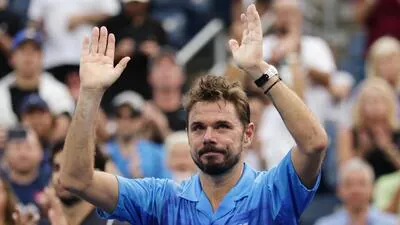
Stan Wawrinka’s final Grand Slam appearance at the 2026 US Open marked the closing of an extraordinary chapter in men’s tennis. The 41-year-old Swiss lost to Matteo Berrettini in the first round, ending his career at the sport’s four major tournaments with a farewell that reflected the respect he earned over two decades.
Wawrinka entered the tournament knowing that this would be his last opportunity to compete at a Grand Slam. His defeat was therefore not simply another first-round result. It was the final major match of a career that repeatedly challenged the established order during one of the strongest eras tennis has ever seen.
The Swiss star was scheduled to retire at the end of the 2026 season, making the US Open his final Grand Slam stop. His participation was itself significant because he initially appeared unlikely to receive a wild card. Eventually, he was given the opportunity to return to New York and finish his Grand Slam journey on his own terms.
His farewell also highlighted a fascinating truth about Wawrinka’s career: he never needed to dominate tennis for an entire decade to become one of its most memorable champions.
Wawrinka’s final US Open match was about more than the result
Wawrinka lost 6-7(4), 6-7(3), 0-6 to Berrettini in his final Grand Slam match. The scoreline showed a difficult ending, but the atmosphere around the match told a different story.
The Swiss received a standing ovation from the crowd after the contest. A video montage and specially prepared photographs were also used to celebrate his career.
His match was played on the Grandstand court, which seats around 8,125 spectators and is the third-largest stadium at the Billie Jean King Tennis Center.
That setting was fitting in an unexpected way.
Wawrinka spent much of his career away from the spotlight occupied by the biggest stars. He was never the permanent centre of attention in the way Roger Federer, Rafael Nadal or Novak djokovic were. Yet he repeatedly found ways to create unforgettable moments on tennis’s biggest stages.
The late bloomer who refused to disappear
Wawrinka was born into the same broad generation as the Big Three, but his career initially looked very different from theirs.
While Federer, Nadal and Djokovic were collecting major titles and establishing themselves as the dominant forces in men’s tennis, Wawrinka spent years trying to move closer to the highest level.
His natural weapons were obvious. His one-handed backhand became one of the most recognisable and powerful shots in modern tennis, while his aggressive baseline game allowed him to attack opponents with tremendous force.
But having the tools and consistently using them against the best players are two very different things.
Wawrinka eventually developed the mental approach required to turn his ability into Grand Slam success. His career became an example of what can happen when a player does not treat early failures as proof that the ceiling has already been reached.
The three Grand Slam titles that changed everything
Wawrinka finished his career with three Grand Slam singles titles, and each one came with a remarkable detail: he defeated the reigning world No.1 in the final.
2014 Australian Open: Defeating Rafael Nadal
Wawrinka won his first Grand Slam title at the Australian Open in 2014. His victory became even more significant because Rafael Nadal was his opponent in the final.
It was the breakthrough moment that transformed Wawrinka from a respected tour professional into a Grand Slam champion.
2015 French Open: Overcoming Novak Djokovic
A year later, Wawrinka produced another extraordinary upset at Roland Garros. Novak Djokovic entered the 2015 French Open final in outstanding form and was chasing the title that had eluded him.
Wawrinka came from a set down to defeat Djokovic and claim his second major championship.
The victory demonstrated that his Australian Open triumph had not been a one-time surprise. He could produce elite tennis against the very best players when the pressure was at its highest.
2016 US Open: Beating Djokovic again
Wawrinka completed his Grand Slam collection at the 2016 US Open.
Once again, Djokovic stood across the net in the final. Wawrinka won in four sets to claim his third major title.
The achievement gave his career a remarkable pattern. Each of his three Grand Slam victories came against a reigning world No.1.
| Grand Slam | Year | Final opponent | Career significance |
|---|---|---|---|
| Australian Open | 2014 | Rafael Nadal | First Grand Slam title |
| French Open | 2015 | Novak Djokovic | Second major and proof of consistency |
| US Open | 2016 | Novak Djokovic | Third Grand Slam title |
Why Wawrinka’s record is more impressive than the numbers suggest
Three Grand Slam titles may appear modest when compared with the extraordinary totals accumulated by Federer, Nadal and Djokovic. That comparison, however, can obscure what made Wawrinka special.
He competed during an era in which three historically great players occupied the top of men’s tennis for years.
Winning one Grand Slam during that period was difficult enough. Wawrinka won three, and he did so by defeating two members of the Big Three in major finals.
His career therefore demonstrates an important distinction between consistency and peak performance.
Federer, Nadal and Djokovic combined extraordinary peaks with remarkable consistency. Wawrinka’s path was different. He was capable of reaching an exceptionally high level when everything came together, and that level was good enough to defeat the best players in the world.
His highest ranking was world No.3, but his influence cannot be measured by that number alone.
The one-handed backhand became his signature weapon
One of the defining features of Wawrinka’s tennis was his one-handed backhand.
In an era increasingly dominated by powerful two-handed backhands, Wawrinka’s shot stood out because of its combination of pace, control and attacking intent.
It was not merely a stylish stroke. It was a major tactical weapon.
Against elite opponents, Wawrinka could use the backhand to redirect pace, attack from the baseline and change the direction of rallies. When he was playing at his best, the shot helped him turn defensive situations into attacking opportunities.
That made Wawrinka particularly dangerous against players who normally controlled rallies through their own consistency.
‘Stan the Man’ became more than a nickname
Wawrinka’s popularity also extended beyond Grand Slam statistics.
The nickname “Stan the Man” became closely associated with him, reflecting both his personality and the memorable tennis he produced during his best years.
His popularity was particularly visible at the Chennai Open, where he won four titles. Fans embraced him strongly, and his merchandise became a familiar sight around the tournament.
That connection with supporters was still visible during his final US Open appearance, with fans wearing Wawrinka shirts as they watched his farewell.
It showed that a player does not need to spend years as world No.1 to build a lasting relationship with tennis audiences.
The philosophy behind Wawrinka’s longevity
One of the most revealing parts of Wawrinka’s career was his attitude toward losing.
His approach was built around accepting defeat as part of professional sport rather than treating every loss as evidence of failure.
That philosophy helped explain why he was able to continue competing for so long, even after the peak years of his career had passed.
Instead of measuring himself only against trophies or rankings, Wawrinka focused heavily on improving weaknesses and understanding what each defeat could teach him.
That mindset is particularly valuable in tennis because professional players inevitably lose far more matches than casual observers might imagine. Even elite champions cannot win every week.
Wawrinka’s career demonstrated that resilience does not necessarily mean avoiding failure. Sometimes it means learning how to respond to it.
His career offers a different lesson from the Big Three
The obvious comparison is between Wawrinka and Federer, Nadal and Djokovic, but the more interesting lesson comes from the differences between them.
| Career model | Defining characteristic | Wawrinka’s difference |
|---|---|---|
| Roger Federer | Exceptional consistency and attacking elegance | Wawrinka was less consistent but produced a similarly dangerous peak level on his best days |
| Rafael Nadal | Relentless intensity and extraordinary Grand Slam dominance | Wawrinka developed later and had a smaller overall trophy haul |
| Novak Djokovic | Elite longevity, consistency and adaptability | Wawrinka relied more heavily on extraordinary peak performances |
This comparison should not be interpreted as ranking the players. Instead, it shows how different routes can lead to a significant legacy.
Wawrinka did not need to replicate the careers of Federer, Nadal or Djokovic to establish his own identity.
Why his US Open farewell was especially meaningful
The US Open carried particular importance for Wawrinka because it was the tournament where he completed his Grand Slam collection in 2016.
Returning to New York for the final major appearance of his career therefore created a natural full-circle moment.
There was also an element of uncertainty before the tournament. Wawrinka had not initially received the wild card he needed to enter the event, raising the possibility that his Grand Slam career could end without one final appearance at the venue where he won his third major.
The eventual invitation gave him the opportunity he wanted.
His farewell speech made clear how much the opportunity meant to him. Rather than focusing on disappointment, Wawrinka expressed gratitude for being able to finish his Grand Slam journey in New York.
That reaction captured the character of his career: competitive when he needed to be, emotional when the moment demanded it and appreciative of the opportunity to keep playing.
The Federer connection adds another layer
Wawrinka’s farewell came shortly after Roger Federer, his Swiss compatriot and Olympic doubles partner, was inducted into the International Tennis Hall of Fame.
The two shared a memorable achievement at the 2008 Beijing Olympics, where they won the men’s doubles gold medal for Switzerland.
Federer and Wawrinka therefore represent two very different versions of Swiss tennis greatness.
Federer became one of the most dominant and globally recognisable players in the history of the sport. Wawrinka, meanwhile, carved out his legacy through spectacular Grand Slam peaks and an ability to defeat the world’s best when the stakes were highest.
That difference makes Wawrinka’s career particularly interesting when assessing the broader Big Three era.
Could Wawrinka enter the International Tennis Hall of Fame?
Whether Wawrinka eventually receives a place in the International Tennis Hall of Fame is not something he appears to have built his career around.
His own comments reflect that attitude. He has repeatedly emphasised playing for himself, giving his best effort and pushing his own limits rather than attempting to control how future generations remember him.
That may ultimately become one of the strongest elements of his legacy.
His résumé includes three Grand Slam singles titles, an Olympic doubles gold medal, a career-high ranking of world No.3 and victories over some of the greatest players ever to compete.
More importantly, his biggest achievements came during an exceptionally difficult competitive era.
The deeper lesson from Stan Wawrinka’s career
Wawrinka’s story offers an important lesson for athletes who do not become superstars in their early twenties.
Professional sport often creates the impression that greatness must arrive quickly. Players are judged by rankings, age and early-career results, while those who develop later can be overlooked.
Wawrinka challenged that assumption.
His greatest period came after years of trying to find the consistency and confidence needed to compete with the very best. Once he found that level, he turned opportunities into some of the biggest victories of his career.
His journey suggests that development is not always linear and that a player’s peak does not necessarily arrive according to a predetermined timetable.
What Wawrinka leaves behind
When Wawrinka finally retires at the end of the 2026 season, his legacy will not simply be the number three next to his name on a list of Grand Slam champions.
It will be the memory of a player who repeatedly challenged the strongest generation men’s tennis had ever seen.
It will be the image of his one-handed backhand producing enormous winners.
It will be the three Grand Slam finals in which he defeated reigning world No.1 opponents.
It will be his determination to continue competing long after his most successful years had passed.
And it will be the respect of fans who recognised that his career was never about being the biggest name in the sport.
Conclusion: Stan Wawrinka’s farewell is the end of a career worth relishing
Stan Wawrinka’s final Grand Slam match was always going to carry emotional weight, but the significance of his career extends far beyond one farewell at the US Open.
He competed alongside Federer, Nadal and Djokovic during their extraordinary era, yet managed to create a completely separate identity. His three Grand Slam titles were not accumulated through years of dominance. They came through moments of extraordinary performance when the pressure was greatest.
He defeated Nadal in Melbourne, Djokovic at Roland Garros and Djokovic again in New York. Each victory against a reigning world No.1 demonstrated just how high Wawrinka’s peak could reach.
His final US Open appearance provided an appropriate ending: a competitive contest, an emotional crowd and a standing ovation for a player who spent two decades repeatedly showing up and pushing his limits.
Wawrinka may never have matched the statistical achievements of the Big Three, but that was never necessary for his career to matter.
His legacy is different.
It is a legacy built on persistence, powerful tennis, late-career determination and the belief that losing is not necessarily the end of the story.
Sometimes, as Wawrinka’s career proved, it is simply another opportunity to learn, return and try again.
For breaking news and live news updates, like us on Facebook or follow us on Twitter and Instagram. Read more on Latest Sports on thefoxdaily.com.




COMMENTS 0