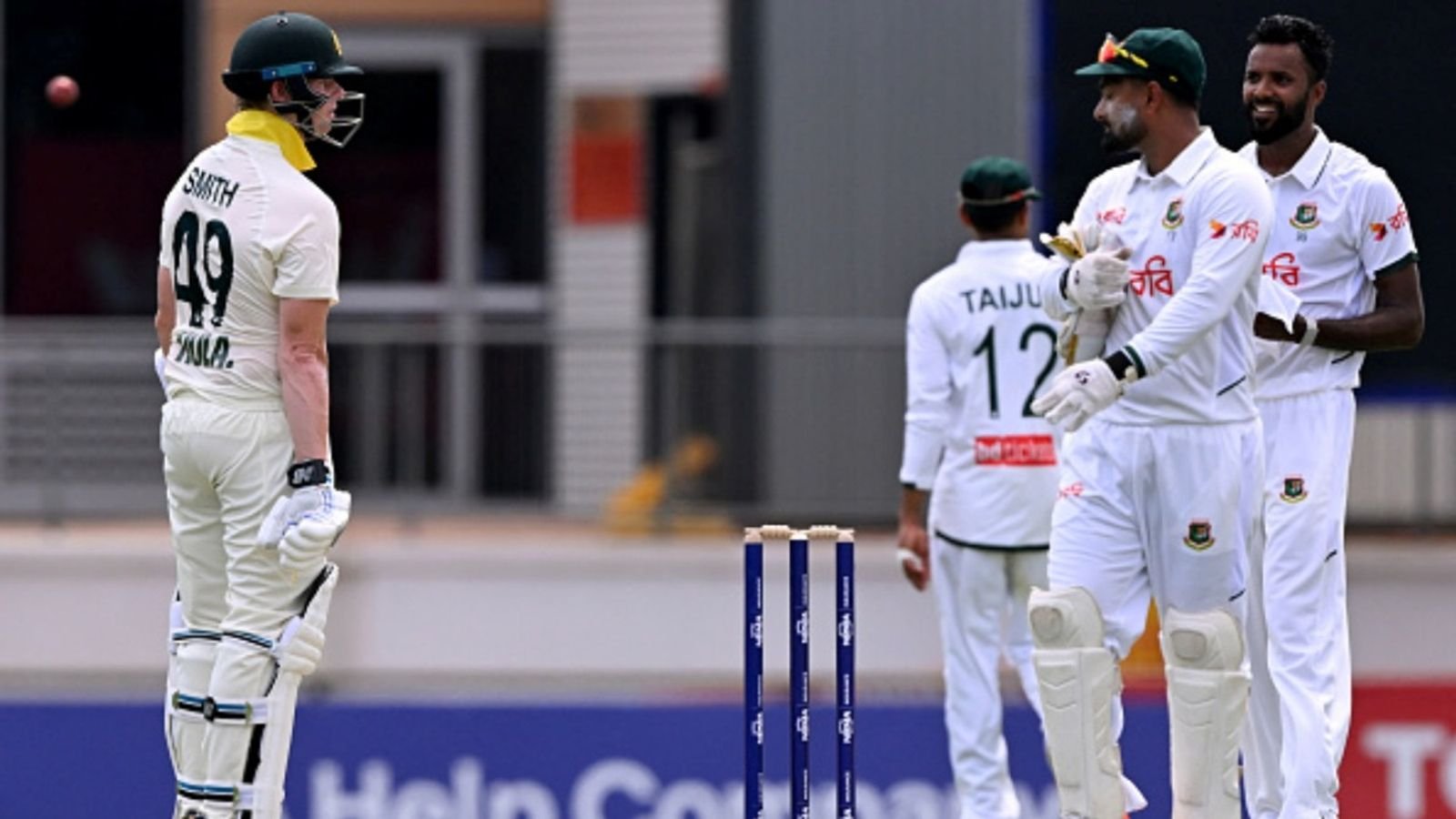
Steve Smith technology became one of the biggest talking points from Day 1 of the Australia vs bangladesh first Test in Darwin. The veteran Australian batter survived a dramatic early dismissal scare against Ebadot Hossain after Bangladesh reviewed an appeal for a catch behind the stumps.
Smith appeared to believe that he had edged the delivery through to wicketkeeper Litton Das. However, Bangladesh captain Najmal Hossain Shanto opted for a review, and UltraEdge failed to provide the evidence required to overturn the decision.
The moment proved extremely valuable for Australia. Smith was batting on only seven runs from 23 balls when the review went in his favour. Instead of returning to the pavilion, he remained at the crease and eventually scored 71 from 109 deliveries.
Smith later admitted that he believed he had nicked the ball and said he would have walked away if the umpire had given him out. His comments added another layer to an incident that highlighted the complicated relationship between player instinct, umpiring decisions and modern cricket technology.
What happened when Steve Smith edged Ebadot Hossain?
The incident occurred during the opening session of the first Test at Marrara Cricket Ground in Darwin. Smith was still finding his rhythm when Ebadot Hossain produced a delivery that appeared to pass extremely close to the outside edge of the Australian batter’s bat.
Litton Das completed the catch behind the stumps and Bangladesh appealed. Smith’s immediate reaction suggested that he was unsure whether he had made contact, and he appeared close to walking away.
Bangladesh, however, did not simply accept the situation. Najmal Hossain Shanto chose to review the decision, bringing the DRS process into play.
The available UltraEdge evidence did not establish the underedge required to overturn the decision. As a result, Smith remained not out and continued his innings.
The importance of the moment became clear later. Smith did not merely survive for a few more balls; he remained at the crease long enough to become Australia’s leading run-scorer in the innings.
Steve Smith admits technology saved him
After the day’s play, Smith was asked directly whether he believed he had edged the ball. His response was remarkably candid. He acknowledged that he felt something but also accepted that the technology had ultimately worked in his favour.
“Technology saved me today, I guess.”
Smith also explained that had the umpire originally raised his finger, he would have walked off the field. That admission is significant because it shows the difference between knowing or suspecting that contact occurred and being officially dismissed.
In professional cricket, the final decision belongs to the umpires and, where applicable, the review system. A batter is not required to make an independent dismissal decision simply because he suspects that the ball touched his bat.
Why UltraEdge was crucial in the Smith decision
UltraEdge is used to assist officials in determining whether the ball has made contact with the bat or another part of the batter’s equipment. It can provide an additional piece of evidence when an appeal involves a possible edge.
The technology is particularly important because an outside edge can happen extremely quickly. The human eye may struggle to determine whether the ball has passed the bat or made the slightest contact before reaching the wicketkeeper.
In Smith’s case, Bangladesh needed the review evidence to demonstrate enough contact to change the original outcome. The available evidence did not provide that confirmation.
This is an important distinction for viewers. The review did not necessarily establish with absolute certainty that Smith had not touched the ball. Instead, the evidence available to the officials was not sufficient to overturn the decision.
Smith turned a lucky escape into a 71-run innings
The reprieve became even more important as Australia’s innings progressed. Smith was on seven when the review went his way, but he gradually settled into the innings and began building Australia’s score.
He reached his 45th Test half-century from 76 balls, showing the patience required to survive Bangladesh’s attack on a challenging opening day.
Smith eventually scored 71 runs from 109 balls, hitting seven fours and one six. His innings ended when he miscued an upper cut against Hasan Mahmud, with wicketkeeper Litton Das completing the catch.
Although Smith did not reach three figures, his contribution was vital because Australia’s other batters struggled to make significant scores.
His innings also demonstrated the value of surviving the difficult opening period of a Test match. A batter can look vulnerable at the beginning and still go on to produce a substantial score if he successfully manages the pressure.
Hasan Mahmud’s historic six-wicket haul overshadowed Smith’s 71
While Smith’s DRS escape attracted attention, Bangladesh’s bowling performance was arguably the biggest story of the day.
Hasan Mahmud claimed six wickets as Australia were bowled out for 198 in 53 overs. The performance was historic for Bangladesh because Mahmud became the first Bangladesh bowler to claim a six-wicket haul on Australian soil.
Mahmud’s spell ensured that Smith’s resistance did not develop into a match-defining hundred. Once Smith departed, Australia were unable to produce another substantial partnership capable of pushing the total beyond 200.
For Bangladesh, this was a major achievement. They were playing away from home against a highly experienced Australian batting unit, yet their bowlers maintained pressure throughout the innings.
Australia’s batting collapse puts Smith’s contribution into perspective
Australia’s final score of 198 demonstrates just how important Smith’s 71 was. His individual contribution represented more than a third of the team’s total.
The contrast between Smith and the rest of the batting order was significant. While the veteran batter managed to absorb pressure and build a substantial innings, Bangladesh’s attack repeatedly found ways to dismiss Australia’s other batters.
This created a situation where Australia’s overall score remained vulnerable despite Smith’s individual success.
| Match factor | Australia | Bangladesh |
|---|---|---|
| First-innings total | 198 all out | 96/1 at stumps |
| Top batting contribution | Steve Smith – 71 | Mominul Haque – 35 not out |
| Major bowling performance | Australia struggled to take wickets | Hasan Mahmud – six wickets |
| Position at stumps | 102-run lead | 102 runs behind |
Bangladesh also benefited from Australia’s fielding mistakes
Australia’s problems were not restricted to their batting performance. They also missed an opportunity in the field when Nathan Lyon dropped Tanzid Hasan Tamim during Josh Hazlewood’s new-ball spell.
That missed chance became another example of the small moments that can influence a Test match. Bangladesh’s batters were able to survive and gradually move their team into a strong position by the end of the day.
Mitchell Starc did provide Australia with an early breakthrough by removing Shadman Islam. However, Bangladesh avoided a major collapse and finished the day with only one wicket down.
Tanzid Hasan Tamim remained unbeaten on 32, while Mominul Haque was unbeaten on 35. Bangladesh reached 96 for one from 24 overs and trailed Australia by just 102 runs.
Smith’s reprieve highlights the changing nature of walking in cricket
The incident has also renewed discussion around the traditional practice of walking.
Cricket has historically had players who voluntarily left the field when they knew they had edged a ball despite the umpire not giving them out. However, walking has never been a universal requirement of professional cricket.
Smith’s situation demonstrates why the debate is complicated. He admitted that he believed he had edged the ball, but he also said he would have walked if the umpire had given him out.
Once the umpire’s decision remained not out and Bangladesh’s review failed to establish an edge, Smith had no formal obligation to leave the field.
The modern DRS era has therefore changed the context. Players now operate within a system where technology can challenge, confirm or leave an on-field decision unchanged.
The biggest lesson: technology and instinct can disagree
The Smith incident provides a fascinating example of what happens when a player’s instinct and technological evidence appear to point in different directions.
Smith’s physical sensation told him that he may have nicked the ball. The review system, however, could not provide enough evidence to overturn the decision.
That does not necessarily mean one side was simply right and the other wrong. A batter can feel contact without knowing exactly what caused it, while technology can sometimes produce inconclusive evidence when the contact is extremely fine.
The final outcome is therefore based on the evidence available within the review system rather than on the batter’s personal belief.
Why Smith’s 71 could become crucial later in the Test
Australia’s first innings total of 198 means every run could become important. Smith’s 71 therefore carries greater significance than it might have in a larger team total.
If Bangladesh eventually build a substantial first-innings lead, Australia’s inability to reach 250 or 300 could become one of the decisive factors in the match.
On the other hand, if Australia’s bowlers quickly remove Bangladesh’s remaining batters, Smith’s innings may prove to have provided enough runs for Australia to remain competitive.
This is what makes Test cricket different from shorter formats. A single early reprieve can have consequences several sessions later.
What Australia need to do on Day 2
- Take early wickets: Australia need to prevent Bangladesh from turning their strong start into a major first-innings lead.
- Improve catching: Missed opportunities such as Lyon’s dropped catch cannot continue if Australia want to regain control.
- Attack with discipline: The bowlers need to maintain pressure without allowing Bangladesh’s batters easy scoring opportunities.
- Build partnerships in the next innings: Australia’s batting unit must provide more support around its senior players.
- Use the advantage of experience: Australia have experienced players who understand how quickly a Test can change after a poor opening day.
What Bangladesh need to do next
Bangladesh are in an encouraging position after the opening day, but the match is far from settled. Their immediate objective should be to convert the 96 for one into a substantial total.
Tanzid Hasan Tamim and Mominul Haque have already negotiated the most difficult phase of the opening day. Their ability to continue batting for a long period could put Australia under considerable pressure.
At the same time, Bangladesh cannot afford to become overly defensive. Australia still possess an experienced bowling attack capable of producing a sudden collapse.
The visitors therefore need to balance patience with scoring intent. The larger their first-innings advantage becomes, the more pressure will eventually return to Australia’s batting lineup.
Steve Smith’s DRS escape could become one of the defining moments
It is impossible to know after only one day whether the Smith review will influence the final result. However, the incident already stands out because it directly preceded an innings that became crucial to Australia’s total.
Had Smith been dismissed for seven, Australia could have been under even greater pressure. Instead, he survived and scored 71, helping Australia approach 200 despite losing wickets regularly.
That makes the episode a perfect example of how Test cricket is shaped by small moments. A dropped catch, a review, a half-century or a missed opportunity can all become significant when viewed across five days.
Conclusion: Technology gave Steve Smith a lifeline, but Bangladesh seized control
Steve Smith’s technology-assisted reprieve became one of the most intriguing moments of the Australia vs Bangladesh first Test. Smith admitted that he felt he had edged Ebadot Hossain but remained at the crease after UltraEdge failed to provide enough evidence to overturn the decision.
He eventually scored 71 from 109 balls, making him Australia’s standout batter as Bangladesh bowled the hosts out for 198.
Hasan Mahmud’s six-wicket haul was the defining bowling performance, while Bangladesh’s batters responded strongly by reaching 96 for one before stumps. Tanzid Hasan Tamim and Mominul Haque remained unbeaten, leaving Bangladesh only 102 runs behind.
The wider significance of Smith’s incident goes beyond one controversial review. It shows how modern Test cricket combines player instinct, umpiring judgment and technology. Smith believed he had made contact, but the available evidence did not support a dismissal.
For Australia, the priority now is to recover control with the ball. For Bangladesh, the opportunity is clear: build a first-innings lead and turn an excellent opening day into a position of genuine dominance.
For breaking news and live news updates, like us on Facebook or follow us on Twitter and Instagram. Read more on Latest Cricket on thefoxdaily.com.






COMMENTS 0