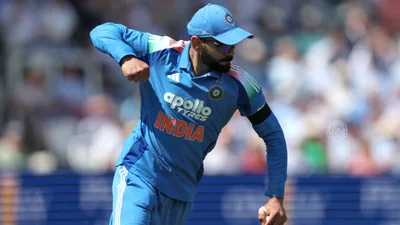
Virat Kohli’s intensity has long been one of the most recognizable features of his cricket, but former India fielding coach T Dilip believes its biggest impact may be on the players around him. According to Dilip, Kohli’s commitment does not disappear when the ball moves away from him, and that constant involvement can push an entire group to operate at a higher level.
Kohli has built a reputation for demanding the highest standards from himself in fitness, fielding and preparation. Even as his international role has evolved, his approach on the field remains aggressive and highly engaged. Dilip’s comments underline why Kohli’s influence cannot be measured only through runs, catches or individual match-winning moments.
The former fielding coach highlighted Kohli’s movement, reflexes, dives and anticipation, but particularly praised what the veteran does when he is not directly involved in a delivery. For India, that kind of example can be extremely important as younger players gradually take on bigger responsibilities.
Why Virat Kohli’s fielding intensity remains so important
Fielding has become an increasingly important part of modern international cricket. Matches can turn on a single saved boundary, a quick stop, a sharp throw or an extra run prevented. Kohli has consistently approached fielding as an active responsibility rather than something secondary to batting.
Dilip pointed specifically to Kohli’s work in positions such as cover and short mid-wicket. These areas require rapid reactions because batters can strike the ball with considerable power and give fielders very little time to respond.
What separates Kohli’s approach, however, is the consistency of that intensity. He does not appear to switch on only when the ball is coming toward him. Instead, he remains involved in the play and constantly prepares for what could happen next.
That mindset is particularly valuable in pressure situations. When a batter is searching for quick runs, every fielder needs to anticipate rather than simply react. Kohli’s habits demonstrate that fielding can be about creating pressure even when no spectacular catch or run-out follows.
The overlooked part of Kohli’s fielding game
One of Dilip’s most interesting observations was about Kohli’s work when the ball is nowhere near him. The former coach explained that Kohli can move toward the non-striker’s end to collect a throw and immediately return the ball toward the wicketkeeper.
Such actions rarely become the headline moment of a match, but they reveal a high level of awareness. A fielder who is already moving into position for the next phase of play can potentially prevent an additional run or create pressure on the batting side.
This is an important distinction between reactive and proactive fielding. Reactive fielding begins when the ball reaches a player. Proactive fielding starts before that moment, with the fielder anticipating where the ball could go next.
Kohli’s ability to stay mentally engaged throughout the delivery sequence is therefore part of his wider contribution. Younger players watching him can learn that elite fielding is not simply about athleticism; it is also about concentration and anticipation.
Kohli continues to lead through effort
Dilip also highlighted Kohli’s willingness to continue putting in the work despite being one of the most experienced players in the Indian setup.
The former coach pointed out that Kohli can field at long-on during the final overs and still be among the first players ready to react. Long-on can be an especially demanding position when batters are attempting to attack the boundary, making speed, anticipation and concentration essential.
The significance goes beyond Kohli’s own performance. When an experienced player continues to accept demanding responsibilities, it sends a powerful message to younger teammates.
There is no suggestion that seniority should automatically result in reduced effort. Instead, Kohli’s example reinforces the idea that reputation does not replace preparation. The standards have to be demonstrated repeatedly.
Why Kohli’s practice habits influence the team
Dilip believes one of Kohli’s most valuable characteristics is the similarity between his approach during practice and his approach during matches.
In international sport, it is easy for players to become more intense when the stakes are high. Practice sessions, however, provide the foundation for those performances. If a senior player maintains a serious and competitive approach during training, younger players receive a daily example of what professional preparation looks like.
Dilip’s observation suggests that Kohli does not treat intensity as something reserved for match day. It is part of his normal working method.
That consistency can have a significant effect on team culture. Players who train alongside someone operating at a high level may naturally increase their own effort, concentration and competitiveness.
How one player can influence an entire fielding unit
Dilip described Kohli’s intensity as contagious, and that phrase captures the wider impact of his presence. A fielder does not operate independently in cricket. Every player’s position is connected to what teammates are doing around them.
If Kohli is highly alert, the players around him may also become more attentive. A fast movement toward the ball can encourage quicker support from another fielder. A sharp return can make the entire group aware that every extra run matters.
This creates what can be described as a ripple effect. Kohli does not need to make every stop or catch himself for his influence to be felt. His approach can encourage the other fielders to stretch their own limits.
That is particularly significant for India because the team has increasingly emphasized athletic fielding and fitness as part of its overall cricketing identity.
Kohli’s fitness standards changed expectations in Indian cricket
Kohli’s influence on Indian Cricket extends beyond his performances with the bat. His commitment to fitness helped reinforce a broader cultural change in the national setup.
Indian cricket has increasingly demanded players who can contribute across all three disciplines. Fitness is no longer simply about surviving long spells in the field. It affects running between wickets, recovery, agility, throwing ability and the capacity to maintain concentration during long periods of play.
Kohli became one of the most visible examples of that philosophy. His approach helped demonstrate that physical preparation could become a competitive advantage rather than merely a requirement.
The younger generation entering Indian cricket has therefore grown up in a very different environment. High fitness standards and athletic fielding are now expected at the highest level.
Why Kohli’s influence matters as India’s next generation develops
India’s squad will continue to evolve as established players move toward the later stages of their careers and younger cricketers receive more opportunities. During such transitions, maintaining a strong team culture can be as important as replacing individual skills.
Kohli’s influence provides an example of how experienced players can contribute even when they are not captains. Leadership can come through behaviour, preparation and standards rather than simply through formal authority.
For younger Indian cricketers, sharing a dressing room or field with Kohli offers an opportunity to observe how one of the game’s most successful players approaches seemingly routine moments.
The lesson is particularly relevant in fielding, where concentration can sometimes drop between major events. Kohli’s approach suggests that every delivery deserves attention.
Kohli’s fielding philosophy goes beyond spectacular catches
Cricket highlights often focus on diving catches, direct-hit run-outs and boundary-saving efforts. Those moments are important, but elite fielding involves much more.
Positioning, communication, anticipation and preventing singles can collectively have a major impact on an innings. Kohli’s style demonstrates that a fielder can influence a game without producing a viral highlight.
This is particularly important in modern limited-overs cricket, where batters constantly look for gaps and additional runs. A fielder who closes those opportunities can create pressure that eventually produces a mistake.
Kohli’s intensity therefore has tactical value as well as emotional value. His energy can influence the atmosphere, while his awareness can influence the number of scoring opportunities available to the opposition.
The psychological effect of having Kohli nearby
There is also a psychological dimension to Dilip’s comments. Cricket is a team sport in which body language can quickly spread across a group.
A player who celebrates a sharp stop, immediately backs up a throw or sprints into position communicates urgency to teammates. When that behaviour comes from a senior player, it can carry additional weight.
Kohli’s reputation means younger players already understand his competitive standards. When those standards are reinforced through his actions, the message becomes even stronger.
It can create an environment in which players feel encouraged to compete for every run and every ball rather than waiting for major moments to become involved.
What T Dilip’s comments reveal about Kohli’s lasting legacy
Dilip’s assessment is ultimately about more than Kohli’s fitness or fielding ability. It highlights the difference between individual excellence and influence.
A great player can produce extraordinary numbers. An influential player can also change how teammates approach their own responsibilities.
Kohli has already left an enormous statistical mark on Indian cricket, but comments from coaches such as Dilip suggest that his legacy will also be measured through the standards he helped establish.
His impact can be seen in the expectation that Indian players remain athletic, alert and committed throughout a match. That culture is likely to continue even after the current generation eventually moves on.
Conclusion: Virat Kohli’s biggest contribution may be his example
Virat Kohli’s intensity remains one of his most valuable qualities, and T Dilip’s comments explain why it matters beyond individual performances. His relentless fielding, constant awareness and willingness to work hard continue to set an example for teammates.
The most significant point is that Kohli’s influence does not depend on making a spectacular play. His presence can raise the energy of the players around him, encourage greater concentration and reinforce the standards expected from an Indian cricketer.
As India continues to develop its next generation, that influence could prove to be one of Kohli’s most lasting contributions. Records may eventually be broken, but the culture created by consistent professionalism can remain long after the player who established it has left the field.
For breaking news and live news updates, like us on Facebook or follow us on Twitter and Instagram. Read more on Latest Cricket on thefoxdaily.com.






COMMENTS 0