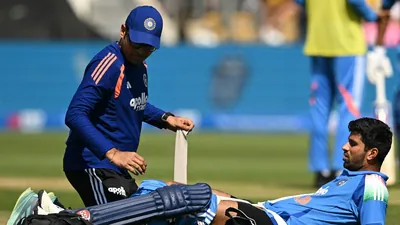
India’s preparations for the decisive third ODI against England have suffered a significant setback after Washington Sundar was ruled out with a hamstring injury. The all-rounder sustained the injury during the second ODI in Cardiff, creating fresh concerns for a touring side that has already battled multiple fitness issues throughout its UK campaign.
The injury comes at a crucial moment. With the three-match ODI series level at 1-1, the final match at Lord’s will determine the winner. Beyond the immediate loss of Sundar’s all-round abilities, his absence has reignited discussions about India’s team balance, bowling combinations, and whether this could finally open the door for Kuldeep Yadav’s return to the playing XI.
For India, the challenge extends beyond replacing one player. It is about finding the right combination capable of succeeding at one of cricket’s most iconic venues while ending a difficult overseas tour on a positive note.
Washington Sundar’s Injury: What Happened in Cardiff?
Sundar’s injury occurred during the second ODI at Sophia Gardens, where he appeared uncomfortable while batting. Hamstring injuries are particularly troublesome for all-rounders because they affect nearly every aspect of performance, including running between wickets, fielding mobility, and bowling rhythm.
Observers noted that Sundar struggled to move freely during his brief stay at the crease. His reduced mobility became apparent as England’s bowlers targeted him with aggressive lengths and short-pitched deliveries.
Eventually, the injury limited his effectiveness and shortened his contribution during a phase when India desperately needed stability in the middle order.
Medical assessments following the match confirmed that the all-rounder would not recover in time for the series decider, forcing India’s management to rethink their strategy for Lord’s.
Why Washington Sundar Has Become So Important to India’s ODI Setup
Over the past few years, Sundar has evolved into one of India’s most valuable utility cricketers. While he may not always dominate headlines, his ability to contribute across multiple disciplines gives captains significant tactical flexibility.
His value comes from three key areas:
- Providing economical spin bowling during the middle overs.
- Adding batting depth in pressure situations.
- Offering balance that allows India to field additional specialist bowlers.
The first ODI of the series perfectly demonstrated his importance. During a tense run chase, Sundar produced a composed unbeaten half-century that helped stabilize the innings after multiple setbacks.
In modern ODI cricket, players who can perform multiple roles are increasingly valuable. Losing such a player shortly before a series-deciding match inevitably disrupts team planning.
India’s Injury Concerns Continue to Grow
Sundar’s setback is not an isolated incident. India’s tour of the United Kingdom has been heavily impacted by fitness concerns.
Several squad members have dealt with injuries during the tour, forcing management to make adjustments across formats.
| Player | Issue | Impact |
|---|---|---|
| Washington Sundar | Hamstring Injury | Ruled out of 3rd ODI |
| Harshit Rana | Hamstring Injury | Missed ODI Series |
| Nitish Kumar Reddy | Injury Before Series | Replaced in Squad |
| Multiple Players | Workload Management Concerns | Selection Adjustments |
Such recurring injuries raise broader questions about workload management, scheduling pressures, and the physical demands of modern international cricket.
Kuldeep Yadav’s Opportunity Finally Arrives?
Perhaps the biggest talking point emerging from Sundar’s absence is the potential return of Kuldeep Yadav.
The left-arm wrist spinner has remained on the sidelines throughout the ODI series despite many former cricketers and analysts arguing that his skill set could be particularly effective in English conditions.
Unlike traditional finger spinners, Kuldeep relies heavily on deception, drift, flight, and sharp turn. His variations often force batters into mistakes even on surfaces that offer limited assistance.
England’s aggressive batting philosophy can sometimes make them vulnerable to attacking wrist-spin, especially during the middle overs when batters look to maintain scoring momentum.
As a result, Sundar’s injury may inadvertently create the tactical change that many experts have been advocating.
How Kuldeep Could Change India’s Bowling Strategy
If selected, Kuldeep would offer a completely different bowling dimension.
Rather than focusing primarily on containment, India could adopt a more attacking approach aimed at taking wickets during crucial middle-over phases.
His inclusion could help India in several ways:
- Creating wicket-taking opportunities against attacking batters.
- Breaking partnerships when seamers fail to make breakthroughs.
- Adding variation to India’s bowling attack.
- Increasing pressure through unpredictability.
- Reducing England’s ability to settle against spin.
At Lord’s, where conditions often evolve throughout a match, having a bowler capable of producing magic deliveries can be invaluable.
The Tactical Question: Balance or Firepower?
Sundar’s absence creates a classic selection dilemma.
Do India replace him with another all-round option to maintain balance, or do they strengthen one specific department?
Modern ODI cricket increasingly rewards teams that can take wickets consistently. While batting depth remains important, matches are often decided by bowling units capable of creating breakthroughs at key moments.
Given the conditions expected at Lord’s and the nature of England’s batting lineup, India may decide that wicket-taking firepower is more valuable than maintaining a like-for-like replacement.
This strategic decision could ultimately determine the outcome of the series.
Why Lord’s Presents a Unique Challenge
Known as the “Home of Cricket,” Lord’s offers conditions unlike many other venues in England.
The famous slope, changing overhead conditions, and unique dimensions often influence match tactics.
Fast bowlers traditionally enjoy assistance, particularly early in the innings. However, successful spinners have also found ways to exploit pressure created by the venue’s demanding environment.
Captains frequently emphasize patience at Lord’s because momentum can shift rapidly.
For India, adapting quickly to conditions will be essential, especially with a modified team combination.
India’s Tour Has Been More Difficult Than Expected
The ODI series decider arrives against the backdrop of a challenging tour.
Results across formats have highlighted both strengths and weaknesses within the squad.
While there have been impressive individual performances, consistency has often been missing.
The team has experienced:
- Mixed results across formats.
- Injury disruptions.
- Selection debates.
- Questions surrounding middle-order stability.
- Pressure on the bowling attack.
Winning the ODI series would not erase every concern, but it would provide a positive conclusion to an otherwise difficult overseas campaign.
What England Will Be Watching Closely
England’s management will undoubtedly be assessing how India’s balance changes without Sundar.
The all-rounder’s ability to contribute in multiple phases often forces opponents to plan carefully. Without him, England may identify opportunities to target specific areas of India’s lineup.
At the same time, the introduction of Kuldeep or another specialist bowler could create entirely new challenges for England’s batters.
Series deciders frequently come down to adaptability, and both teams will spend significant time evaluating how personnel changes alter the tactical landscape.
The Bigger Picture: Building Toward Future ICC Events
While immediate attention remains focused on the Lord’s decider, every ODI also contributes to India’s preparations for future ICC tournaments.
Selection decisions made now can influence long-term planning.
Management must determine which combinations offer the greatest flexibility, which players can handle pressure situations, and how the squad should adapt when injuries occur.
Sundar’s absence provides an opportunity to test alternative strategies under high-pressure conditions.
Such experiences often prove invaluable during major international tournaments where unexpected setbacks are inevitable.
A Key Insight Many Fans Overlook
Most discussions surrounding Sundar’s injury focus on who will replace him. However, the more important question may be how India adapts strategically.
International cricket is increasingly about squad depth rather than individual stars.
The strongest teams are not necessarily those with the best starting XI. They are the teams capable of maintaining performance levels when injuries strike.
India’s response to this setback could reveal just as much about the team’s future prospects as the result of the match itself.
If the replacement performs effectively and India secures victory, the team management may gain valuable clarity regarding future squad combinations.
Conclusion
Washington Sundar’s hamstring injury is a significant blow for India ahead of the decisive third ODI at Lord’s. His all-round abilities have become an important component of the team’s balance, making him difficult to replace directly.
However, every setback creates opportunity. Kuldeep Yadav now appears poised to receive a chance that many experts believe has been overdue. His inclusion could provide India with greater wicket-taking potential and a fresh tactical dimension against England.
With the series level at 1-1, the stakes could hardly be higher. Lord’s will host not only a series decider but also an important test of India’s adaptability, squad depth, and ability to overcome adversity.
Whether Sundar’s absence proves costly or becomes the catalyst for a successful tactical adjustment will be one of the defining storylines of the final ODI.
For breaking news and live news updates, like us on Facebook or follow us on Twitter and Instagram. Read more on Latest Sports on thefoxdaily.com.






COMMENTS 0