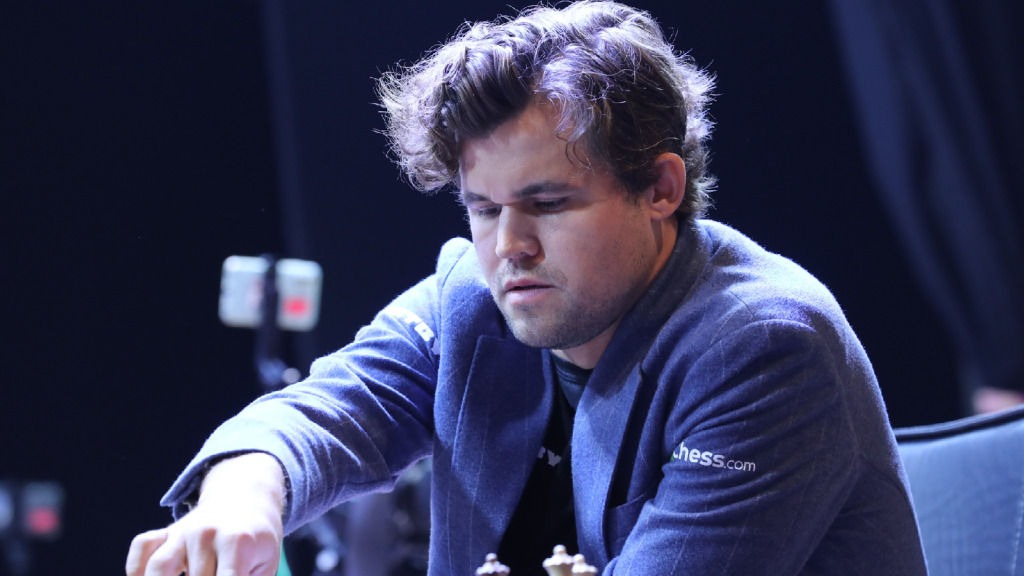
Magnus Carlsen is widely regarded as the greatest active chess player in the world, but even the five-time world champion may not enter the new Total Chess tournament as the clear favourite. The experimental competition, making its debut in Budapest, will bring together 24 elite players to determine who can perform consistently across three different formats: fast classical, rapid and blitz.
The tournament features some of the biggest names in international chess, including Carlsen, Fabiano Caruana, Wesley So, Alireza Firouzja and India’s R Praggnanandhaa, Arjun Erigaisi and Vaishali Rameshbabu. However, the unusual structure of the competition makes predicting a winner particularly difficult.
Total Chess is designed as a test of versatility rather than dominance in a single time control. Players will have to demonstrate their skills across different formats, with the results of the blitz stage playing an important role in determining group positions and seedings. Even the world’s leading players could struggle to navigate the demanding format.
What Makes the Total Chess Format So Difficult?
Total Chess is being introduced as a new way to identify the most complete chess player across three formats. The tournament combines fast classical, rapid and blitz chess, creating a challenge that requires players to adapt their thinking and preparation to different time controls.
The most unusual element is fast classical chess, which gives players 45 minutes on the clock with a 30-second increment after every move. This is significantly shorter than the traditional classical format, where players generally receive around two hours with increments at major competitions such as the World Championship, Candidates, FIDE World Cup and Grand Swiss.
The reduced time available could change how players approach complicated positions. They will need to balance careful calculation with faster decision-making, making the format unfamiliar even for experienced classical specialists.
The overall tournament structure adds another layer of difficulty. Nine rounds of blitz will help determine group placings and seedings. Players will then need to win their respective groups to progress towards the title. That means a strong performance in one format may not be enough if a player struggles in another.
This combination makes Total Chess particularly unpredictable. A player who dominates classical chess could face difficulties in blitz, while someone with exceptional rapid and blitz skills may gain an advantage through the tournament structure.
Praggnanandhaa Explains Why Magnus Carlsen Is Not a Clear Favourite
Indian Grandmaster R Praggnanandhaa believes the format is difficult enough that no single player can be confidently identified as the favourite. Even Carlsen, whose record makes him a leading contender at almost every tournament, will face considerable uncertainty.
Speaking to The Indian Express, Praggnanandhaa explained that the blitz stage could have a major influence on the final outcome because it determines group positions and seedings before players compete to win their groups.
“As far as I have understood the format, I don’t think anyone has a clear way to say that they will make it to the top four. First, blitz plays a major role (because players play nine rounds of blitz on to figure out group placings and seedings). Then you have to win your group. That in itself seems like it’s not given. Even for Magnus, it’s not at all given. It’s a difficult format. Anyone can win the group stage. So I don’t think anyone is like a favorite more than anyone else,” R Praggnanandhaa told The Indian Express.
His assessment highlights the central challenge of Total Chess: consistency across formats. Rather than relying on a player’s reputation or strength in one discipline, the competition will reward those who can adapt to different time controls and handle pressure throughout the event.
Praggnanandhaa Picks Arjun Erigaisi as India’s Strong Contender
Among the Indian players competing in Budapest, Praggnanandhaa believes Arjun Erigaisi has particularly strong credentials because of his performances in faster formats.
Erigaisi has demonstrated his ability in rapid and blitz chess, and Praggnanandhaa pointed out that his compatriot is rated higher than him in both formats. He also highlighted Erigaisi’s medal-winning performances at the 2025 World Rapid Championship and World Blitz Championship.
“Arjun is also really good at all formats. He’s also higher rated than me in rapid and blitz. And of course, he won bronze medals at the 2025 World Rapid Championship and the World Blitz Championship,” says Pragg.
Erigaisi’s experience in faster time controls could prove valuable in a tournament where blitz results influence the group stage. His ability to compete across different formats makes him an important Indian contender alongside Praggnanandhaa and Vaishali Rameshbabu.
However, the unfamiliar fast classical format could still create uncertainty for every participant, including those who have already established themselves in rapid and blitz competitions.
Fast Classical Chess: The Biggest Unknown for Players
While the rapid and blitz formats at Total Chess will not be radically different from those used in existing competitions, fast classical chess presents a new challenge for many of the participants.
Praggnanandhaa admitted that he has little experience playing with the 45-minute time control and 30-second increment. The format is unfamiliar enough that players may need the Budapest pilot event to understand how best to approach it.
“We don’t have much experience of playing this format before. I don’t think I’ve ever played the 45-minute-plus-30 format. It’s going to be interesting. Since this is the first tournament, I don’t think anyone can come up with a good strategy,” said Pragg.
He also confirmed that he had prepared for the competition but expects the first event to provide valuable lessons for future tournaments.
“I’ve done decent prep for the tournament. But I think the first tournament in Budapest will also give us some clarity on how to go about it.”
Because this is the first Total Chess event, players will be learning about the format while competing against some of the strongest opponents in the world. Their performances could help establish which strategies work best under the new time controls.
Total Chess Pilot Event Is a Test Before the 2027 Championship Tour
The Budapest competition is not intended to be a one-off experiment. It is a pilot event designed to evaluate how players respond to the format before organisers launch a larger competition in 2027.
The organisers want to build a Grand Slam-style tour that will eventually culminate in the crowning of a Total World Champion. The pilot will provide an opportunity to assess player feedback and understand how the combined format could work as a major chess event.
Kjell Madland, the CEO of Norway Chess and the person behind the new championship concept, previously described the initiative as an effort to develop the sport for the future.
“We are trying to build something for the future,” Kjell Madland told The Indian Express earlier this year.
The ambition is to create a competition that tests a wider range of chess abilities and potentially attracts new audiences through a faster-paced television product.
Will Total Chess Challenge the Prestige of the Classical World Championship?
The introduction of Total Chess raises an important question about the growing number of world championship titles in the sport. Classical chess already has its established World Champion, while separate World Rapid and World Blitz champions are crowned every year. From 2027, chess will also have a Freestyle World Champion.
The organisers of Total Chess and FIDE have maintained that the new championship will complement the existing titles rather than replace them. The Classical World Championship will continue to hold its position at the top of the traditional chess hierarchy.
Praggnanandhaa also believes that the classical title will remain the ultimate priority for elite players. However, he sees the possibility of Total Chess becoming a regular and respected part of the international chess calendar.
“At least among players, the Classical World Championships will still stand at the top. The focus for all the players will be looking at the Classical World Championship. Because even if you win the Total World Championship, you earn a spot at the Candidates tournament. But maybe this tournament can become a tradition in chess like the World Rapid and Blitz,” R Praggnanandhaa said.
His comments suggest that the new competition is unlikely to replace the importance of the classical title. Instead, it could offer another prestigious challenge for players who want to prove their abilities across multiple formats.
All 24 Players Competing in the Total Chess Budapest Pilot Event
The inaugural Total Chess pilot event will feature 24 players from across the international chess circuit. The lineup includes established world champions, elite grandmasters, rising talents and leading players from India.
- Magnus Carlsen
- Fabiano Caruana
- Wesley So
- Vincent Keymer
- Nodirbek Abdusattorov
- R Praggnanandhaa
- Arjun Erigaisi
- Anish Giri
- Alireza Firouzja
- Jan-Krzysztof Duda
- Liem Le
- Richard Rapport
- Levon Aronian
- Hans Moke Niemann
- Shakhriyar Mamedyarov
- Ian Nepomniachtchi
- Maxime Vachier-Lagrave
- Jordan van Foreest
- Haik M. Martirosyan
- Vladislav Artemiev
- Abhimanyu Mishra
- Andrew Hong
- Bibisara Assaubayeva
- Vaishali Rameshbabu
With Carlsen, Caruana, Praggnanandhaa, Erigaisi and several other top-level competitors in the field, the Budapest event promises a demanding test of all-round chess ability.
Why the Total Chess Pilot Could Be Difficult to Predict
The biggest attraction of Total Chess is also its greatest uncertainty. The tournament does not simply reward the player with the strongest classical record or the highest reputation in international chess. Instead, competitors must navigate a combination of blitz, rapid and fast classical games.
Carlsen remains one of the most formidable names in the field, but the group-stage structure and unfamiliar fast classical format could make his path to the title more complicated than in a conventional tournament. Praggnanandhaa’s comments underline that no participant can be considered a guaranteed finalist.
For Indian Chess, the performances of Praggnanandhaa, Arjun Erigaisi and Vaishali Rameshbabu will be closely watched. Erigaisi’s rapid and blitz credentials could make him particularly dangerous, while the pilot event will give every player an opportunity to discover how well they can adapt to the new format.
Ultimately, the Budapest tournament will serve two purposes: crowning the first winner of the Total Chess pilot and testing whether this ambitious multi-format concept can become a major feature of the chess calendar from 2027.
For breaking news and live news updates, like us on Facebook or follow us on Twitter and Instagram. Read more on Latest Sports on thefoxdaily.com.






COMMENTS 0