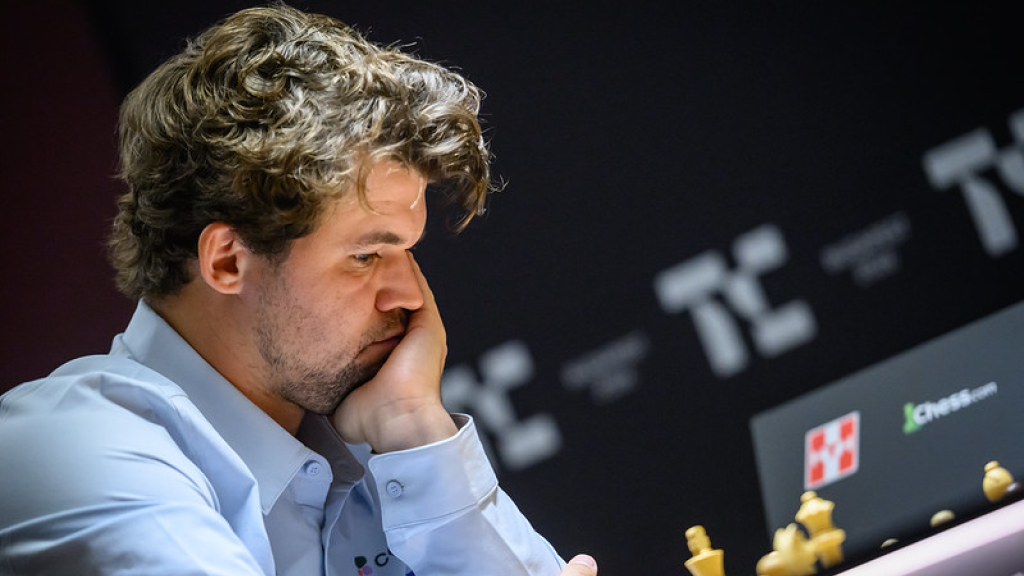
Magnus Carlsen has continued to attract attention at the Total Chess pilot event in Budapest after forfeiting two rapid games against Russian grandmaster Vladislav Artemiev on Thursday. The Norwegian decided to play the four blitz games before skipping the rapid section, saying he wanted to save his energy for the fast classic encounter later in the day.
The decision came after Carlsen faced criticism for skipping fast classic games against Kazakhstan’s Bibisara Assaubayeva during the previous two days. However, his latest move showed that he was willing to approach the tournament’s unusual format differently, even if it meant surrendering valuable points.
Carlsen played the first four blitz games against Artemiev, losing the opening encounter before winning the next three. That gave him a 3-1 lead in the blitz section. He then chose not to return for the two rapid games, allowing Artemiev to collect eight points through forfeits.
The decision significantly changed the match situation ahead of the fast classic game. Artemiev moved into the final encounter with a 9-3 advantage, meaning Carlsen needed to win the eight-point game to avoid losing the match on the opening day. The Norwegian will have another opportunity to change the overall match score when the players return on Friday.
Carlsen explains why he skipped rapid games against Artemiev
Carlsen explained his decision in an interview with Norway’s TV2 after completing the four blitz games. He said that he enjoyed playing blitz but preferred to conserve his energy for the longer fast classic format.
“I’m not coming back until the fast classic. I think it’s fun to play the blitz games, but for the rapid, give or take, I would rather be more rested for the classical,” Carlsen told Norway’s TV2.
The format at the knockout stage of the Total Chess pilot event requires players to face the same opponent in three different time controls. Each match day begins with four blitz games, followed by two rapid games and then a fast classic encounter.
The players return the following day to repeat the sequence, with the colours reversed in the fast classic game. This structure places considerable importance on managing energy and preparing for different time controls within a single match.
Carlsen’s decision to skip the rapid games suggests that he considered the fast classic encounter more important to his preparation. However, forfeiting two games also meant giving Artemiev a substantial points advantage before the final game of the day.
How Carlsen’s forfeits changed the match score
Carlsen entered the rapid section with a 3-1 advantage after winning three of the four blitz games. His decision not to play the two rapid encounters allowed Artemiev to receive eight points by forfeit.
As a result, Artemiev went into the fast classic game with a 9-3 lead. Since the fast classic encounter was worth eight points, the final game became particularly important for both players.
If Artemiev won the fast classic game, he would secure the match on the first day. Carlsen, meanwhile, needed to win the encounter to prevent his opponent from taking the match lead beyond his reach for that day.
Even if the Norwegian lost the opening day’s match, the competition’s two-day structure would give him another opportunity on Friday. The players would return to the board and repeat the format, with the colours reversed in the fast classic game.
The situation highlighted the unusual consequences of the tournament’s scoring system. By choosing not to participate in certain time controls, a player could surrender points while still preserving energy for another part of the match.
Viswanathan Anand questions the tournament’s rules
Carlsen’s decision also raised questions about the regulations governing the Total Chess pilot event. FIDE Deputy President and former world champion Viswanathan Anand expressed surprise that players could choose which games to participate in during an ongoing match.
Speaking to journalists from India, Anand said that he would not have expected such a decision to be possible under the tournament format.
“I wouldn’t even have realized that it was possible to do such a thing (skipping games in a match),” Anand said.
He explained that his natural reaction would have been to attend the scheduled games, even if he had concerns about the format or the conditions.
“It’s like a game day, and my (instinct is) I will go and play. I would have mumbled, I would have complained (about things), but I wouldn’t have (forfeited games).”
Anand’s comments reflected his concern about the possibility of players selectively participating in different sections of a match. He also suggested that the incidents had exposed a weakness in the tournament regulations.
According to Anand, the rules need to be examined and potentially tightened to prevent similar situations in the future.
Anand says Carlsen was not the only player using the rule
Anand also pointed out that Carlsen was not the only participant who had taken advantage of the tournament’s rules. He specifically mentioned Indian-American grandmaster Abhimanyu Mishra and Richard Rapport, who had also used the regulations to skip certain games.
“Not only Carlsen but Abhimanyu Mishra and Richard Rapport also took advantage of the rule. That rule is something we’ll have to tighten. The concept of not playing dead rubbers does exist. Like in the World Championship it doesn’t happen,” Anand said.
The reference to dead rubbers concerns games that cannot change the final outcome of a match or competition. In some formats, players may be permitted to skip contests once the result has effectively been decided.
However, Anand highlighted an important distinction in the Total Chess situation. He noted that players were deciding which games to play even when the overall match had not yet been settled.
He also suggested that Carlsen could have communicated his decision more clearly to Assaubayeva during their earlier encounters.
“It could have been explained more nicely (by Carlsen to his opponent Bibisara). But now we are in a situation where the player is just deciding which game he is going to play and which he isn’t, that too when the match has not been decided at all. You’d have to ask (Carlsen) what exactly he’s showing us.”
Anand’s remarks indicate that the issue extends beyond one player’s decision. The tournament’s format and the freedom given to competitors to skip scheduled games have become central topics of discussion.
Why Carlsen faced criticism after skipping games against Bibisara Assaubayeva
Before his match against Artemiev, Carlsen had already attracted criticism for skipping the fast classic games against Bibisara Assaubayeva on two consecutive days.
Some observers questioned whether the Norwegian was avoiding the longer time control to protect his classical rating. At the time, his rating was hovering just above the 2,800 mark, a significant milestone in elite chess.
Carlsen’s live rating stood at 2,801.2 after he had lost 21 rating points during his week in Budapest. A defeat against Assaubayeva could potentially have pushed him down to second place in the live rankings, with American grandmaster Hikaru Nakamura rising to the No. 1 position.
That possibility led to speculation about whether rating protection had influenced Carlsen’s decision. However, the Norwegian’s stated explanation focused on the match situation rather than his rating.
Carlsen argued that he had already won the matches against Assaubayeva on both days. Because of the points he had accumulated in the other time controls, she could not overtake his total even if she won the fast classic game.
From his perspective, playing the remaining encounter would not have changed the match result. He therefore saw little reason to take part in a game that could potentially affect his classical rating without changing the outcome of the contest.
Nevertheless, the decision generated debate because the fast classic games were part of the scheduled match format. Critics questioned whether players should be able to decide independently which sections they would contest.
Total Chess format brings different time controls together
The Total Chess pilot event in Budapest uses a distinctive format that combines blitz, rapid and fast classic chess within the same match. Rather than competing in only one time control, players must adjust their approach throughout the day.
The structure includes four blitz games, two rapid games and one fast classic encounter. The same sequence is repeated the next day, with the colours reversed in the final game.
This format is designed to test different aspects of a player’s ability. Blitz games demand quick decisions and rapid calculation, while rapid chess provides more time to evaluate complicated positions. Fast classic games place greater emphasis on deeper preparation and sustained concentration.
Managing energy becomes an important part of the competition because players must move between these different formats within a short period.
Carlsen’s decision to skip the rapid games against Artemiev has brought that issue into sharper focus. His explanation centred on being better rested for the fast classic game, while Anand’s response raised questions about whether the rules should allow such selective participation.
What happens next for Carlsen at the Budapest event?
Carlsen’s decision against Artemiev has created an unusual match situation, with the Russian receiving eight points through the rapid-game forfeits. The fast classic encounter then became crucial, as an Artemiev victory would secure the first day’s match.
Friday’s competition will provide another opportunity for Carlsen to respond. The players are scheduled to repeat the same sequence of time controls, with the colours reversed in the fast classic game.
Beyond the immediate result, the tournament organisers may also face questions about whether the regulations need to be changed. Anand’s comments suggest that the current format has exposed a gap that could influence how future matches are conducted.
The issue is particularly significant because the event is a pilot competition. The organisers have an opportunity to examine how the format works in practice and consider adjustments based on the experiences of players and officials.
Conclusion
Magnus Carlsen’s decision to forfeit two rapid games against Vladislav Artemiev has intensified debate at the Total Chess pilot event in Budapest. After winning three of four blitz games, the Norwegian chose to save his energy for the fast classic encounter, allowing Artemiev to take an eight-point advantage through forfeits. FIDE Deputy President Viswanathan Anand questioned the practice and said the tournament rules may need tightening. With Carlsen having previously skipped fast classic games against Bibisara Assaubayeva, the controversy has become a wider discussion about player choices, competitive fairness and the regulations governing the new format.
For breaking news and live news updates, like us on Facebook or follow us on Twitter and Instagram. Read more on Latest Sports on thefoxdaily.com.






COMMENTS 0