
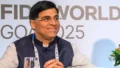
World chess is entering one of its most significant governance moments in recent years, and Viswanathan Anand is once again at the center of the conversation. The five-time world champion, widely regarded as India’s greatest chess player, has unexpectedly emerged as a key figure in the upcoming FIDE elections after a dramatic leadership shake-up within the International Chess Federation.
What initially appeared to be a routine transition toward a new election cycle has transformed into a major governance story with global implications. Following sanctions imposed on FIDE President Arkady Dvorkovich, Anand has stepped into the role of interim president while simultaneously positioning himself for another term as deputy president alongside presidential candidate Timur Turlov.
The development is more than a personnel change. It raises important questions about the future direction of international chess, the increasing role of former champions in administration, and how geopolitical events continue to influence global sporting organizations.
Why Viswanathan Anand’s Return Matters
Viswanathan Anand has already secured his place among the greatest chess players in history. His achievements over multiple decades transformed chess in India and inspired a generation of players who have since become elite grandmasters.
However, Anand’s influence has expanded beyond the chessboard. Since entering chess administration, he has increasingly been viewed as a bridge between players, federations, sponsors, and governing bodies.
His expected return to the FIDE election ticket signals continuity at a time when the organization faces uncertainty. Anand brings credibility, global recognition, and a player-centric perspective that few administrators can match.
For many federations, his presence represents stability during a period when leadership transitions could otherwise create disruption.
The Chain of Events That Changed the Election Landscape
The current situation emerged after sanctions targeting Arkady Dvorkovich created immediate governance challenges for FIDE.
As president of the organization, Dvorkovich had been preparing to seek another term. However, the sanctions significantly complicated his ability to continue leading the federation and campaigning for re-election.
Under FIDE’s governance framework, Anand stepped in as interim president to ensure operational continuity.
The leadership vacuum also prompted Timur Turlov to launch his own presidential campaign, transforming what was expected to be a predictable election into a highly competitive contest.
This sequence of events demonstrates how international sports organizations can be affected by developments far beyond their own competitive arenas.
Timeline of Key Developments
| Event | Significance |
|---|---|
| Anand elected FIDE Deputy President in 2022 | Began his formal leadership role in world chess administration |
| Preparations begin for 2026 FIDE elections | Leadership transition discussions intensify |
| EU sanctions target Arkady Dvorkovich | Creates uncertainty around FIDE presidency |
| Anand assumes interim presidential duties | Ensures continuity of governance |
| Timur Turlov launches presidential campaign | Reshapes the election race |
| FIDE Election scheduled in Samarkand | Member federations prepare to decide future leadership |
How FIDE Has Changed in Recent Years
To understand the importance of the upcoming election, it is necessary to examine how FIDE has evolved over the past decade.
Historically, chess governance was often criticized for political disputes, limited commercial growth, and inconsistent efforts to expand the game’s global audience.
In recent years, however, the federation has focused heavily on modernization.
- Expansion of international tournaments.
- Greater digital integration.
- Growth in online chess engagement.
- Increased sponsorship opportunities.
- Stronger youth development programs.
- Improved global visibility.
The challenge for future leadership will be maintaining this momentum while navigating increasingly complex geopolitical realities.
Why the FIDE Election Is Bigger Than a Leadership Contest
Many sports elections attract attention only within their respective communities. The FIDE election is different because it will influence how chess develops globally over the next several years.
The next administration will oversee critical issues including tournament expansion, technology integration, anti-cheating measures, commercial partnerships, youth participation, and relationships with national federations.
Chess is experiencing unprecedented international popularity. Online platforms have introduced millions of new players to the game, while elite tournaments continue attracting global audiences.
The leaders elected in Samarkand will be responsible for converting that popularity into sustainable long-term growth.
The Anand Factor: Why His Reputation Carries Unique Weight
Few sporting legends successfully transition into governance roles. Anand is among the rare exceptions.
Unlike many administrators who come from business or political backgrounds, Anand understands the realities of professional competition firsthand.
His career spans multiple chess eras—from traditional over-the-board competition to the modern digital age.
This experience gives him unique insight into challenges faced by both elite professionals and emerging talents.
For developing chess nations, Anand also represents proof that a player from outside traditional chess powerhouses can reach the summit of the sport.
That perspective has helped strengthen his global appeal.
India’s Growing Influence in Global Chess
Anand’s rise within FIDE leadership reflects a broader trend: India’s emergence as one of the most influential forces in world chess.
Over the past decade, India has produced an extraordinary wave of grandmasters and elite young talents.
The country now hosts major tournaments, contributes significantly to the global player base, and consistently produces world-class competitors.
Several analysts believe India could become the dominant chess nation of the next generation.
Anand’s leadership role therefore symbolizes more than personal achievement—it reflects the shifting balance of power within the chess world.
Key Challenges Facing the Next FIDE Leadership Team
1. Maintaining Political Neutrality
International sports organizations increasingly face pressure from geopolitical developments. Future leaders must balance governance responsibilities while preserving chess as a global and inclusive sport.
2. Fighting Technological Cheating
Advances in artificial intelligence and digital assistance tools have created new integrity concerns. Anti-cheating measures will remain a top priority.
3. Expanding Commercial Opportunities
Chess has become more marketable than ever before. Securing sponsorships and media partnerships will be essential for long-term growth.
4. Growing Grassroots Participation
Professional success alone is not enough. Future strategies must encourage broader participation among schools, youth players, and developing federations.
5. Strengthening Women’s Chess
Increasing participation and visibility for women’s chess remains a major objective for the global community.
A Comparison With Other Global Sports Federations
Chess is not the only sport facing governance challenges shaped by international politics.
Organizations across football, athletics, swimming, and other disciplines have been forced to adapt to changing geopolitical conditions.
The difference is that chess occupies a unique position as both a competitive sport and an intellectual pursuit with deep international roots.
This makes leadership decisions particularly important because they influence not only competitions but also educational initiatives, cultural exchange programs, and international cooperation.
What a Turlov-Anand Leadership Team Could Mean
If elected, a Turlov-Anand partnership would combine business expertise with chess credibility.
Such a combination could help FIDE pursue commercial expansion while maintaining trust among players and federations.
The arrangement would also provide continuity with recent administrative initiatives while potentially introducing fresh strategic priorities.
Supporters argue that this balance could help chess navigate a rapidly changing global environment.
The Real-World Impact on Players and Federations
For most chess fans, governance discussions may seem distant from everyday competition. In reality, leadership decisions influence nearly every aspect of the sport.
- Tournament opportunities.
- Prize funds.
- Youth development programs.
- National federation support.
- Anti-cheating policies.
- Global rankings and qualification systems.
As a result, the upcoming election will affect not only administrators but also players, coaches, organizers, and fans worldwide.
An Underappreciated Story: Chess Is Becoming a Global Power Industry
One aspect often overlooked in coverage of FIDE elections is the rapid transformation of chess into a major international industry.
Streaming platforms, online tournaments, educational content, sponsorship deals, and digital communities have fundamentally changed the economics of the game.
Modern chess is no longer confined to tournament halls.
It is now part of a global digital ecosystem attracting audiences across continents.
The next FIDE leadership team will play a critical role in determining how successfully chess capitalizes on this opportunity.
What Happens Next?
The focus now shifts to the FIDE Chess Olympiad in Samarkand, where member federations will evaluate competing visions for the organization’s future.
Campaign discussions are expected to center on governance, growth strategies, transparency, technological innovation, and international cooperation.
While election outcomes remain uncertain, Anand’s unexpected return to the leadership race has already become one of the defining stories of the campaign.
Conclusion
Viswanathan Anand’s emergence as interim FIDE president and likely deputy-presidential candidate represents a pivotal moment for international chess. What began as a response to an unexpected leadership challenge has evolved into a broader conversation about governance, modernization, and the future direction of the sport.
As federations prepare to vote in Samarkand, the election will determine more than who occupies the top offices of FIDE. It will help shape how chess grows, innovates, and responds to global challenges during a period of unprecedented popularity.
For Anand, the moment offers another opportunity to influence the game he helped transform as a player. For world chess, it could mark the beginning of a new chapter in an era where leadership, technology, and global expansion are becoming just as important as the moves played on the board.
For breaking news and live news updates, like us on Facebook or follow us on Twitter and Instagram. Read more on Latest Sports on thefoxdaily.com.





COMMENTS 0