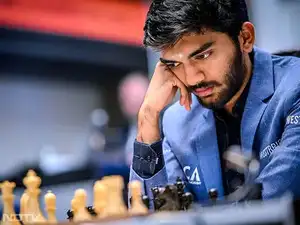
D Gukesh has already achieved what generations of chess players spend their careers pursuing: becoming the world champion. But as he prepares to defend his crown in Geneva, Switzerland, the Indian grandmaster is facing a different kind of test one that began long before the first move of the match.
His opponent, Uzbekistan’s Javokhir Sindarov, arrives after an impressive run that earned him the right to challenge for the title. Meanwhile, some of the sport’s biggest names have questioned Gukesh’s standing, with former world champion Anatoly Karpov describing his 2024 triumph as an accident and five-time champion Magnus Carlsen identifying Sindarov as the favourite.
The 14-game classical match begins on November 24 at the Fondation Martin Bodmer in Cologny, near Geneva. Both players will be 20 when the contest starts, making it the youngest World Championship match in history.
For Gukesh, the challenge is not simply to prove that he can win the title again. It is to demonstrate that his first victory was the product of sustained ability rather than a favourable sequence of circumstances. For Sindarov, it is an opportunity to turn his rapid rise into the biggest achievement in chess.
What makes a champion accidental?
Karpov’s description of Gukesh’s world title as an accident has added an uncomfortable dimension to the build-up. The former Soviet and Russian world champion questioned the circumstances of the Indian’s victory, suggesting that the result did not necessarily establish him as the strongest player in the world.
The remark is provocative, but it also raises a broader question about what a World Championship title represents.
Gukesh won the 2024 championship by defeating China’s Ding Liren in Singapore. The match ended 7.5-6.5 after 14 classical games, with Gukesh securing the decisive victory in the final game after a major error by Ding.
That final result was dramatic, but the title was not awarded through a random draw or an administrative decision. Gukesh had qualified through the Candidates Tournament, earned the right to challenge Ding and then won the match under the official championship rules.
His achievement also made him the youngest undisputed world champion in chess history, at 18. The result placed him in a select group of Indian players to reach the top of classical chess and followed years of development as one of the world’s strongest young grandmasters.
Calling the victory accidental therefore reflects Karpov’s assessment of the circumstances, not the official status of the championship. A single opponent’s mistake can decide a game, but the ability to reach a world title match and convert the opportunity remains part of competitive chess.
There is also an important distinction between winning the world championship and being the highest-rated player. The classical title is decided through a specific qualification and match system, while ratings measure performance across a wider range of tournaments and opponents.
Gukesh’s task in Geneva will be to answer criticism through the same process that earned him the title: playing the games and competing under the rules.
Have we seen this film before?
The pressure surrounding Gukesh is not entirely new. World champions have often entered title defences facing questions about their form, their opponents’ strengths and whether their previous success can be repeated.
The history of chess also shows that a world championship match can produce a different contest from the one suggested by tournament results or pre-match opinions. A player who dominates a tournament may struggle in a long match, while a challenger with less experience can adapt quickly once the games begin.
Gukesh’s own route to the title illustrates how quickly the balance can change. He won the 2024 Candidates Tournament to qualify for the match against Ding Liren, then handled the pressure of a closely contested championship to become the youngest undisputed world champion.
His victory over Ding also demonstrated the importance of endurance and concentration. The Singapore match was tied going into the final game, where Ding’s mistake gave Gukesh the opportunity to secure the title.
Sindarov’s route has been different. The Uzbek grandmaster earned his place as challenger by winning the 2026 Candidates Tournament in Cyprus. His performance established him as one of the strongest contenders in the current generation and gave him a direct opportunity to challenge for the crown.
However, winning the Candidates and winning a World Championship match are different challenges. The Candidates is a tournament in which players face several opponents over multiple rounds. A title match involves an extended head-to-head contest against one opponent, with preparation, opening choices and psychological adjustments becoming central to the result.
That distinction could matter in Geneva. Sindarov’s recent form gives him confidence, but Gukesh has already experienced the unique pressure of playing for the world title.
Why is the champion praising his challenger?
Gukesh has spoken positively about Sindarov, a stance that may seem unusual when a champion is preparing to defend his title. But recognising an opponent’s strengths is not necessarily a sign of weakness. It can also reflect an understanding of the scale of the challenge ahead.
Sindarov has built a reputation for sharp calculation, tactical awareness and energetic play. His success in the Candidates demonstrated that he can handle high-pressure positions and compete consistently against elite opposition.
At just 20, he belongs to the same generation of young grandmasters as Gukesh. Their match is therefore not simply a contest between an established champion and an experienced challenger. It is a meeting between two young players who have already reached the highest level of the sport through different paths.
Gukesh’s public respect for Sindarov also fits the demands of a World Championship match. Underestimating an opponent can be costly, particularly when both players have extensive preparation and the ability to exploit small inaccuracies.
The Indian champion will need to understand Sindarov’s strengths without allowing the growing expectations around the challenger to dictate his own approach. The same applies to Sindarov, who will have to manage the pressure of facing a reigning champion rather than treating the contest as another tournament.
Carlsen’s shadow hangs over the title match
Magnus Carlsen’s comments have become another major talking point in the build-up to Geneva. The five-time world champion has identified Sindarov as the favourite, pointing to the Uzbek player’s more complete game and Gukesh’s recent difficulties in maintaining his best form.
Carlsen has also questioned aspects of Gukesh’s positional understanding and decision-making, arguing that the Indian sometimes evaluates positions too optimistically and takes unnecessary risks.
His assessment carries weight because Carlsen remains one of the strongest players in chess history and continues to compete at the highest level. Although he gave up the classical world championship title in 2023 and did not participate in the subsequent title cycle, his views on elite chess remain influential.
Carlsen has not, however, dismissed Gukesh’s potential. He has acknowledged that the Indian demonstrated an exceptionally high level during 2024 and suggested that a strong start could change the psychological balance of the match.
He has also argued that the word “defend” may place an unnecessary burden on Gukesh. Rather than approaching Geneva as someone with everything to lose, Carlsen suggested that the champion should see the contest as an opportunity to regain the form that made him world champion.
That observation points to one of the central questions of the match: can Gukesh reproduce his best chess when the pressure is at its highest?
Carlsen’s comments are an assessment, not a prediction that determines the result. A 14-game match can be shaped by preparation, a single critical position or a change in momentum. Even a player considered the favourite must still prove it over the board.
So, what are the odds?
Carlsen’s assessment has helped shape the pre-match conversation, with Sindarov receiving considerable attention after his Candidates victory. But assigning a favourite before the first game does not settle the contest.
The official championship format provides for 14 classical games. A player scores one point for a win and half a point for a draw, with the first player to reach 7.5 points winning the match. If the score remains level after all 14 games, a series of rapid and, if necessary, faster time-control games will decide the title.
The format places a premium on consistency. One victory can change the match’s direction, but a player must also avoid unnecessary losses and maintain concentration over several weeks.
There are different strengths on both sides:
- Gukesh’s championship experience: He has already played and won a World Championship match, giving him direct experience of the preparation, pressure and rhythm involved.
- Sindarov’s recent momentum: His Candidates victory and strong performances have established him as a serious challenger with considerable confidence.
- Opening preparation: Both players will arrive with extensive preparation. The ability to introduce new ideas and respond accurately when preparation ends could become crucial.
- Psychological resilience: A difficult position or unexpected result can affect confidence. Recovering quickly from setbacks will be important throughout the match.
Gukesh’s previous championship experience may help him manage the occasion, but it does not guarantee that he will repeat his 2024 success. Similarly, Sindarov’s recent results provide evidence of his strength, but a World Championship match brings a different kind of pressure.
The opening games could be particularly important. An early win would give either player a psychological boost and force the opponent to reconsider the balance between taking risks and protecting the position.
However, the match is long enough for momentum to change. A player who falls behind can still recover, while an early advantage does not automatically secure the championship.
Geneva will test more than chess ability
The 2026 World Championship is significant for another reason: both competitors will be 20 when the match begins. It will be the youngest title contest in the history of the championship, highlighting the extraordinary rise of a new generation of elite players.
For India, Gukesh’s title defence carries considerable attention. His 2024 victory established him as a landmark figure in the country’s chess history, and another successful campaign would strengthen his position among the leading players of his generation.
For Uzbekistan, Sindarov represents an opportunity to bring the world title to a country with a strong and growing chess tradition. His qualification through the Candidates has already made him a central figure in the sport’s next generation.
The match will also provide a test of how the two players respond to the attention surrounding them. Karpov’s criticism, Carlsen’s assessment and the expectations attached to their respective achievements will remain part of the conversation, but none of those opinions can make a move on the board.
Gukesh is not entering Geneva as an accidental champion in the official sense. He earned his title through the established qualification process and a victory over Ding Liren. Whether he can retain it is a separate question that only the match can answer.
Sindarov, meanwhile, has earned his opportunity and will be looking to convert his recent success into a world championship victory.
When the first game begins on November 24, the debate will finally move from predictions and criticism to the chessboard. Gukesh will have the experience of having reached the summit once. Sindarov will have the momentum of a challenger who has fought his way into the title match.
The result will depend on what happens across 14 classical games not on Karpov’s label, Carlsen’s opinion or the expectations surrounding either player.
For breaking news and live news updates, like us on Facebook or follow us on Twitter and Instagram. Read more on Latest Sports on thefoxdaily.com.






COMMENTS 0