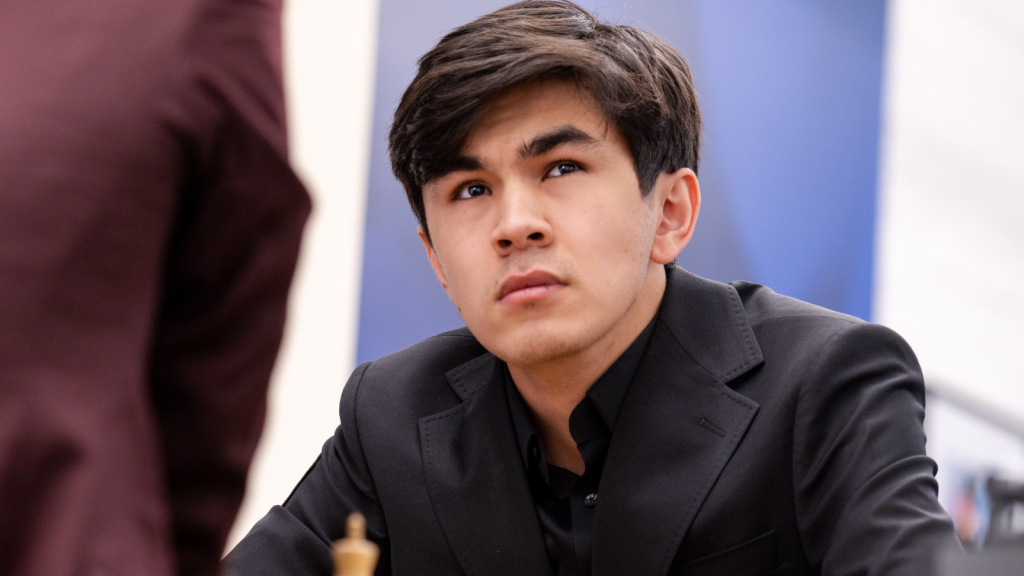
Javokhir Sindarov has taken an unconventional route to the top of world chess, choosing intensive over-the-board training instead of relying heavily on chess engines and computer-generated opening lines. The Uzbek grandmaster’s preparation methods, developed alongside coach Roman Vidonyak, have helped transform him into one of the strongest players in the world and earned him a place in the World Championship match against reigning champion Gukesh Dommaraju.
At the 2026 Candidates Tournament in Cyprus, Sindarov demonstrated the impact of that preparation with a remarkable performance. Just four games into the competition, the 20-year-old had already defeated India’s R Praggnanandhaa and pre-tournament favourite Fabiano Caruana. He was also preparing to face Hikaru Nakamura, whom he went on to defeat in a game that left the American veteran without a playable move for an hour and seven minutes.
Sindarov’s speed, confidence and apparent understanding of the positions made him look several steps ahead of his opponents. His performance stood out in a tournament where the world’s leading players were competing for the opportunity to challenge for the biggest title in chess.
Reflecting on that extraordinary period, Sindarov described a feeling of unusual clarity during his games.
“Somehow in that tournament I felt like I could see the best moves for both sides. I don’t know why,” Sindarov told Chess.com a few months later.
That confidence was not simply a result of natural talent or a sudden improvement in form. Behind it was a demanding preparation system that Sindarov had developed over more than a year, focusing on practical chess skills, calculation and decision-making without depending on computers.
How Roman Vidonyak changed Sindarov’s approach to chess
The foundation of Sindarov’s new training method was established in January 2025, when he formally began working with Munich-based International Master Roman Vidonyak. Their relationship had started a few months earlier, in late 2024, when Vidonyak offered Sindarov a few basic adjustments after their first conversation.
Those early suggestions quickly produced encouraging results. At the Freestyle Chess event in Weissenhaus, Sindarov defeated several leading players, including Magnus Carlsen, Hikaru Nakamura, Levon Aronian and Nodirbek Abdusattorov. He came close to winning the tournament before losing an intense Armageddon game against Caruana.
For Sindarov, the event was an important confidence boost and helped him recognise the value of Vidonyak’s approach.
“I beat Magnus, Hikaru, Aronian, Abdusattorov, everyone there. I was very close to winning the tournament, eventually losing an insane Armageddon game against Fabi. But anyways, I played very well in that tournament and I started feeling very confident in my chess after that,” Sindarov told The Indian Express.
The young grandmaster believes Vidonyak brings something different from what he has experienced with traditional coaches. He specifically highlighted his trainer’s instincts and ability to identify areas that could improve his overall game.
“Roman has something which other coaches maybe don’t have,” Sindarov said.
The partnership eventually developed into a structured training programme. Over the following 16 months, the pair conducted around nine intensive training camps, spending long hours working through chess positions on a physical board without a computer in sight.
Training sessions lasting up to 10 hours
One of the most striking aspects of Sindarov’s preparation was the amount of time devoted to training. Rather than limiting their work to occasional sessions or focusing exclusively on opening preparation, Sindarov and Vidonyak committed to long days of practical exercises.
Sindarov revealed that they worked for more than 80 days during the previous year, with the total possibly reaching 100 days. On training days, sessions generally lasted between seven and 10 hours.
“We worked more than 80 days in the last year. Maybe even more, like 100, I didn’t calculate. Every time we work, every day we work at least seven, eight to ten hours,” Sindarov told this newspaper.
He explained that the benefits of this workload became increasingly clear as he competed in major tournaments. Repeated practice helped him develop confidence across different types of positions, including situations that demanded accurate calculation, defensive resilience and strong endgame technique.
Recalling his performances at important events, Sindarov said he began to feel that he had fewer weaknesses and could handle different challenges on the board.
“When you work a lot with chess, after many tournaments you start to feel this power. In an important tournament like the World Cup, I started feeling like I didn’t have any weaknesses and I was playing well everywhere. That was probably one of my best tournaments.”
The training system was not built around memorising thousands of computer-generated opening variations. Instead, Vidonyak divided chess into 17 specific skills and created exercises to improve each one. These included defensive endurance, calculation speed, positional understanding and what the coach described as “hand intuition” the ability to identify a suitable positional move quickly.
The pair developed thousands of manual exercises covering different phases and situations in a game. The objective was to strengthen Sindarov’s practical decision-making so that he could recognise patterns and respond confidently without needing constant computer assistance.
Why Sindarov trained without chess engines
Chess engines have become an important part of modern elite preparation. Top players regularly use powerful computer programmes to analyse positions, identify the strongest moves and prepare deep opening variations. However, Sindarov and Vidonyak chose to place greater emphasis on direct board work.
Their method involved solving puzzles and analysing positions manually. The exercises covered endgames, middlegames, tactical traps and time management, allowing Sindarov to develop skills that could be applied across different tournament situations.
Sindarov explained that the pair generally worked over a physical board without an engine. Vidonyak would provide a large number of exercises designed to improve different parts of his game.
“Normally we are working only over the board without an engine. He just gives us a lot of puzzles. There are many puzzles for everything: for the endgame, for the middlegame, for some traps, and we even have exercises for time management. We work on all of these small things, and I think all of these small things help in big games.”
This approach was intended to develop independent thinking rather than make Sindarov dependent on computer evaluations. By repeatedly solving practical positions, he could improve his ability to identify candidate moves, calculate variations and make decisions under pressure.
It also helped address one of the most important challenges in competitive chess: knowing when to spend time calculating deeply and when a position calls for a straightforward decision.
How time-management training helped Sindarov
Time management became a particularly important part of the programme. Strong players can sometimes find themselves in difficult situations on the clock after spending too long considering routine positions. Sindarov’s training was designed to reduce that problem.
Through repeated exercises, he worked on recognising familiar patterns and separating ordinary decisions from genuinely critical moments. This allowed him to avoid using excessive time on standard middlegame moves and preserve more time for positions where precise calculation could determine the result.
The ability to manage the clock is especially valuable in elite tournaments, where players often face complicated positions against opponents who are equally capable of finding strong moves. A player who spends too much time early in a game can be forced into rushed decisions later, even when the position remains competitive.
By practising time-management situations during training, Sindarov aimed to make his decision-making more efficient. The method helped him approach difficult positions with greater control and avoid unnecessary time pressure.
Vidonyak says Sindarov still has room to improve
Despite Sindarov’s rapid rise and impressive results, Vidonyak has maintained demanding standards when evaluating his student’s progress. The coach assesses players across individual chess skills using a grading system that ranges from C-minus to A-plus.
Under this system, students are expected to master particular areas before moving on to others. Vidonyak believes that even a player competing at the highest level must continue improving rather than assume that success means every part of their game is complete.
By his assessment, Sindarov still has considerable work to do. Vidonyak told ChessBase India that the young grandmaster had not yet reached the A-minus level and currently stood at B, while retaining the potential to improve across every skill.
“At this moment, not even A-minus. He is at B right now. But he has the potential to go ahead in every skill,” Vidonyak told ChessBase India.
Sindarov agreed with much of his coach’s assessment, although he did not accept every part of it. He acknowledged that there were several areas in which he could continue developing his game.
“I don’t agree with all of his words, but I agree with most, maybe 90 percent. I think I have a lot of things where I can really improve my chess.”
The exchange reflects the approach behind their partnership: even after major tournament victories and a significant rise in the world rankings, the focus remains on identifying weaknesses and improving individual skills.
Sindarov’s major tournament results under Roman Vidonyak
The results achieved since Sindarov began working with Vidonyak in January 2025 demonstrate the scale of his progress. His performances across classical, rapid, blitz and team competitions have established him as a consistent contender at the highest level.
- Freestyle Chess Grand Slam, Weissenhaus (February 2025): Finished second.
- TePe Sigeman & Co, Malmö (May 2025): Won the tournament.
- UzChess Cup Masters, Tashkent (June 2025): Tied for first place.
- FIDE Grand Swiss, Samarkand (September 2025): Finished in the top 25 with 6.5 points from 11 games.
- FIDE World Cup, Goa (November 2025): Won the tournament.
- Tata Steel Chess Masters, Wijk aan Zee (January 2026): Finished second with 8.5 points from 13 games, remaining undefeated.
- FIDE Freestyle World Championship, Weissenhaus (February 2026): Finished seventh.
- FIDE Candidates Tournament, Cyprus (March–April 2026): Won with 10 points from 14 games, without losing a game.
- Superbet Chess Classic, Romania (May 2026): Finished in the middle of the standings, ending his 53-game classical unbeaten streak.
- Daniel Naroditsky Memorial, Charlotte (July 2026): Won both the rapid and blitz competitions.
- 46th Chess Olympiad, Samarkand (September 2026): Helped his team win gold and earned individual bronze on Board 2.
- Clutch Chess Champions Showdown, St. Louis (October 2026): Finished second.
The list includes victories and strong finishes against some of the world’s leading players. His success at the 2025 World Cup and the 2026 Candidates Tournament proved particularly important in his journey towards a World Championship opportunity.
Rating jump and 53-game unbeaten run
Sindarov’s improvement has also been reflected in his FIDE rating. When he began working with Vidonyak in January 2025, his rating stood at 2692. By October 2026, he had gained 90 Elo points, reaching a career-high rating of 2782 and becoming World No. 4 on the FIDE rating list.
Another major achievement was his 53-game unbeaten run in classical chess. The streak stretched across the 2025 World Cup, the 2026 Tata Steel Chess Masters and the 2026 Candidates Tournament.
Such consistency against elite opposition underlined his development as a player capable of competing at the highest level. Although the streak eventually ended at the Superbet Chess Classic in Romania, it remained one of the defining achievements of his rise.
A new challenge awaits against Gukesh
Sindarov’s preparation methods and tournament performances have now taken him to the biggest challenge of his career: a World Championship match against Gukesh Dommaraju. The Uzbek grandmaster will face the reigning champion after establishing himself as the winner of the 2026 Candidates Tournament.
His journey offers an alternative perspective on how elite chess players can prepare for major competitions. While computer engines remain central to modern chess analysis, Sindarov’s work with Vidonyak demonstrates the value they place on practical exercises, independent calculation, pattern recognition and long hours of over-the-board training.
The approach has not eliminated the need for further improvement. Both coach and player acknowledge that there are still weaknesses to address, even after the achievements of the past two years. That continued focus on development could be important as Sindarov prepares for the demands of a World Championship match.
For now, his rise shows how a carefully structured training system, combined with talent and commitment, can produce remarkable results. Rather than relying solely on computer preparation, Sindarov and Vidonyak built their partnership around mastering the smaller skills that decide major games. Those hours spent solving positions on a physical board have helped turn the 20-year-old into Gukesh’s next challenger.
For breaking news and live news updates, like us on Facebook or follow us on Twitter and Instagram. Read more on Latest Sports on thefoxdaily.com.






COMMENTS 0