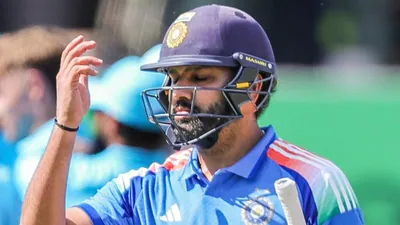
Every great sporting career eventually reaches a crossroads. For some athletes, the moment arrives suddenly through injury or loss of form. For others, it emerges gradually as a new generation pushes forward and teams begin planning for the future.
Rohit Sharma appears to be confronting exactly such a moment.
Reports suggesting that the veteran opener is no longer part of India’s roadmap for the 2027 ODI World Cup have sparked widespread debate. For many fans, the possibility feels difficult to accept. Rohit remains one of the greatest white-ball batters in cricket history, a World Cup record-holder, an ICC-winning captain, and one of the most influential figures Indian cricket has produced.
Yet modern international sport is often driven by long-term planning rather than past achievements. If recent reports prove accurate, Rohit’s World Cup dream did not end because of one series, one season, or one poor performance. Instead, it appears to be the result of a broader strategic shift within Indian cricket.
Understanding that shift is essential to understanding why one of India’s greatest ODI careers may be approaching its final chapter.
The Bigger Story Is Not About Rohit Sharma Alone
Much of the public conversation has focused on Rohit’s recent performances, fitness, and age.
While those factors matter, they only tell part of the story.
The more significant development is the apparent change in how India’s selectors and management view the next World Cup cycle. Rather than focusing solely on immediate results, the emphasis appears to have shifted toward building a squad capable of peaking in 2027.
This type of planning often requires difficult decisions involving senior players.
History shows that championship-winning teams frequently make bold calls years before major tournaments. Those decisions are rarely popular at the time, but they are often driven by a desire to maximize long-term competitiveness.
That context helps explain why Rohit’s situation cannot be evaluated through statistics alone.
The Rohit Sharma World Cup Journey: A Story of Triumph and Heartbreak
Few Indian cricketers have experienced a more dramatic World Cup journey.
The ODI World Cup has been both the stage for some of Rohit’s greatest achievements and the source of some of his most painful disappointments.
| World Cup Edition | Key Moment |
|---|---|
| 2011 | Missed selection in India’s title-winning squad |
| 2015 | Established himself among the world’s elite ODI batters |
| 2019 | Produced one of the greatest individual World Cup campaigns ever |
| 2023 | Led India to the final but fell short of the trophy |
| 2027 | Participation reportedly uncertain amid selection changes |
The 2023 final remains particularly significant. India dominated much of the tournament and entered the championship match carrying enormous expectations. Falling short of the title left many players with unfinished business, but perhaps none more than Rohit.
For a cricketer who missed India’s 2011 triumph and later became one of the format’s greatest performers, lifting the ODI World Cup remained the ultimate objective.
Why Fitness Alone Was Never Going to Decide His Future
Reports indicate that Rohit worked extensively on his fitness in an effort to remain competitive for another World Cup cycle.
In modern cricket, fitness has become a critical component of selection.
Players are expected to maintain elite physical standards while navigating packed schedules, extensive travel, and increasingly demanding formats.
However, fitness alone rarely determines selection decisions.
Selectors also evaluate future availability, role suitability, consistency, age profile, and how a player fits into long-term plans.
Even if a veteran athlete improves physically, selectors may still decide that investing in younger alternatives offers greater long-term value.
This reality is one of the harshest aspects of professional sport.
The Ajit Agarkar Selection Philosophy
Whether one agrees with his decisions or not, recent years have demonstrated that Ajit Agarkar’s selection approach is built around long-term planning rather than sentiment.
Modern selectors are increasingly expected to think several years ahead rather than simply reward past achievements.
That often leads to uncomfortable decisions involving highly respected players.
The apparent objective is clear: identify the strongest possible squad for the next major tournament and begin preparing that group well in advance.
From that perspective, age becomes relevant not because it diminishes a player’s legacy but because selectors must assess whether the player can remain effective throughout an entire World Cup cycle.
Gautam Gambhir’s Influence on India’s Future Direction
Coaches often shape selection discussions indirectly through the type of cricket they want their teams to play.
Gautam Gambhir has consistently emphasized intensity, adaptability, and long-term development.
Like many modern coaches, he appears focused on creating a squad capable of evolving rather than relying exclusively on established stars.
That philosophy does not necessarily conflict with retaining experienced players.
However, it does place greater importance on succession planning and creating opportunities for emerging talent.
In a country with India’s player depth, those opportunities become increasingly difficult to ignore.
The Rise of Yashasvi Jaiswal Changed Everything
If there is one factor that has transformed India’s opening-batter discussion, it is the emergence of Yashasvi Jaiswal.
The left-handed opener represents the future of Indian batting in many respects.
He is young, aggressive, technically accomplished, and capable of adapting to multiple formats.
Most importantly, he offers selectors something every team values: long-term potential.
When a young player begins producing performances that suggest elite-level ability, selectors naturally start considering how that player fits into future plans.
This does not diminish Rohit’s achievements.
Instead, it highlights the reality that international sport constantly renews itself through emerging talent.
Why Virat Kohli’s Situation Appears Different
An interesting aspect of the current discussion is that Virat Kohli reportedly remains central to India’s World Cup planning.
This contrast has generated significant debate among fans.
Several factors may explain the difference.
- Different batting roles within the lineup
- Recent performance trends
- Perceived fitness levels
- Availability of direct replacements
- Strategic requirements of the team
Kohli’s role as a middle-order anchor remains difficult to replicate. Meanwhile, India’s growing depth among opening batters creates more competition for Rohit’s position.
Selectors often evaluate players relative to available alternatives, not in isolation.
The Difficult Reality of Cricketing Legacy
One challenge facing fans is separating legacy from selection.
Rohit Sharma’s place in cricket history is secure regardless of future decisions.
His achievements include:
- Three ODI double centuries
- World Cup records
- ICC tournament success
- Exceptional leadership achievements
- Transformation of modern ODI opening batting
These accomplishments are permanent.
Selection decisions, however, focus on future performance rather than historical achievements.
That distinction often creates emotional debates because supporters naturally associate greatness with continued inclusion.
The Unique Insight Most Coverage Is Missing
Many discussions frame the situation as Rohit Sharma versus the selectors.
In reality, the bigger story is India’s extraordinary player depth.
Few international teams possess enough talent to seriously contemplate moving beyond players of Rohit’s caliber.
The fact that India can even consider such a transition reflects the strength of its development system.
This is not necessarily a sign that Rohit has failed.
Rather, it is evidence that India continues producing elite-level talent capable of challenging established stars.
Strong cricketing systems eventually create difficult selection decisions. India appears to be experiencing exactly that scenario.
Could Rohit Sharma Still Change the Narrative?
Cricket history suggests writing off elite players is often dangerous.
Many legendary cricketers have responded to doubts with remarkable performances.
One strong series, one major tournament, or one defining innings can completely alter perceptions.
Until official announcements are made, speculation should be treated cautiously.
Performance remains the most powerful argument any athlete can make.
Rohit has spent much of his career proving critics wrong. It would be unwise to assume that chapter has already ended.
What This Means for India’s 2027 World Cup Ambitions
The reported shift in thinking highlights India’s determination to build toward the future rather than merely defend the present.
If selectors believe younger players offer greater long-term value, they may be willing to make difficult decisions earlier than expected.
The success of that strategy will ultimately be judged by one metric: whether India can finally win another ODI World Cup.
If the transition produces a championship-winning squad, the decisions will likely be viewed as visionary.
If it fails, questions about moving on from experienced players will inevitably return.
Conclusion: A Potential Farewell to One of India’s Greatest ODI Careers
Rohit Sharma’s reported exclusion from India’s 2027 World Cup plans represents far more than a selection decision. It symbolizes the beginning of a new era in Indian cricket.
The combination of long-term planning, emerging talent, evolving team strategies, and future-focused thinking appears to be reshaping India’s ODI roadmap.
Whether Rohit’s international journey concludes soon or continues for longer than expected, his impact on the game is already undeniable. He transformed ODI opening batting, inspired millions of fans, and built a legacy that few players can match.
Yet international sport is relentlessly forward-looking. As India prepares for its next World Cup challenge, the focus is increasingly shifting toward the future. The difficult reality is that even legends eventually become part of that transition.
If this truly is the closing chapter of Rohit Sharma’s World Cup dream, it will not be remembered as a story of failure. It will be remembered as the conclusion of one of the greatest ODI careers cricket has ever seen.
For breaking news and live news updates, like us on Facebook or follow us on Twitter and Instagram. Read more on Latest Sports on thefoxdaily.com.






COMMENTS 0