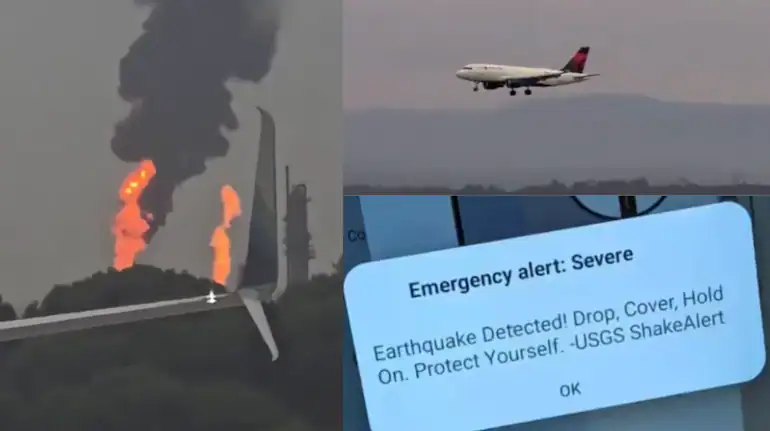
Southern California experienced a burst of seismic activity after a magnitude 5.0 earthquake struck off the coast near Manhattan Beach on November 28, 2026. The main tremor was followed by dozens of smaller earthquakes, including one measuring magnitude 4.5, prompting renewed concern among residents across the Los Angeles region. A live earthquake tracker recorded 19 earthquakes of magnitude 2.5 or stronger within 100 kilometres of Los Angeles in the 24 hours leading up to November 29.
The US Geological Survey (USGS) identified the November 28 event as the potential mainshock of an earthquake sequence and warned that further aftershocks are possible. Although there were no immediate reports of major structural damage or injuries, shaking was felt across Southern California. At Los Angeles International Airport (LAX), reports included broken glass and fallen ceiling tiles.
The repeated tremors have raised a familiar question for people living in one of America’s most earthquake-prone regions: does a cluster of earthquakes mean a much larger earthquake is approaching? Scientists say the sequence warrants awareness and preparation, but it does not establish that a major earthquake is imminent.
What Happened in Los Angeles? A Magnitude 5.0 Earthquake Struck Near Manhattan Beach
The earthquake occurred at approximately 9:30 am local time on November 28. Its epicentre was located about 6 kilometres west-southwest of Manhattan Beach, off the Southern California coast. The USGS recorded the earthquake at a depth of approximately 12.2 kilometres.
The tremor was strong enough to be felt across a wide area of the Los Angeles region. Residents reported sudden shaking, while objects were knocked from shelves and buildings experienced noticeable movement. The earthquake also activated the ShakeAlert early-warning system, which sent alerts to people in affected areas.
The USGS event record lists the earthquake at magnitude 5.0. Initial automated estimates and early alerts can differ from the magnitude assigned after seismic data are reviewed, which is why preliminary earthquake figures sometimes change.
The event was identified as the potential mainshock of a developing sequence. That classification matters because it indicates that the smaller earthquakes occurring around the same area are being assessed in relation to the larger initial event.
Why Were 19 Earthquakes Recorded Within 24 Hours?
The 19 earthquakes reported within 24 hours do not necessarily represent 19 separate major seismic events. The count refers to earthquakes of magnitude 2.5 or stronger recorded within a 100-kilometre radius of Los Angeles during the specified period. Most of the activity was part of the sequence associated with the Manhattan Beach earthquake.
After a significant earthquake, stress in the surrounding rocks changes. The sudden movement along a fault can redistribute pressure in nearby sections of the Earth’s crust, causing additional adjustments. These movements produce smaller earthquakes known as aftershocks.
Aftershocks can occur minutes, hours or days after the main earthquake. Some are too small for most people to feel, while others can be strong enough to rattle buildings and alarm residents. They generally become less frequent over time, although the sequence can continue for an extended period.
Caltech seismologists reported at least 40 aftershocks following the main event, including tremors above magnitude 4.0. One of the stronger aftershocks measured magnitude 4.5, demonstrating that an aftershock sequence can include earthquakes large enough to be widely felt.
The difference between the number of earthquakes in a live tracker and the number of events identified in a specific sequence can arise from different geographic boundaries, magnitude thresholds and catalogue updates. Earthquake counts can also change as monitoring agencies review and add new observations.
What Is an Aftershock and Why Can It Be Strong?
An aftershock is an earthquake that follows a larger earthquake in the same general area and is associated with the adjustment of the surrounding crust. When a fault ruptures, the movement does not necessarily bring the entire surrounding region into an immediately stable condition. Stress changes can trigger further movement on the same fault or nearby structures.
Most aftershocks are smaller than the mainshock, but their strength can vary. A magnitude 4.5 aftershock may still produce noticeable shaking, particularly in communities close to its epicentre. It can also cause additional concern if buildings have already been weakened by the initial earthquake.
Aftershocks are not simply minor repetitions of the first event. Their locations and magnitudes provide scientists with information about how the earthquake sequence is developing and which parts of the surrounding fault system may be adjusting.
For residents, the practical implication is that the end of the strongest shaking does not necessarily mean the immediate end of earthquake activity. People should remain alert and avoid entering buildings that have visible structural damage until they have been assessed.
Could a Stronger Earthquake Hit Southern California?
The possibility of another strong earthquake cannot be ruled out, but the available forecast does not indicate that a much larger earthquake is likely. The USGS aftershock forecast issued for the Manhattan Beach sequence estimated a 5% chance of at least one magnitude 5.0 or stronger earthquake within the following week.
The estimated probability of a magnitude 6.0 or stronger earthquake during the same period was below 1%. The forecast also indicated a much higher likelihood of additional smaller tremors, which are a normal feature of earthquake sequences.
These figures are probabilities, not predictions of a specific event. They do not identify the exact time, location or magnitude of a future earthquake. Forecasts are updated as more seismic observations become available, particularly during the first days after a significant earthquake.
There is also an important distinction between an aftershock and a foreshock. An earthquake is generally classified as a foreshock only if a larger earthquake subsequently occurs in the same sequence. Until that happens, scientists cannot know with certainty whether a particular tremor was a foreshock.
Why Is California So Prone to Earthquakes?
California experiences frequent earthquakes because it lies along the boundary between two major tectonic plates: the Pacific Plate and the North American Plate. These enormous sections of the Earth’s outer shell are constantly moving relative to one another, building up stress along faults in the crust.
The San Andreas Fault is the best-known part of this boundary. It stretches for hundreds of kilometres through California and accommodates much of the sideways movement between the two plates. However, earthquake activity is not limited to the San Andreas Fault. Southern California contains a complex network of active faults, including structures beneath populated areas and offshore zones.
When accumulated stress exceeds the strength of rocks along a fault, the rocks can suddenly slip. The released energy travels through the ground as seismic waves, producing the shaking people experience during an earthquake.
The Manhattan Beach earthquake occurred offshore, southwest of the coastal community. Its location is a reminder that the Los Angeles region’s seismic risk comes from a network of faults rather than one single fault line. Earthquakes can occur beneath the ocean, along coastal structures or inland, and their effects depend on factors such as magnitude, depth, distance from communities and local ground conditions.
Southern California’s dense population and extensive infrastructure make earthquake preparedness particularly important. Even a moderate earthquake can disrupt transport, damage vulnerable structures and affect utilities, depending on where the shaking is strongest.
Is the ‘Big One’ Coming to Los Angeles?
The latest earthquake sequence has renewed discussion about the possibility of the long-feared “Big One” in California. The term generally refers to a major earthquake capable of causing extensive damage across a large part of the region, particularly if it occurs on a major fault such as the San Andreas.
However, a cluster of earthquakes near Manhattan Beach does not prove that such an event is approaching. Earthquake sequences can occur without being followed by a substantially larger earthquake. Scientists cannot reliably determine from a short burst of seismic activity whether it signals an impending major rupture.
California’s long-term earthquake risk exists independently of this particular sequence. The region’s active faults mean that damaging earthquakes remain a possibility, but there is no reliable method to predict the precise date and time of the next major event.
The distinction is important because dramatic earthquake headlines can create the impression that a larger disaster is inevitable. The scientific evidence supports caution and preparedness, not certainty that the “Big One” is about to strike.
What Damage Was Reported at Los Angeles International Airport?
Although no major structural damage was initially reported following the magnitude 5.0 earthquake, some effects were observed at Los Angeles International Airport. Reports included broken glass and ceiling tiles falling inside the airport.
Airport buildings and other large public facilities can experience noticeable movement during an earthquake. The impact depends on the strength and duration of shaking, the design of the structure and the condition of its non-structural components, such as ceilings, fixtures and glass panels.
Emergency personnel also carried out checks across Los Angeles. The Los Angeles Fire Department sent personnel from 106 neighbourhood stations to inspect infrastructure and assess reports following the earthquake. The department subsequently resumed normal operations after finding no damage or injuries in the city, according to reports.
The absence of immediate reports of widespread damage is reassuring, but it does not eliminate the need for inspections. Aftershocks can create additional risks, particularly in buildings or facilities where components may have been loosened during the initial shaking.
What Should Los Angeles Residents Do After the Earthquake?
Residents should continue following guidance from local emergency authorities and remain prepared for additional shaking. The USGS advises people to use the “Drop, Cover and Hold On” procedure when an earthquake occurs.
- Drop: Get down on your hands and knees before the shaking knocks you over.
- Cover: Protect your head and neck under a sturdy table or desk. If no shelter is available, move away from windows and cover your head with your arms.
- Hold On: Stay under your shelter and hold on until the shaking stops. Be prepared to move with it if the furniture shifts.
- Check for damage: Look for broken glass, fallen objects, damaged walls, gas leaks and other hazards after the shaking ends.
- Prepare for aftershocks: Keep emergency supplies accessible and be ready to take protective action if another tremor occurs.
People should avoid elevators during and immediately after an earthquake. Anyone who suspects a gas leak should leave the building and contact the appropriate emergency service from a safe location. Damaged buildings should not be re-entered until authorities or qualified professionals have determined that they are safe.
What Happens Next in the Los Angeles Earthquake Sequence?
The Manhattan Beach earthquake has placed Southern California under renewed attention as seismologists monitor the sequence and update their forecasts. The USGS has confirmed that the event may produce further aftershocks, while its probability estimates indicate that smaller earthquakes remain more likely than another major tremor.
The number of recorded earthquakes may continue to change as monitoring networks detect and review additional events. The frequency of aftershocks is generally expected to decline over time, although the exact pattern cannot be known in advance.
For Los Angeles residents, the central message is that the 19 earthquakes recorded within 24 hours are part of an active seismic sequence, not proof that a larger disaster is imminent. The region remains exposed to earthquake risk because of its complex fault system, making preparedness essential even when the immediate damage appears limited.
Scientists cannot say when the next powerful earthquake will strike California. For now, monitoring the aftershock sequence, following official safety guidance and checking buildings for damage are the most practical steps for residents as Southern California continues to experience tremors.
For breaking news and live news updates, like us on Facebook or follow us on Twitter and Instagram. Read more on Latest Technology on thefoxdaily.com.


COMMENTS 0