A comfortable home depends on more than clean floors and fresh bedding. Persistent musty smells, black spots on bathroom walls, condensation on windows and dust that triggers sneezing can all indicate problems with indoor air quality or excess moisture. While regular cleaning and proper ventilation are essential, choosing the right appliance can help address the underlying issue.
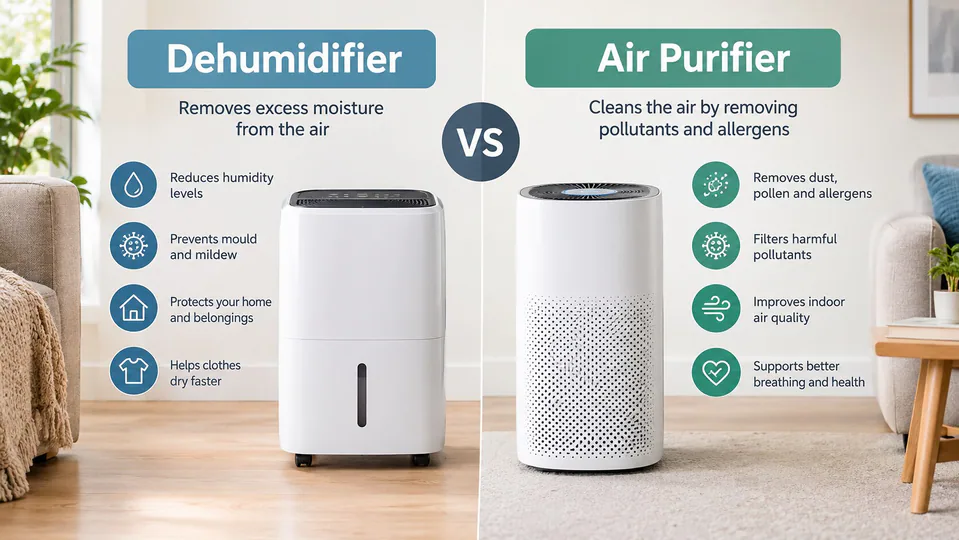
This is where the choice between an air purifier and a dehumidifier becomes important. Both appliances can improve the indoor environment, but they work in different ways. An air purifier filters airborne particles such as dust, pollen and pet dander, while a dehumidifier removes excess moisture from the air to make damp conditions less favourable for mould and dust mites.
The right choice depends on what is causing the problem in your home. Buying an air purifier when high humidity is the main concern may leave dampness unresolved. Similarly, using a dehumidifier to tackle airborne dust will not provide the same benefits as effective particle filtration.
Air Purifier vs Dehumidifier: Key Differences
Before deciding which appliance to buy, it helps to understand what each one does, which household problems it can address and what it cannot fix.
| Feature | Air Purifier | Dehumidifier |
|---|---|---|
| Primary function | Filters airborne particles from indoor air | Removes excess moisture from the air |
| Best for | Dust, pollen, pet dander and airborne particles | High humidity, condensation and dampness |
| Mould management | Can capture some airborne mould spores when equipped with effective particle filtration | Helps control humidity, reducing conditions that encourage mould growth |
| Dust mite management | May capture airborne particles associated with dust mites, but does not control their preferred humid environment | Can make conditions less favourable for dust mites by reducing humidity |
| Musty smells | Some models with suitable activated carbon filters can reduce certain odours | Can help reduce odours caused by excess moisture |
| Humidity control | Does not meaningfully reduce indoor humidity | Designed to lower indoor humidity |
| Best suited for | Dusty rooms, allergy concerns and airborne pollution | Damp bedrooms, humid bathrooms and condensation-prone spaces |
Air Purifier vs Dehumidifier: Which One Should You Buy?
Choose an air purifier if airborne dust, pollen, pet dander or other particles are your main concern. A model equipped with a properly sized HEPA filter can capture many airborne particles, potentially making it useful for households dealing with common indoor allergens.
Choose a dehumidifier if your home has persistent dampness, condensation, high humidity or moisture-related musty smells. By removing water vapour from indoor air, it can help create conditions that are less favourable for mould growth and dust mites.
If your home has both poor air quality and a moisture problem, the two appliances may complement each other. However, neither replaces the need to fix water leaks, remove existing mould safely or improve ventilation where necessary.
Air Purifier: When Should You Choose One?
An air purifier is designed to improve indoor air quality by drawing air through filters that capture particles. Depending on the filtration system, these may include dust, pollen, pet dander and other airborne pollutants.
For households concerned about allergens, a model with a genuine HEPA filter can be particularly useful. HEPA filtration is designed to capture very small airborne particles, although the real-world benefit depends on the purifier’s performance, room size, airflow and how consistently it is used.
An air purifier may also help reduce airborne mould spores. However, filtering spores from the air does not eliminate the source of mould or prevent it from growing on persistently damp surfaces. Moisture must still be controlled to address the underlying problem.
Similarly, an air purifier will not remove excess humidity. If windows regularly collect condensation or a musty smell returns because a room remains damp, filtration alone is unlikely to solve the problem.
Who Should Buy an Air Purifier?
- People with dust or pollen allergies: A suitable HEPA-filter air purifier can capture many airborne particles associated with common allergens. It may help reduce exposure, although it cannot guarantee relief from allergy symptoms.
- Families living in polluted cities: Indoor air can contain particulate pollution that enters from outdoors. An appropriately sized purifier can help reduce airborne particles when windows and doors are closed, depending on the home’s ventilation and pollution sources.
- Pet owners: Air purifiers can capture airborne pet dander and other particles shed by cats, dogs and other household animals. They do not replace regular cleaning and grooming.
- People concerned about airborne mould spores: Effective particle filtration may reduce some airborne spores, but eliminating moisture and treating existing mould remain essential.
- People who spend long hours in bedrooms or home offices: A properly sized, quiet purifier can help maintain cleaner air in frequently occupied rooms.
What to Check Before Buying an Air Purifier
Not every air purifier is equally effective. Consider these factors before choosing a model.
- Filter quality: Look for a genuine HEPA filter if particle removal is your main priority. Check the manufacturer’s filtration specifications rather than relying only on broad claims about cleaner air.
- Room size: Match the purifier’s clean air delivery rate, or CADR, to the size of the room. A unit that is too small may not circulate and filter enough air to provide the intended benefit.
- Activated carbon filtration: If odours are a concern, a model with a suitable activated carbon filter may help reduce certain gaseous pollutants and smells. Particle filters alone are not designed to remove every type of odour.
- Noise levels: Check operating noise if you intend to use the appliance in a bedroom or study, particularly at night.
- Filter replacement costs: Replacement filters are an ongoing expense. Check their availability, expected replacement intervals and cost before buying.
- Ozone generation: Avoid devices that intentionally produce ozone as a method of cleaning indoor air. Ozone can irritate the lungs.
Dehumidifier: When Should You Choose One?
A dehumidifier is the more relevant appliance when excess moisture is causing problems in your home. It draws in humid air, removes some of its moisture and releases drier air back into the room. Depending on the model, the collected water is stored in a tank or discharged through a drainage hose.
High indoor humidity can encourage mould growth and create favourable conditions for dust mites. A dehumidifier helps address this environmental factor by lowering moisture levels. It may also reduce musty smells associated with damp rooms, wet materials and persistent condensation.
However, a dehumidifier is not a substitute for repairing leaks or dealing with water entering through walls, roofs or floors. If moisture continues to enter a room, the appliance may struggle to keep humidity under control. Existing mould must also be addressed rather than simply relying on drier air to make it disappear.
For many homes, maintaining indoor relative humidity at approximately 30% to 50% is a useful general target. The ideal level can vary with climate, building conditions and individual circumstances, so a humidity meter can help you understand what is happening inside your home.
Who Should Buy a Dehumidifier?
- People living in damp homes: If rooms feel persistently damp or humidity readings remain high, a dehumidifier can help remove excess moisture from indoor air.
- Households dealing with recurring mould: Lowering humidity can help reduce the conditions that encourage mould growth, particularly when combined with repairing leaks and improving ventilation.
- People concerned about dust mites: Dust mites thrive in humid environments. Reducing indoor humidity can make conditions less favourable for them, although it will not remove mites already present in mattresses, carpets or upholstery.
- Residents in humid or rainy climates: Homes that remain humid during wet weather may benefit from a dehumidifier, especially in rooms where natural drying is difficult.
- Households struggling with musty smells: If odours come from excess moisture, reducing humidity may help. Persistent smells can also indicate hidden mould, damp building materials or drainage problems that need separate attention.
- Homes with frequent window condensation: A dehumidifier may help reduce condensation when indoor humidity is a contributing factor. Cold surfaces, inadequate insulation and poor ventilation may also need attention.
What to Check Before Buying a Dehumidifier
A dehumidifier’s effectiveness depends on its capacity, the room conditions and how much moisture needs to be removed. Consider the following factors before making a purchase.
- Moisture removal capacity: Check how much water the appliance can remove over a specified period under stated test conditions. A persistently damp room may require a higher-capacity unit than a small space with occasional humidity.
- Room size and humidity: Match the appliance to the room and the severity of the moisture problem. Manufacturer recommendations can help identify a suitable capacity.
- Humidity controls: A built-in humidistat can help the appliance maintain a selected humidity level instead of running continuously without regard to conditions.
- Water tank and drainage: A larger tank means less frequent emptying, while continuous drainage may be useful if the room has a suitable drain.
- Noise and placement: Check operating noise and ensure the appliance can be positioned according to the manufacturer’s clearance and ventilation requirements.
- Energy consumption: Compare power use because a dehumidifier may operate for several hours a day in a damp climate.
- Operating temperature: Performance varies by technology and temperature. Refrigerant models may be less effective in colder rooms, while desiccant models can be more suitable for some cool environments.
Air Purifier vs Dehumidifier for Mould: Which Is Better?
If mould is the main problem, a dehumidifier is generally more useful when the underlying issue is high indoor humidity. By reducing moisture in the air, it can help make the environment less favourable for mould to grow.
An air purifier may capture some mould spores that become airborne, but it cannot stop mould from growing on damp walls, ceilings, window frames or furniture. Filtering the air does not remove the moisture that allows mould to persist.
The first step is to identify and correct the source of dampness. This could involve repairing a leak, improving ventilation, addressing water intrusion or managing condensation. Existing mould should then be cleaned or remediated appropriately, depending on the extent of the growth and the materials affected.
If mould keeps returning despite cleaning, investigate the moisture source rather than relying on an appliance alone. Extensive mould growth, recurring water damage or contamination in difficult-to-access areas may require professional assessment.
Air Purifier vs Dehumidifier for Dust Mites
Dust mites are microscopic organisms commonly found in household dust, particularly in bedding, mattresses, carpets and upholstered furniture. Their presence is influenced by factors including humidity, temperature and the availability of skin flakes as a food source.
A dehumidifier can help by reducing indoor humidity, making conditions less favourable for dust mites. However, it does not directly remove mites or their allergens from fabrics and surfaces.
An air purifier, meanwhile, can capture some airborne particles, including particles carrying dust mite allergens. Its effect is limited to particles that pass through the appliance, and it does not control the humidity conditions that support dust mites.
For households with dust mite allergies, a combined approach may be more useful than relying on one appliance. Keep indoor humidity under control, wash bedding regularly according to care instructions, clean surfaces and carpets appropriately, and consider allergen-resistant mattress and pillow covers. An air purifier may provide an additional way to reduce airborne particles.
Air Purifier vs Dehumidifier for Musty Smells
A musty smell can be a sign of excess moisture, mould growth or damp materials. Before buying an appliance, try to determine where the odour originates.
If the smell is associated with damp walls, condensation or a room that never seems to dry out, a dehumidifier may help by reducing excess moisture. However, it will not remove the source of an odour if mould is growing behind furniture, inside walls or beneath flooring.
If the problem is an airborne odour from cooking, pets or other indoor sources, an air purifier with a suitable activated carbon filter may be more appropriate. Standard particle filters are not designed to remove every gaseous pollutant or smell.
Neither appliance should be treated as a universal solution for persistent odours. Investigate the source, remove damp materials where necessary and address any drainage, plumbing or ventilation problems. Covering up a smell without correcting its cause can allow the underlying problem to continue.
Can You Use an Air Purifier and a Dehumidifier Together?
Yes. The two appliances perform different functions and can complement each other when a home has both airborne pollution and excess moisture.
A dehumidifier can help control humidity in a damp bedroom, while an air purifier can filter airborne particles in the same room. This combination may be useful in homes where condensation and mould concerns coexist with dust, pollen or pet allergens.
However, buying both appliances is not always necessary. If humidity is normal and dust is the primary concern, an air purifier may be sufficient. If the air is relatively clean but the room remains damp, a dehumidifier may be the more practical purchase.
Before investing in both, identify the main problem and consider whether simpler measures could help. Repairing leaks, using exhaust fans where appropriate, cleaning regularly and improving air circulation may address part of the issue without requiring additional equipment.
Common Mistakes to Avoid When Choosing Between the Two
- Expecting an air purifier to stop mould growth: Air filtration may capture airborne spores, but it does not correct moisture problems or remove existing mould from surfaces.
- Expecting a dehumidifier to remove dust: A dehumidifier lowers humidity but is not designed to filter airborne particles.
- Ignoring the source of musty smells: Persistent odours can signal hidden dampness, leaks or mould. An appliance may reduce symptoms without fixing the cause.
- Choosing a model that is too small: Appliances need to be appropriately sized for the room and the severity of the problem to work effectively.
- Overlooking running costs: Filter replacements, electricity use, maintenance and water-tank emptying can affect the long-term cost of ownership.
- Assuming one appliance solves every indoor air problem: Airborne particles, excess humidity, ventilation and water damage require different approaches.
Final Verdict: Air Purifier or Dehumidifier?
The better appliance depends on whether your main concern is airborne particles or excess moisture. Both can improve the indoor environment, but they solve different problems.
- Buy an air purifier if dust, pollen, pet dander or airborne particles are your primary concern. Choose a suitable filtration system and match its performance to the room size.
- Buy a dehumidifier if high humidity, dampness, condensation or moisture-related musty smells are the main issues. Look for a unit with suitable moisture-removal capacity and effective humidity controls.
- Consider both appliances if your home has persistent humidity problems as well as airborne dust or allergens. Use each appliance for its intended purpose.
- Address the underlying cause if mould or musty smells keep returning. Repair leaks, manage condensation, improve ventilation where appropriate and deal with existing mould instead of relying on appliances alone.
Ultimately, an air purifier helps manage what is floating in the air, while a dehumidifier helps control how much moisture the air contains. Identifying which problem affects your home is the most important step towards choosing the right appliance.
For breaking news and live news updates, like us on Facebook or follow us on Twitter and Instagram. Read more on Latest Technology on thefoxdaily.com.


COMMENTS 0