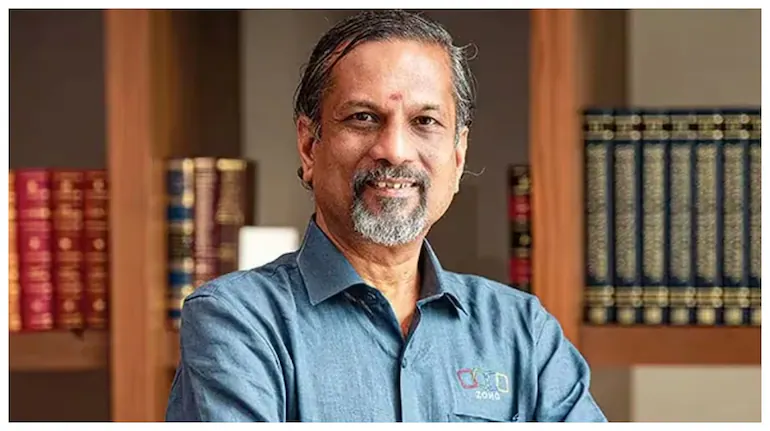
Artificial Intelligence is changing not only how people complete their work but also how they organise their daily routines. Zoho co-founder and chief scientist Sridhar Vembu has offered a glimpse into this shift, revealing that he now makes sure an AI system has a lengthy assignment to work on before he steps away from his desk.
In a post on X, Vembu described how he queues up long-running AI tasks before taking breaks such as going for a walk, practising yoga or having lunch. His reasoning is straightforward: if an AI system can continue working while he is away, leaving it idle would mean losing an opportunity to make progress.
He also made a humorous observation about the productivity impact of the technology. Rather than reducing working hours, AI appears to be encouraging people to take on more assignments and keep their systems occupied for longer periods.
Vembu’s comments capture an emerging workplace paradox. Artificial intelligence is increasingly capable of completing tasks that once required considerable human effort, yet the time saved is not always translating into more leisure. For some professionals, faster execution simply creates room for additional work.
How Sridhar Vembu Uses AI During His Daily Routine
Vembu’s approach reflects a growing habit among professionals who use AI tools for tasks that can continue running without constant human supervision. Instead of treating artificial intelligence only as a system that responds to individual questions, he describes using it as a background worker that can handle longer assignments while he attends to other activities.
Before stepping away for a walk, yoga or lunch, he queues up a task for the AI system. By the time he returns, the system may have completed part of the assignment or produced results that can be reviewed and developed further.
This changes the traditional relationship between working time and task completion. In conventional workflows, employees often need to remain at their desks while research, coding, analysis or document preparation is underway. With suitable AI tools, some of these activities can continue in the background.
The approach does not mean that every task can be handed over without supervision. AI-generated work still needs review, particularly when it involves important business decisions, technical changes or information that must be accurate. However, delegating suitable tasks can reduce the time spent waiting for intermediate results.
Vembu’s example is less about avoiding work altogether and more about making productive use of time that would otherwise be spent waiting for a process to finish.
AI Is Becoming More Than a Chatbot
One of the biggest developments in artificial intelligence is the shift from conversational assistants to more capable AI agents. Traditional chatbots primarily respond to prompts, explain information or generate text. Agentic AI systems can go further by carrying out sequences of actions to complete a defined objective.
Depending on the tools and permissions available, these systems can conduct research, write and test code, analyse datasets, organise information and interact with software applications. Some can work through multiple stages of a task before returning a result for human review.
This ability makes them useful for assignments that involve several connected steps. A developer, for example, may ask an AI agent to inspect a codebase, identify a problem, propose a correction and run tests. A researcher may delegate the collection and organisation of information before reviewing the findings.
Such workflows are different from asking a chatbot a single question and receiving an immediate response. The AI system is expected to maintain the context of an assignment, work through subtasks and produce an output that can be checked later.
Vembu’s routine reflects this model of AI use. Rather than waiting for a prompt-response interaction, he appears to be treating the system as something that can continue working while he is occupied elsewhere.
The Productivity Paradox: Why AI May Be Making People Work Harder
One of the most interesting aspects of Vembu’s observation is his suggestion that AI is making people work harder, not less. The comment, delivered humorously, points to a concern that is increasingly relevant as AI tools become part of everyday professional life.
Technology is often introduced with the promise of saving time. If a task that once took several hours can be completed much faster, employees should theoretically gain more time for other responsibilities or personal activities.
In practice, however, organisations and individuals may respond to faster execution by increasing the amount of work they attempt to complete. A professional who saves two hours on research may use that time to begin another project. A developer who finishes routine coding faster may take on additional features, testing or maintenance work.
This creates a productivity paradox: greater efficiency does not necessarily mean less work. It can instead raise expectations about how much should be accomplished within the same working day.
AI can also encourage a continuous-work mindset. When a system can keep processing assignments while its user is away, people may feel pressure to ensure that every available moment is being used. Even breaks can become opportunities to queue up more work.
Vembu’s comment highlights this behaviour without necessarily presenting it as a problem. Yet it raises an important question for workplaces: should AI-driven productivity be measured by the volume of tasks completed, or by whether employees gain meaningful time and flexibility?
How AI Agents Are Changing Workplace Productivity
The growing use of AI agents could reshape how businesses distribute responsibilities between employees and software systems. Rather than assigning every step of a project to a human worker, organisations may increasingly divide tasks between people and AI tools.
Human employees can define objectives, provide context, make decisions and assess results, while AI systems handle selected execution-heavy activities. This arrangement can change how teams plan projects and measure progress.
From completing tasks to delegating work
In traditional office environments, productivity is often associated with the time employees spend completing assignments. AI introduces another dimension: the ability to identify which tasks can be delegated effectively.
A professional may spend less time writing an initial draft, searching for information or handling repetitive coding work. More attention can then go towards reviewing results, correcting mistakes and deciding what should happen next.
This means that effective AI use requires more than knowing how to write prompts. Employees need to understand the task, identify suitable parts for automation and evaluate whether the output meets the required standard.
Long-running tasks can reduce waiting time
Background execution is particularly useful for assignments that take time but do not require constant intervention. Research, data processing, software testing and certain development workflows can involve waiting periods during which a person may be able to work on something else.
AI agents can potentially use those periods more effectively by continuing with the assigned process. However, the benefit depends on whether the system can operate reliably, access the necessary tools and recover appropriately when it encounters an obstacle.
Human oversight remains essential
Delegating a task does not transfer responsibility for its outcome. AI systems can misunderstand instructions, produce incorrect information, introduce software errors or make assumptions that were not intended by the user.
Businesses therefore need review processes, access controls and clear rules about which activities AI systems are permitted to perform independently. Tasks involving sensitive information, financial decisions or critical infrastructure may require particularly careful supervision.
The most effective workplace model is likely to involve collaboration rather than unrestricted automation, with people remaining responsible for decisions and the quality of the final output.
Why Vembu’s Observation Matters for India’s Technology Sector
Vembu’s comments are relevant to India’s technology industry, where software development, business services and knowledge-based work employ large numbers of professionals. AI adoption is creating opportunities to automate routine activities while changing the skills expected from employees.
Indian technology companies are exploring AI for software development, customer support, business analysis, documentation and internal operations. The growing availability of agentic tools could extend automation beyond individual tasks to more complex workflows.
For technology workers, this shift may change the value placed on different skills. Writing code or preparing documents may become faster with AI assistance, while understanding business requirements, evaluating technical decisions and managing complex projects may become increasingly important.
For businesses, the challenge will be to turn AI adoption into measurable improvements rather than simply increasing the number of tasks assigned to employees. Faster output can improve competitiveness, but it does not automatically produce better products, stronger customer relationships or healthier working conditions.
Vembu’s observation also reflects the importance of adapting work habits as AI becomes more capable. Professionals who learn to delegate suitable tasks effectively may be able to manage complex assignments more efficiently. Those who rely on AI without reviewing its work could face new risks.
Does AI Actually Give Workers More Free Time?
Whether AI creates more free time depends largely on how individuals and organisations use the productivity gains. If employees complete assignments faster and retain control over their schedules, AI could reduce repetitive work and create more room for rest, learning and creative activities.
But if employers respond by increasing workloads or expecting continuous availability, the same technology could intensify working pressure. Faster task completion may become the new baseline rather than an opportunity to reduce working hours.
There is also a difference between having an AI system work in the background and being free from professional responsibility. Employees may still need to monitor progress, review outputs, correct errors and make decisions before a task can be considered complete.
In some cases, AI can even create additional work. Generated code may need extensive testing, research summaries may require fact-checking and automated reports may need human interpretation. The time saved during production can partly shift into verification and quality control.
This makes the way companies measure productivity especially important. If success is judged only by the number of completed tasks, AI could encourage an endless cycle of additional assignments. If businesses also value accuracy, creativity, employee well-being and sustainable performance, the technology may deliver broader benefits.
The Future of Work May Depend on How Well People Delegate to AI
Vembu’s routine offers a simple illustration of a much larger workplace transition. As AI systems become capable of handling longer and more complicated assignments, professionals may increasingly organise their day around what machines can complete in the background.
The change could affect how people schedule breaks, manage projects and collaborate with colleagues. A task that once required uninterrupted attention may become something that can be delegated and reviewed later.
However, the ability to assign work to an AI agent will not automatically make someone more productive. Users will need to provide clear instructions, select appropriate tools, monitor important tasks and understand the limitations of automated outputs.
For companies, the next challenge will be deciding how to distribute the benefits of AI-driven efficiency. Greater output is one possible result, but reduced administrative pressure, improved work quality and more flexible schedules are also potential measures of success.
Vembu’s light-hearted observation captures the contradiction at the centre of this transition. AI can continue working while people step away, but the availability of an always-active digital assistant may also encourage them to keep finding new tasks to assign.
The real measure of AI’s impact may therefore not be how long machines can work without human involvement. It may be whether people can use that capability to achieve better results without turning every saved minute into another obligation.
For breaking news and live news updates, like us on Facebook or follow us on Twitter and Instagram. Read more on Latest Technology on thefoxdaily.com.






COMMENTS 0