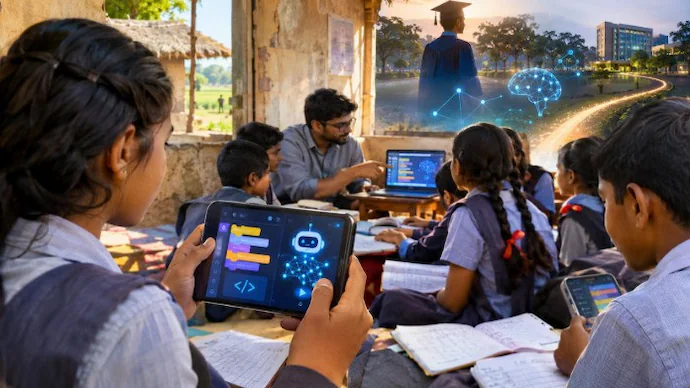
For thousands of students in rural India, learning computer programming and Artificial Intelligence (AI) remains difficult because of limited access to computers, laboratories, trained teachers and reliable learning resources. Prashant Chaudhary, an IIT Delhi graduate from a small village near Meerut in Uttar Pradesh, is working to change that through the CodeYogi Foundation, an initiative that makes technology education accessible through basic smartphones.
Founded in December 2019, the CodeYogi Foundation aims to help students from underserved communities develop practical coding, artificial intelligence and other digital skills without depending on expensive infrastructure or conventional classroom facilities. According to Chaudhary, the initiative has reached more than 3.5 lakh students across nine states and 120 districts over the last three years.
His work has earned him the fifth Rohini Nayyar Prize for rural development. The award carries a cash prize of Rs 10 lakh, along with a citation and trophy, recognising his efforts to expand access to technology education among young people from economically disadvantaged backgrounds.
Chaudhary’s approach challenges the idea that students need personal computers, specialised laboratories or advanced educational infrastructure to begin learning technology. By using smartphones and an AI-powered learning platform, CodeYogi seeks to bring practical digital education closer to students who might otherwise have limited opportunities to acquire these skills.
From a Village Near Meerut to IIT Delhi
Prashant Chaudhary’s journey into technology began in a small village near Meerut, Uttar Pradesh. In 2010, he became the first person from his village to secure admission to an Indian Institute of Technology (IIT), marking an important milestone for his family and local community.
His educational journey later influenced his understanding of the unequal access to technology and learning opportunities in India. Although digital skills were becoming increasingly important, many students in rural and economically disadvantaged communities continued to face basic barriers, including the absence of computers and access to experienced instructors.
Chaudhary began working on technology education in 2014. His early teaching efforts took place in borrowed spaces, on rooftops and in school corridors where he could find an internet connection and students interested in learning.
These informal learning environments helped shape his understanding of how education could be delivered outside traditional classrooms. Rather than waiting for schools to acquire expensive equipment, he explored ways to make practical technology learning possible with the limited resources already available to students.
A School Dropout’s Smartphone Learning Experience Changed His Perspective
One experience that influenced Chaudhary’s approach involved a school dropout from an under-resourced background. The student did not have access to a laptop and depended on a basic smartphone to learn.
Despite these limitations, the student demonstrated an ability to learn quickly, impressing Chaudhary with his progress. The experience challenged conventional assumptions about the relationship between educational background, access to technology and learning ability.
It also highlighted a central problem facing rural students: a lack of resources does not necessarily indicate a lack of talent or interest. Many young people may have the ability to learn programming and other technical skills but lack the tools and guidance needed to develop those abilities.
This understanding gradually shifted Chaudhary’s focus towards creating a learning model that could work with basic devices and reach students beyond well-equipped educational institutions.
CodeKamp, DevsLane and the Beginning of CodeYogi Foundation
Before establishing the CodeYogi Foundation, Chaudhary worked on technology and software development initiatives. He founded CodeKamp, a coding bootcamp designed to teach practical software development skills, followed by DevsLane, a product engineering company that worked with startups.
These experiences gave him exposure to software development and the practical skills required in the technology industry. Over time, however, his focus moved towards addressing the gap between the growing demand for digital skills and the limited opportunities available to students from underserved communities.
In December 2019, he established the CodeYogi Foundation with the aim of building a learning ecosystem that would not depend on expensive computers, specialised laboratories or conventional classroom arrangements.
The initiative was designed around a straightforward principle: students should be able to begin learning technology with a smartphone and an internet connection. This approach was intended to reduce the financial and geographical barriers that often prevent rural students from accessing digital education.
How CodeYogi Makes Coding and AI Learning Accessible
The CodeYogi Foundation uses an AI-powered learning platform designed to operate on basic family smartphones. Its approach focuses on practical learning and accessibility, allowing students to engage with technology education without needing personal computers or specialised laboratories.
The platform also uses Indian languages, helping reduce the language barrier for learners who may not be comfortable studying technical subjects in English. Its model does not require students to have trained teachers available for every learning activity or access to conventional computer-based classrooms.
Initially, the programme focused on coding education. As artificial intelligence became more prominent in everyday life and professional environments, the foundation expanded its learning offerings to include AI literacy and practical use of AI tools.
Chaudhary described the development of the programme as a shift towards applied AI education. Speaking to news agency PTI, he said:
“The model has evolved into a 30-day applied AI fluency programme where students use real AI tools for tasks that matter in their studies and family lives.”
The 30-day programme is intended to help students move beyond theoretical explanations and understand how AI tools can be used for practical purposes. By connecting learning activities with everyday requirements, the foundation aims to make artificial intelligence more approachable for young people who may have little previous exposure to the technology.
CodeYogi Reaches 3.5 Lakh Students Across Nine States
The foundation’s expansion highlights the potential reach of technology education delivered through mobile devices. According to Chaudhary, CodeYogi has reached more than 3.5 lakh students across nine states and 120 districts over the last three years.
He also said that the districts covered by the initiative represent around 30% of India’s geographical area.
“In the last three years, it has reached over 3.5 lakh students across nine states and 120 districts, which constitute 30 per cent of India’s geographical area,” Chaudhary was quoted as saying by PTI.
The reported reach reflects the foundation’s effort to take digital learning beyond major cities and well-resourced schools. Its smartphone-based approach is particularly relevant in areas where establishing computer laboratories and maintaining specialised infrastructure can be difficult or expensive.
However, access to a smartphone and an internet connection remains important for the model. The initiative’s broader objective is to make the learning process less dependent on the availability of dedicated educational hardware and more accessible to students using devices already available within their families.
Beyond Coding: Spoken English and Other Essential Skills
CodeYogi’s work is not limited to programming and artificial intelligence. The foundation is also developing spoken English learning tools aimed at helping students improve their communication abilities.
These tools use storytelling, animated videos and voice recognition to create an interactive learning experience. The approach is intended to make language practice more accessible to students who may not have regular opportunities to communicate in English or receive specialised instruction.
Combining technology education with communication skills reflects the foundation’s wider focus on preparing students for a changing employment landscape. Coding and AI knowledge can introduce learners to emerging areas of technology, while communication abilities can help them participate more effectively in academic and professional environments.
The broader vision is to ensure that students from underserved communities can develop skills relevant to technology-driven careers, regardless of their school, academic stream or geographical location.
What Is the Rohini Nayyar Prize for Rural Development?
The Rohini Nayyar Prize recognises individuals who have made significant contributions to rural development in India. Instituted in 2022, the award was established in memory of Dr Rohini Nayyar, an economist and administrator who devoted much of her professional life to rural development.
The annual award is presented by the Nayyar Foundation for Social and Economic Purpose, established by her family to support social and economic development in the country.
The fifth Rohini Nayyar Prize has been awarded to Prashant Chaudhary for his work through the CodeYogi Foundation. The recognition includes a cash prize of Rs 10 lakh, a citation and a trophy.
The award highlights initiatives that address challenges faced by rural communities through practical interventions. In Chaudhary’s case, the focus is on reducing barriers to technology education and helping young people develop skills that could be useful in an increasingly digital economy.
Previous Winners of the Rohini Nayyar Prize
Since its establishment in 2022, the Rohini Nayyar Prize has recognised individuals working in different areas of rural development across India.
- 2022: Sethrichem Sangtam from Nagaland.
- 2023: Dinanath Rajput from Chhattisgarh.
- 2024: Anil Pradhan from Odisha.
- 2025: Vidhya Parshuramkar from Pune.
- 2026: Prashant Chaudhary for his work through the CodeYogi Foundation.
The foundation’s directors include Deepak Nayyar, Emeritus Professor of Economics at Jawaharlal Nehru University and former Vice-Chancellor of Delhi University; Dhiraj Nayyar, Director, Economics and Policy and Senior Vice-President at Vedanta Resources; and Gaurav Nayyar, Lead Economist at the World Bank.
CodeYogi’s Next Target: Reaching One Million Learners
After reaching more than 3.5 lakh students across nine states, the CodeYogi Foundation has set its next target at one million learners. The goal reflects its ambition to expand access to coding, artificial intelligence and other essential skills among students from underserved communities.
Achieving this target would require the initiative to extend its reach while maintaining a learning model that works across different regions, languages and educational backgrounds. Its reliance on basic smartphones is intended to make expansion possible without requiring every participating school or community to establish dedicated computer laboratories.
The larger challenge is ensuring that students can turn access to digital learning into practical knowledge and meaningful opportunities. Learning platforms can introduce young people to programming and AI tools, but sustained skill development also depends on regular practice, guidance and opportunities to apply what they learn.
Why Smartphone-Based Technology Education Matters for Rural India
India’s digital economy is creating demand for people with technology-related skills, but access to quality digital education remains uneven. Students in urban areas may have greater opportunities to use computers, attend coding classes and learn from specialised instructors. In contrast, learners in remote and economically disadvantaged communities may have to depend on shared devices and limited internet access.
Traditional computer laboratories can provide important learning opportunities, but setting them up and maintaining them requires financial investment, equipment and technical support. A smartphone-based model offers another way to introduce digital skills, particularly where such infrastructure is difficult to establish.
CodeYogi’s approach attempts to address this gap by using devices that families may already have. Its use of Indian languages and practical AI exercises also seeks to make learning more accessible to students who might otherwise find technical education difficult to approach.
Prashant Chaudhary’s journey, from becoming the first person in his village to enter an IIT to establishing an initiative that has reached more than 3.5 lakh students, highlights the role of accessible learning models in expanding educational opportunities.
With its next target set at one million learners, the CodeYogi Foundation aims to make a student’s location, financial background or access to conventional educational resources less of a barrier to entering the world of technology.
For breaking news and live news updates, like us on Facebook or follow us on Twitter and Instagram. Read more on Latest Education on thefoxdaily.com.






COMMENTS 0