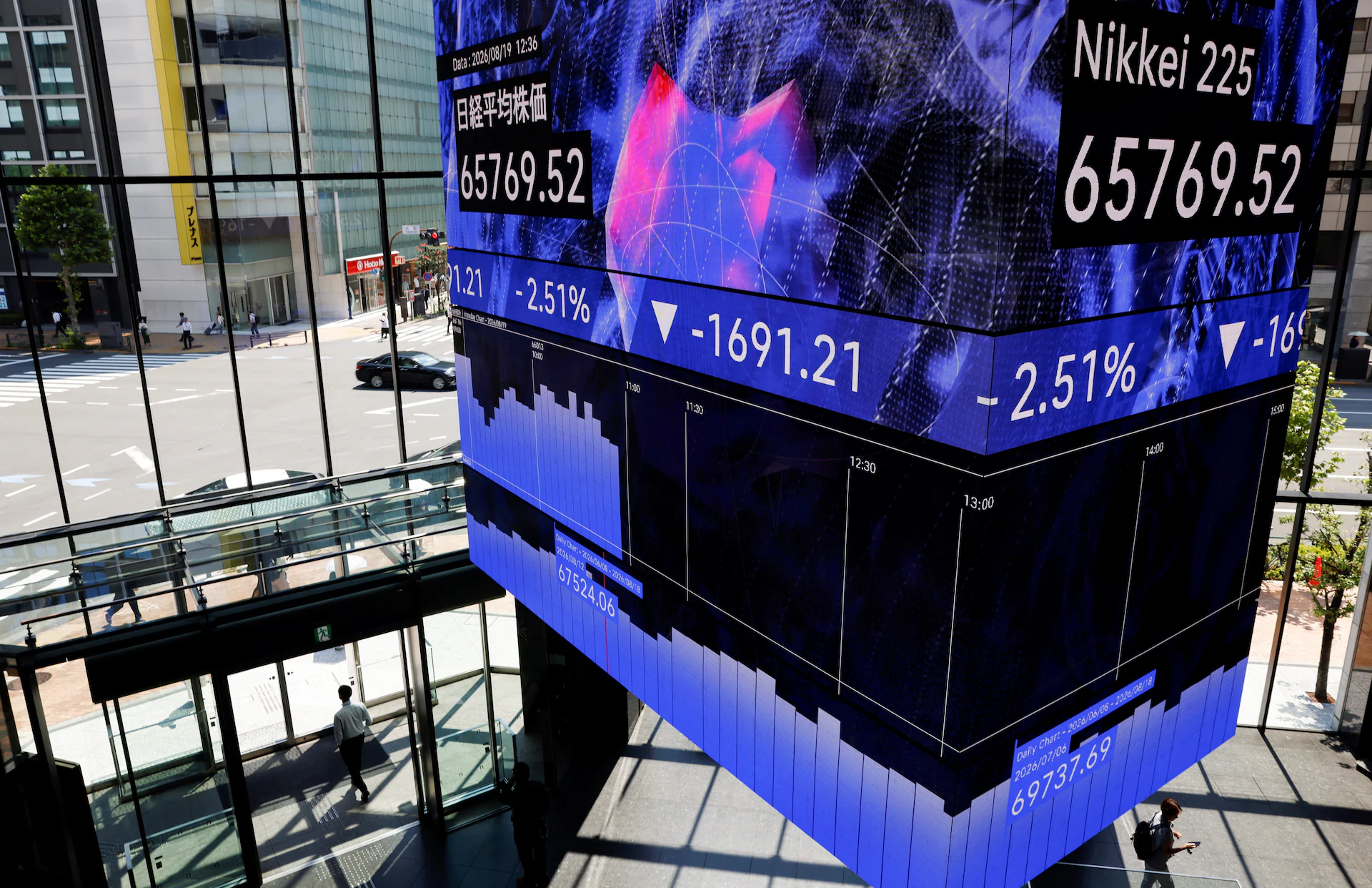
Asian stocks retreated broadly on Tuesday, October 20, while Oil Prices resumed their upward movement as investors assessed geopolitical risks, corporate earnings and the outlook for Artificial Intelligence spending. Markets remained cautious ahead of results from major companies expected to offer fresh evidence about the strength of consumer demand and the broader economy.
The MSCI Asia ex-Japan index fell 1.14%, while Japan’s Nikkei 225 declined 0.98%. South Korea’s KOSPI suffered a sharper fall, dropping 3.92% as selling pressure spread across the region.
Oil prices moved higher as traders considered developments involving US sanctions and tariffs on Russian energy, alongside continuing geopolitical tensions. Meanwhile, investors looked towards upcoming quarterly results from companies including Netflix, SpaceX, Meta and Tesla for indications of business resilience and the sustainability of artificial intelligence-related investment.
The market environment reflects a combination of competing forces. Investors are looking for opportunities as some defensive positions unwind, but uncertainty surrounding geopolitical developments, energy costs and the profitability of AI investments is limiting confidence in a broader rally.
Asian Stock Markets Retreat as South Korea Leads Declines
Asian equity markets recorded widespread losses on Tuesday, with South Korea’s KOSPI experiencing the steepest decline among the major indexes listed in the market report.
The MSCI Asia ex-Japan index dropped 1.14%, while Japan’s Nikkei 225 lost 0.98%. The KOSPI fell 3.92%, reflecting particularly heavy pressure on South Korean equities.
The declines came as investors weighed geopolitical uncertainty against expectations for corporate earnings. With major technology companies preparing to report results, market participants are assessing whether the earnings outlook can justify the valuations and investment commitments associated with the AI boom.
South Korea is an important market for the global technology supply chain, making developments in the AI sector relevant to investor sentiment across the country’s equity market. However, the available market data does not establish that AI-related concerns alone caused Tuesday’s decline in the KOSPI.
One company attracting attention was South Korean AI infrastructure firm Elice Group. Its shares fell nearly 30% below their initial public offering price during their market debut, after the company raised 201.1 billion won, equivalent to approximately $151.12 million, through its IPO.
The debut illustrated the risks investors face when assessing companies associated with fast-growing technology sectors. Even when a business operates in an area attracting significant attention, its market performance can depend on investor expectations, pricing and confidence in its future prospects.
European and US Futures Signal a Cautious Market
European equity futures were lower in early trading, pointing to continued caution among investors. Euro Stoxx 50 futures slipped 0.57%, German DAX futures declined 0.33%, and FTSE futures fell 0.47%.
US stock futures moved in the opposite direction, with S&P 500 e-mini futures rising 0.12% to 7,743.5. The modest gain suggested that investors were not uniformly reducing exposure to equities, despite the weakness across much of Asia and the early declines in European futures.
The mixed performance highlights the importance of distinguishing between short-term market positioning and a sustained improvement in investor confidence. Futures movements provide an indication of market expectations before the main trading session, but they do not guarantee how stocks will perform once trading begins.
Chris Weston, head of research at Pepperstone, said investors were willing to cover short positions and reduce defensive trades but remained hesitant about rebuilding aggressive exposure to AI stocks.
Weston also said French sovereign risk was being reflected in European equities, although the euro’s resilience suggested traders were not yet treating the situation as a systemic problem for Europe.
His assessment points to a market in which investors are adjusting positions in response to individual risks rather than making a decisive move back into higher-risk assets.
AI Earnings Take Centre Stage as Investors Demand Proof of Returns
Corporate earnings are a major focus for global markets this week, particularly results from companies closely associated with artificial intelligence and digital technology.
Netflix and SpaceX were scheduled to report quarterly results on Tuesday, while technology heavyweights Meta and Tesla were due to release results later in the week. Investors are looking for evidence that consumer demand remains resilient and that businesses can continue growing despite economic and geopolitical uncertainty.
Netflix was expected to report slower revenue growth in the third quarter. SpaceX was forecast to generate $12.74 billion in quarterly revenue.
Other companies scheduled to report on Tuesday included General Motors, Hasbro, Halliburton and 3M. Their results could provide additional information about conditions across consumer products, manufacturing, energy services and other parts of the economy.
For technology investors, however, the central question extends beyond whether companies meet or exceed quarterly earnings expectations. Markets are increasingly examining how much major AI developers are spending on infrastructure and whether that expenditure will produce returns sufficient to justify the cost.
Meta, the parent company of Facebook, is among five major AI hyperscalers expected to increase their combined capital expenditure to approximately $1.2 trillion next year, according to Goldman Sachs.
The scale of that projected investment has made capital spending an important consideration for investors. Building AI infrastructure requires substantial financial commitments, while the timing and scale of the resulting revenue remain important uncertainties.
Why AI Capital Spending Is Becoming a Market Risk
The AI investment boom has created expectations of substantial long-term opportunities across technology and other industries. Companies are investing in computing infrastructure, data centres and related capabilities in an effort to support the development and use of increasingly sophisticated AI systems.
However, rising expenditure also creates questions about profitability, financing costs and the speed at which investments can generate measurable economic benefits.
Ninghui Liu, head of investment strategy and research for Asia-Pacific at State Street Investment Management, said investors were increasingly questioning whether AI-related capital expenditure would generate returns greater than the cost of financing it.
Liu described the market’s focus as having moved from an earnings story towards balance sheets and, increasingly, unit economics.
This distinction matters because revenue growth alone does not guarantee that a company’s investment strategy will create value for shareholders. Businesses may generate more sales from AI products while also facing higher infrastructure costs, depreciation expenses and financing requirements.
Investors therefore need to assess not only whether AI adoption is increasing, but also whether companies can turn that adoption into sustainable profits and cash flows.
The upcoming earnings reports may provide additional information about spending plans, business performance and management expectations. However, a single quarter is unlikely to settle the broader debate over whether the enormous investments being made across the AI sector will deliver adequate long-term returns.
Oil Prices Rise as Markets Assess Russia-Related US Policy
Crude oil prices resumed their climb on Tuesday as traders assessed an executive order issued by US President Donald Trump involving Russia-related sanctions and tariffs.
US crude rose 0.18% to $103.85 a barrel, while Brent crude increased 0.08% to $109.64 per barrel.
The executive order, issued on Friday night, waived key Russia-related US sanctions and tariffs, including duties on Russian goods and penalties associated with purchasing Russian oil and gas. Trump said on Saturday that he had yet to announce a final decision on the matter.
The uncertainty surrounding the policy has left markets weighing its potential implications for energy trade and supply conditions. Changes to sanctions and restrictions can influence the movement of oil and gas between producers and consumers, although the precise effect depends on the final policy and how it is implemented.
Oil prices are particularly important for the global economic outlook because energy costs affect transportation, manufacturing, electricity generation and household spending. A sustained increase in crude prices can put pressure on businesses and consumers, potentially complicating efforts by central banks to control inflation.
The latest gains in oil prices therefore come at a time when investors are already assessing the effect of borrowing costs and economic uncertainty on company earnings.
Inflation Concerns Complicate Central Bank Decisions
Elevated oil prices can add to inflationary pressure by increasing costs across energy-intensive industries and raising expenses for consumers. The possibility of renewed inflation has placed central banks in a difficult position as they assess whether monetary policy needs to remain restrictive.
Higher interest rates can help contain inflation by slowing demand, but they can also raise borrowing costs for households and businesses. Companies planning large investment programmes, including AI infrastructure developers, may be particularly sensitive to the cost of financing.
Markets have been monitoring central bank communications for indications of how policymakers view the balance between inflation risks and economic resilience. Recent comments from Federal Reserve officials, including Chair Kevin Warsh, suggested that policymakers were in no rush to raise interest rates again, according to the market report.
That does not mean further rate increases have been ruled out. Central banks typically assess a range of indicators, including inflation, employment, consumer demand and financial conditions, before deciding whether to adjust policy.
The combination of rising oil prices and uncertainty about the economy could make upcoming economic data especially important. Investors will be watching for signs of whether growth remains strong enough to withstand higher energy costs and whether inflation pressures are becoming more persistent.
Dollar Weakens as Euro and Other Currencies Recover
Currency markets showed a mixed but generally softer performance for the US dollar on Tuesday. The dollar index, which measures the greenback against a basket of major currencies, fell 0.16% to 101.80.
The euro rose 0.17% to $1.1229, recovering part of the losses recorded during the previous session amid escalating unrest in France. Sterling gained 0.21% to $1.3327, while the Japanese yen strengthened 0.16% to 158.24 per dollar.
The euro’s recovery came despite concerns about the political and economic implications of the unrest in France. As Weston noted, the currency’s resilience suggested that investors were not yet treating French sovereign risk as a systemic threat to the wider European economy.
Currency movements reflect multiple influences, including interest-rate expectations, political developments and investors’ demand for relatively safe assets. A single session’s change does not necessarily indicate a lasting shift in confidence in a currency or economy.
For international businesses and investors, exchange-rate movements can affect the value of overseas earnings, import costs and returns on cross-border investments. The direction of major currencies will remain relevant as markets respond to earnings announcements and new economic information.
France Unrest and Yemen Attack Add to Geopolitical Uncertainty
Geopolitical developments were another source of uncertainty for financial markets. French authorities imposed curfews in parts of several cities, including Paris, Lille and Nice, following a weekend of riots and looting linked to nationwide anti-government protests.
The unrest has raised concerns about political stability and the potential economic consequences of prolonged disruption. Investors may consider such developments when assessing the outlook for European equities, government borrowing costs and the euro.
In the Middle East, an attack by Iran-aligned Houthi forces on a government security forces training camp in Yemen’s Shabwa province killed dozens of people and injured more than 200, according to the report.
The attack added to the geopolitical risks being monitored by investors, particularly given the region’s significance to global energy markets and shipping routes. However, the immediate effect of any individual security incident on oil prices depends on whether it changes expectations about production, transport or the wider regional situation.
For financial markets, the challenge is to distinguish between developments that create immediate disruptions and those that could have longer-lasting economic consequences. Investors are assessing these risks alongside corporate earnings, monetary policy and the outlook for AI spending.
Gold Advances as Investors Monitor Uncertainty
Spot gold rose 0.13% to $4,145.25 an ounce on Tuesday. The modest gain came as investors considered geopolitical developments, currency movements and uncertainty surrounding the economic outlook.
Gold is often monitored as a potential defensive asset during periods of market stress, although its price can also respond to changes in interest-rate expectations, the US dollar and investor positioning.
When interest rates are expected to remain high, gold can face pressure because it does not pay interest. Conversely, shifts in the dollar or demand for assets perceived as stores of value can support prices.
The latest movement was relatively small and does not, by itself, establish a broad shift towards defensive investments. It nevertheless reflects the range of factors influencing markets as investors await further information from companies and policymakers.
US Housing Data and Central Bank Speeches in Focus
Investors are also preparing for new US housing data that could offer insights into the condition of the economy and the sensitivity of construction activity to borrowing costs.
The US Census Bureau was due to release September figures for housing starts and building permits. Housing starts were expected to rise to 1.305 million from 1.275 million in August, while building permits were forecast at 1.395 million, compared with 1.403 million in the previous month.
Housing starts measure the beginning of construction on new residential buildings, while building permits indicate authorisations for future construction. Together, the indicators can help investors assess housing demand, development activity and the wider economic environment.
Market participants were also scheduled to hear from European Central Bank policymakers Martin Kocher and Olli Rehn, as well as Bank of England Monetary Policy Committee member Megan Greene, who was due to speak at the London School of Economics.
Comments from central bank officials can influence expectations about future interest rates, especially when markets are concerned about the relationship between inflation, energy prices and economic growth.
Cryptocurrencies Post Modest Gains
Cryptocurrency markets recorded small gains on Tuesday. Bitcoin rose 0.22% to $82,117.01, while ether increased 0.63% to $2,413.64.
The advances came amid mixed movements across traditional financial markets, where equities were under pressure in much of Asia while US stock futures edged higher.
Cryptocurrencies can respond to broader changes in investor risk appetite, liquidity conditions and expectations for interest rates. However, the modest gains in bitcoin and ether do not necessarily indicate a wider recovery in digital assets.
Investors will continue to monitor whether movements in cryptocurrencies align with developments in other risk-sensitive markets or reflect factors specific to digital assets.
What Investors Will Watch Next
The next phase of market activity will depend on several closely watched developments. Earnings from major technology companies could provide evidence about the strength of demand for AI products and whether investment spending is translating into financial returns.
Oil prices will remain sensitive to geopolitical developments and changes in expectations surrounding Russian energy trade. Higher energy costs could complicate the inflation outlook and influence expectations for central bank policy.
Investors will also be watching US housing data, central bank speeches and developments in France and the Middle East. Each could affect expectations for growth, interest rates and the willingness of investors to take on risk.
The key question for markets is whether corporate earnings can remain resilient enough to offset uncertainty surrounding geopolitics, energy costs and the growing financial commitments associated with artificial intelligence.
Conclusion
Asian stocks fell on Tuesday as investors assessed geopolitical risks and awaited a fresh round of corporate earnings, while crude oil prices rose amid uncertainty over US policy towards Russian energy. South Korea’s KOSPI led regional losses, while European futures declined and US stock futures edged higher.
Attention is increasingly focused on major AI companies and the scale of their planned capital expenditure. Investors want evidence that rising investment will generate sustainable earnings and returns rather than simply increasing costs and financing requirements.
With oil prices elevated, central banks monitoring inflation and political unrest adding to uncertainty, the coming earnings reports and economic data could help determine whether markets regain confidence or remain cautious. For now, investors are balancing opportunities in the AI sector against questions about profitability, economic resilience and geopolitical risk.
For breaking news and live news updates, like us on Facebook or follow us on Twitter and Instagram. Read more on Latest World on thefoxdaily.com.






COMMENTS 0