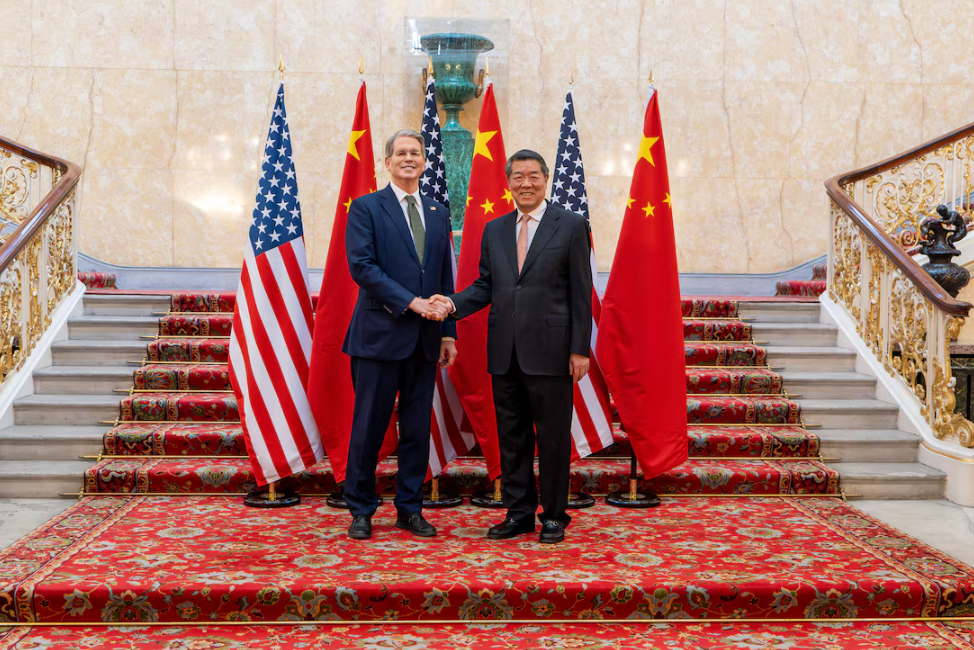
US-China talks on AI, trade and critical minerals are set to take center stage as US Treasury Secretary Scott Bessent and Chinese Vice Premier He Lifeng meet in New York ahead of a planned summit between US President Donald Trump and Chinese President Xi Jinping in Washington. The discussions are expected to address tariffs, access to rare-earth materials, artificial intelligence safeguards and investment, with both governments seeking possible agreements while managing an economically significant relationship.
The meeting comes as the existing US-China trade truce approaches its scheduled expiration on November 10. It also follows unresolved commitments involving agricultural purchases, Boeing aircraft and the movement of critical minerals. Although the discussions could produce limited agreements, analysts cited by Reuters caution against expecting a major breakthrough.
The outcome matters beyond Washington and Beijing. The two economies play major roles in global manufacturing, technology, trade and investment. Decisions involving tariffs, semiconductor-related materials and AI development can affect companies, supply chains and consumers across international markets.
What Is Happening in the US-China Talks?
US Treasury Secretary Scott Bessent and Chinese Vice Premier He Lifeng are scheduled to meet on Sunday, September 20, in Manhattan. US Trade Representative Jamieson Greer is also expected to participate in the discussions, which are planned to take place at JPMorgan Chase’s headquarters and run throughout the day.
The immediate objective is to prepare potential agreements and areas of progress for the anticipated meeting between Trump and Xi later in the week. The senior officials are expected to work through economic and technological issues that have remained unresolved since earlier negotiations.
According to the Reuters report, the agenda includes several connected areas:
- The future of the US-China trade truce, scheduled to expire on November 10.
- Chinese shipments of rare-earth magnets and other critical minerals.
- Potential safeguards for artificial intelligence systems.
- Possible tariff reductions on non-strategic goods.
- Investment-related discussions and business opportunities.
- Earlier commitments involving US agricultural products and Boeing aircraft.
These subjects are linked. Trade restrictions can influence access to materials, while technology rules can affect investment decisions and the availability of AI products. Negotiators therefore face the challenge of addressing several connected disputes without allowing one issue to derail progress on others.
Why the Trump-Xi Summit Matters
The planned summit between Trump and Xi provides a political deadline for the preparatory negotiations. Senior officials are expected to identify areas where their governments might reach an understanding before the presidents meet.
High-level summits can establish broad political direction, but the details of trade and technology agreements often require further work by government agencies and technical teams. Officials must clarify what each side would commit to, how those commitments would be implemented and what happens if they are not fulfilled.
The New York meeting is part of a pattern described in the Reuters report: Bessent, He and Greer have held discussions in European and Asian cities over the preceding 16 months to prepare possible agreements for Trump and Xi.
Those negotiations have included efforts to manage tariffs and restore economic exchanges after periods of escalation. The upcoming summit creates another opportunity to discuss outstanding issues, but it does not automatically mean that all of them will be resolved.
Trade Truce Expiration Creates a Negotiating Deadline
One of the central questions is whether Washington and Beijing can maintain the current trade arrangement beyond November 10. The truce was reached in Busan, South Korea, in November 2025, according to Reuters.
The arrangement followed a period of escalating tariffs, when duties imposed by both countries had reached triple-digit levels. The truce capped US tariffs imposed during Trump’s second term at approximately 20% on Chinese goods, as described in the report.
However, the current tariff framework has been affected by subsequent legal and policy developments. The US Supreme Court struck down tariffs imposed under a national-emergencies law, including duties connected to fentanyl trafficking. The Trump administration has been rebuilding tariffs using other legal authorities.
Reuters reported that these efforts include restoring a 12.5% tariff on Chinese goods over forced-labor allegations. The administration is also finalizing a separate tariff investigation intended to address what it describes as excessive Chinese industrial capacity.
These developments make the trade truce more than a simple agreement to keep tariffs unchanged. The two governments must consider which duties remain in effect, which have been affected by legal decisions and whether additional trade measures could be introduced.
Why tariff policy matters to businesses
Tariffs are taxes on imported goods. Depending on how they are applied, they can change the cost of importing products, influence purchasing decisions and affect the competitiveness of domestic and foreign suppliers.
For companies operating across the US-China trade relationship, uncertainty can complicate planning. Businesses may need to reassess supplier contracts, inventory decisions, prices and investment plans when tariff rules are subject to change.
For consumers, the effects depend on the products involved, the availability of alternative suppliers and whether businesses pass additional costs through to buyers. Tariffs do not affect every product or company in the same way.
The upcoming discussions may therefore focus not only on the headline tariff rates but also on whether the two governments can establish a more predictable framework for trade.
Critical Minerals and Rare-Earth Magnets Take Center Stage
Critical minerals are another major issue in the negotiations. The US has raised concerns about the adequacy of Chinese supplies of rare-earth magnets and other materials that are important to industrial production and advanced technologies.
Under the November 2025 trade truce, China promised to restore the flow of critical minerals to US and global users. However, a senior US official told reporters on Friday that China’s performance had not met Washington’s expectations, according to Reuters.
The issue is expected to be discussed before the Trump-Xi summit.
Why rare-earth materials are strategically important
Rare-earth elements and related materials have applications across a range of industries. Certain rare-earth magnets are used in motors, electronics and other advanced equipment. The Reuters report also highlights the connection between rare-earth materials and the semiconductor technology used in AI systems.
The importance of these materials means that access to them is not simply a matter of routine commercial purchasing. Manufacturers need dependable supplies, while governments may view disruptions as an economic or strategic concern.
When access to important materials becomes uncertain, businesses may have to consider alternative suppliers, adjust production schedules or explore different sourcing arrangements. Such changes can take time and may involve additional costs.
However, the Reuters report does not provide detailed shipment figures or identify specific mineral categories affected by the alleged shortfall. It therefore does not establish the scale of any supply gap across individual industries.
What negotiators may seek
The discussions could examine how China is implementing its commitment to restore mineral flows and what further steps might be possible. The US side has indicated that it wants to address the gap between its expectations and the current situation.
Potential progress would depend on the details of any understanding, including the materials covered, the practical arrangements for shipments and how the parties would assess implementation.
For businesses, clarity about supply arrangements could be important even if the talks do not produce a comprehensive agreement. Predictability can help companies plan production and sourcing, although the actual effect would depend on the terms reached.
Artificial Intelligence Becomes a New Area of US-China Dialogue
Artificial intelligence is emerging as another important subject in US-China economic discussions. Both countries are major participants in the development and adoption of advanced AI systems, creating shared concerns alongside competition over technology.
Bessent said on Friday that he expected the discussions to cover both open-weight and closed-weight AI models. He also said the United States remained a leader in AI and was open to discussions about avoiding shared risks and preventing the two systems from becoming divided.
The focus on AI is significant because the technology is increasingly relevant to business operations, research and digital services. At the same time, powerful AI systems can raise concerns about security, misuse and the protection of sensitive information.
What are open-weight AI models?
Open-weight AI models make their trained parameters available for others to access. Depending on the model’s licence and technical design, users may be able to download the model, run it in their own environment or adapt it for particular tasks.
This differs from many closed-weight systems, where users generally access the model through a service or API and do not receive the underlying model weights.
The distinction is important for businesses evaluating AI tools. Access to model weights can provide flexibility, but it can also shift more responsibility for deployment, security and maintenance to the organisation using the system.
Closed systems may offer a more managed experience, but their users can have less direct control over the underlying model. Actual differences depend on the product, its terms and the way it is deployed.
Why Chinese open-weight models are attracting attention
The Reuters report says Chinese open-weight models are becoming more popular with US companies because they can be less expensive than closed-weight AI tools developed by companies such as Anthropic and OpenAI.
Price is one consideration when businesses assess AI products, but it is not the only one. Organisations may also consider model performance, reliability, data handling, security, technical support, licensing and compatibility with existing systems.
For companies using AI in sensitive environments, the ability to inspect or modify a model does not by itself settle questions about safety or compliance. Those questions depend on how the model was developed, what information it processes and how it is integrated into a business.
The talks could provide a forum for discussing risks associated with different kinds of AI systems while acknowledging that the two countries have distinct technology ecosystems.
AI Guardrails and Shared Security Risks
Bessent has called for the US and China to agree on AI guardrails intended to prevent powerful models from reaching malicious non-state actors. The Reuters report also refers to discussions following reports of security breaches involving AI models.
In this context, guardrails broadly refer to safeguards intended to reduce the likelihood that AI systems will be used in harmful ways. They may involve technical protections, access controls, monitoring practices or procedures for responding to security problems.
However, the report does not identify a completed bilateral framework or provide specific technical standards that the two governments have agreed to adopt. The discussions are described as prospective.
Why international AI safeguards are complicated
AI systems are developed and deployed through complex networks of researchers, companies, cloud providers, users and infrastructure suppliers. A model may be created in one country, hosted in another and used by organisations around the world.
This creates practical questions for any international agreement. Governments would need to determine which systems and activities are covered, what responsibilities companies would have and how compliance could be assessed.
There may also be differences over the balance between security, commercial competition, research access and national control. The Reuters report indicates that Bessent wants to discuss shared risks while avoiding a separation of the two countries’ AI systems.
That goal does not mean the countries have already agreed on common rules. It signals an area for negotiation in which technical, economic and national-security concerns intersect.
Tariff Reductions on Non-Strategic Goods
Another subject carried over from the May meeting between Trump and Xi is the possibility of reducing tariffs on non-strategic goods.
The two countries agreed in May to begin discussions through a mechanism described as a “Board of Trade.” A similar forum was also planned to address specific investment issues.
The distinction between strategic and non-strategic goods could be important because governments may treat products differently depending on their perceived economic or security significance. The Reuters report does not provide a complete list of goods that could qualify for tariff reductions.
Any reduction would require the two sides to determine which products are covered and how the changes would be implemented. Even a limited agreement could affect particular importers and exporters, but its broader impact would depend on the scope of the products included.
Why limited trade agreements can matter
A narrow agreement does not necessarily resolve the underlying trade relationship. It may, however, establish a process for addressing selected disputes and reduce uncertainty in specific areas.
For businesses, targeted changes can matter when they affect frequently traded products or inputs used in manufacturing. The effects are likely to differ across sectors, depending on existing tariff rates, sourcing patterns and the availability of substitutes.
The negotiations will need to clarify whether any proposed reductions are temporary, conditional or part of a longer-term arrangement.
US Agricultural Purchases and Boeing Aircraft Commitments
Several outstanding issues date back to the Trump-Xi meeting in Beijing in May. These include Chinese pledges to increase purchases of US agricultural goods by $17 billion annually and to purchase more than 200 Boeing aircraft.
These commitments connect diplomatic negotiations with commercial activity. Agricultural purchases can affect exporters and producers, while aircraft orders are significant for manufacturers and their supply chains.
However, a pledge to purchase goods is not the same as a completed transaction. The timing, delivery arrangements and implementation of any commitment matter when assessing its economic effect.
The Reuters report identifies these pledges as issues officials must work through before the leaders meet. It does not provide a complete update on how much of the promised agricultural purchasing or aircraft purchasing has already been completed.
That distinction is important when evaluating potential progress. A future commitment, a signed commercial agreement and a delivered product represent different stages of an economic transaction.
Investment Rules and Pharmaceutical Opportunities
Investment is another area where the two governments are exploring possible arrangements. The Trump administration has tightened restrictions on US companies investing in certain Chinese industries, according to the Reuters report.
At the same time, Reuters reported that the administration was working on rules that would likely allow US pharmaceutical companies to invest in promising Chinese drugs and enter licensing agreements.
Such arrangements can provide a way for companies to access research or development opportunities across borders. A licensing agreement may allow a company to develop or commercialise a drug under specified conditions, while an investment can provide financial support in exchange for an ownership interest or other agreed rights.
The potential opening described by Reuters remains subject to the development of rules. The report does not establish that a final policy has been adopted or that particular investments have already been approved.
Why pharmaceutical investment requires careful rules
Pharmaceutical development involves research, intellectual property, clinical testing, regulatory review and commercial decisions. Cross-border arrangements can raise questions about ownership, access to data, licensing terms and compliance with applicable laws.
For that reason, any change in investment policy would need to be understood through its actual legal provisions rather than broad descriptions of openness or restriction.
The possible pharmaceutical rules illustrate how US-China economic policy can involve selective opportunities in some industries alongside continued limits in others.
Chinese Business Delegation Adds a Commercial Dimension
China’s Ministry of Commerce said on Saturday that He Lifeng would lead a delegation of Chinese companies to the United States. The businesses are expected to participate in economic and trade consultations ahead of the summit.
The delegation mirrors a group of US chief executives that Trump brought to Beijing in May, according to Reuters.
Business participation can provide negotiators with information about commercial barriers, investment interests and practical difficulties that government-level discussions may not fully capture. Companies can also explain how proposed policies might affect their operations.
However, the presence of a business delegation does not guarantee that commercial agreements will be signed. Company participation and government commitments are separate elements of the process.
Chinese Automakers and US Market Access
The announcement of the Chinese business delegation came as Trump expressed openness to Chinese automakers building factories in the United States.
US auto industry groups, meanwhile, urged Trump on Friday to maintain what they described as an effective ban on Chinese vehicle sales in the US, citing national-security grounds.
The contrasting positions highlight a policy question involving manufacturing, market access and security concerns. Allowing companies to establish factories in the United States would be different from allowing unrestricted imports of finished vehicles.
Any specific investment or market-access arrangement would depend on the rules that apply to the company, its products and its operations. The Reuters report does not identify a completed agreement permitting a particular Chinese automaker to establish a US factory.
Potential implications for the automotive industry
Automotive manufacturing involves extensive supply chains, including components, materials, software and production equipment. Decisions about factory investment and vehicle imports can therefore affect more than the company directly involved.
For US manufacturers, the policy debate involves competition and the conditions under which foreign companies can operate. For Chinese automakers, access to the US market could involve investment decisions and compliance with US requirements.
The talks may help clarify whether the two governments are prepared to discuss these questions as part of their wider economic relationship. The positions reported by Reuters show that the issue remains contested among the stakeholders involved.
What Outcomes Are Realistic Before the Summit?
Analysts cited by Reuters suggest that the most likely result of the meetings may be limited steps intended to demonstrate that both governments are continuing to avoid escalating tensions.
Anna Ashton, a China trade analyst and founder of Ashton Intelligence, said she expected some visible deliverables because a presidential summit was approaching, while expressing doubt that the countries were close to a major breakthrough. She also described maintaining the status quo as a likely general expectation for both sides.
This assessment is an analyst’s view, not an official agreement or confirmed outcome. The talks were scheduled to begin on September 20, and their final results were not established in the supplied report.
Possible forms of limited progress could include agreement to continue negotiations, clarification of existing commitments or the identification of specific issues for further work. Whether any of these occurs must be determined by the actual statements and agreements issued after the meeting.
What Businesses and Markets Will Be Watching
Companies with exposure to the US-China relationship may monitor the negotiations for information about tariffs, supply-chain access, AI rules and investment policy.
Several developments would be particularly relevant:
- Trade truce: Whether the two sides indicate that they intend to extend or otherwise manage the arrangement before November 10.
- Critical minerals: Whether China provides further clarity about supply commitments and whether the US reports progress.
- AI safeguards: Whether officials agree on a continuing dialogue or identify specific areas for cooperation.
- Tariffs: Whether a process emerges for reducing duties on selected non-strategic goods.
- Agricultural purchases: Whether officials provide details about the status of China’s purchasing pledge.
- Boeing orders: Whether there is further information about the aircraft commitment.
- Investment: Whether the countries clarify any planned changes to investment discussions or pharmaceutical rules.
- Automotive policy: Whether factory investment and vehicle market access become part of a formal discussion.
These are indicators to watch, not confirmed results. Their significance will depend on the wording, scope and implementation of any announcements.
Conclusion: A Test of Economic Coordination Between Washington and Beijing
The planned meeting between Scott Bessent, He Lifeng and Jamieson Greer brings together several of the most consequential issues in the US-China economic relationship: tariffs, critical minerals, artificial intelligence, investment and commercial purchasing commitments.
The November 10 trade-truce deadline gives the negotiations a clear timetable, while the planned Trump-Xi summit creates an immediate reason for officials to seek progress. Yet the number of unresolved issues, differences in policy priorities and uncertainty surrounding implementation mean that a comprehensive settlement cannot be assumed.
The discussions could still produce limited agreements or establish processes for further negotiation. Their importance will depend not only on announcements made before the summit but also on whether both governments follow through on any commitments.
For businesses and the wider global economy, the central question is whether Washington and Beijing can make their economic relationship more predictable while continuing to manage disagreements over technology, trade and strategic materials.
For breaking news and live news updates, like us on Facebook or follow us on Twitter and Instagram. Read more on Latest Business on thefoxdaily.com.






COMMENTS 0