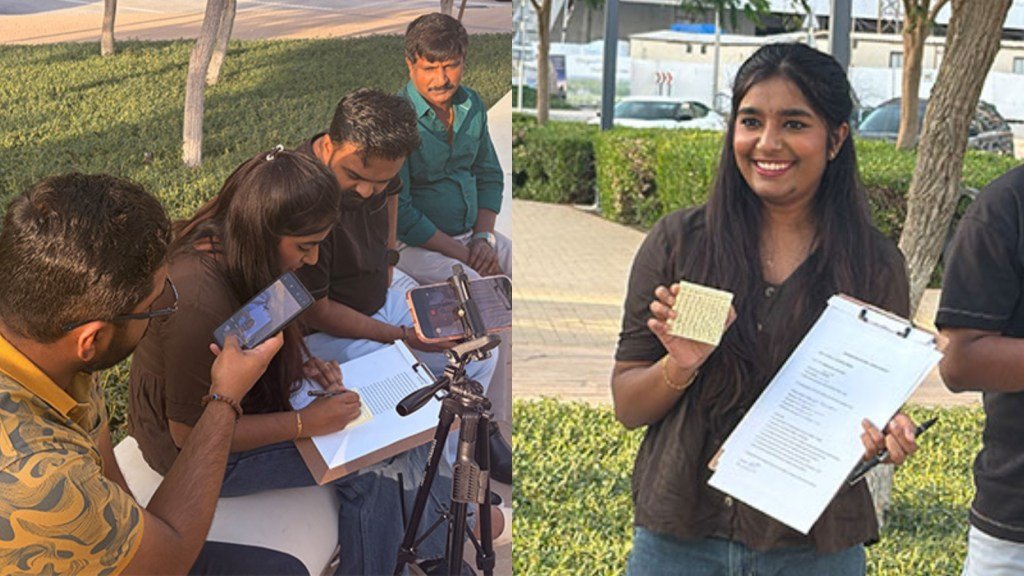
A small sticky note has become the unlikely stage for a Guinness World Records achievement after 29-year-old Pushpajothi Ravikumar managed to write 150 different words on a single note.
Based in the United Arab Emirates and working as a senior cloud engineer, Ravikumar took on a challenge that required much more than simply writing quickly or using tiny lettering. She had to maximise an extremely limited writing surface while ensuring that all 150 words remained readable.
Her successful attempt earned her a place in the Guinness World Records for writing the most words on a single sticky note. The achievement grew out of a childhood fascination with record-breaking feats and eventually turned into a personal challenge she completed on her first attempt.
How Ravikumar fit 150 words on one sticky note
The central challenge was space. A conventional sticky note offers only a small writing area, leaving little room for long words, large handwriting or unnecessary gaps.
Ravikumar approached the problem by making every part of the note count. She selected short and simple words, with most of the words she used containing only three letters.
That choice dramatically reduced the amount of space required for each entry. Instead of attempting to compress long words into extremely small handwriting, she designed the list around words that could naturally fit within the available area.
But word selection was only one part of the task. The words also had to remain legible, meaning that making the writing smaller could not come at the expense of readability.
Ravikumar’s experience experimenting with different handwriting styles became useful during the attempt. She adjusted her writing approach to make better use of the limited surface while keeping the individual words distinguishable.
The record attempt succeeded on her first try
Perhaps one of the most striking details of the achievement is that Ravikumar completed the challenge successfully on her very first attempt.
That does not mean the process was simple. Fitting 150 separate words into such a small area required planning before the actual writing began.
Every additional word consumed some of the remaining space, while every change in handwriting size affected how much could ultimately fit. A mistake could also create a practical problem because rewriting a section might require using valuable space elsewhere on the note.
Her strategy was therefore based on efficiency rather than simply speed. Short words reduced the amount of writing required, while different handwriting techniques helped her use the available area more effectively.
Why using mostly three-letter words mattered
Word length became one of the most important variables in the challenge.
A sticky note does not provide enough space to write 150 ordinary sentences comfortably. Ravikumar instead focused on individual words and selected mostly three-letter examples.
Short words have another advantage beyond their length: they can be written relatively compactly without becoming excessively difficult to read. This helped her balance the two requirements at the heart of the record attempt: quantity and legibility.
The distinction is important. The achievement was not simply about creating the smallest possible writing. If the words could not be read, the attempt would lose its purpose.
Ravikumar therefore had to find a middle ground between compact handwriting and clear writing, turning what looks like a simple stationery challenge into an exercise in planning, spatial Awareness and handwriting control.
A childhood dream of becoming a record holder
For Ravikumar, the sticky-note challenge had a personal motivation that went back much further than the attempt itself.
She had been fascinated by Guinness World Records since childhood and had long dreamed of becoming a record holder. That interest eventually encouraged her to stop simply reading about unusual records and try to create one herself.
Her choice of challenge was also closely connected to an everyday object. Sticky notes are normally associated with reminders, lists, office work and quick messages. Ravikumar turned that ordinary piece of stationery into the basis of a record-breaking experiment.
The result was a particularly compact achievement: 150 words occupying a surface that is normally used for only a handful of reminders.
The record attempt also became a social media hit
After completing the challenge, Ravikumar posted a video of her attempt on Instagram. According to Guinness World Records, the video attracted nearly 1 million views.
The unexpected online attention helped turn what began as a personal record attempt into a much wider story.
Family members, friends and even people from her former college began asking her about the achievement after seeing or hearing about the video.
The reaction illustrates how unusual visual challenges can travel quickly online. The idea is immediately understandable: 150 words, one tiny note. Viewers do not need a lengthy explanation to appreciate the physical constraint involved.
The visual Nature of the attempt also makes it particularly suited to short-form video, where the finished note provides an instant way of showing the result.
More than a test of handwriting
Although the record appears to be about writing, the attempt involved several skills working together.
First came planning. Ravikumar had to consider which words could fit within the available space.
Second was spatial management. The writing had to be arranged so that the available surface was used efficiently without making the words overlap or become unreadable.
Third was handwriting control. Different styles could help her adapt to the shape and remaining space on the note.
Finally, there was execution. Once the attempt began, maintaining consistency mattered because a poorly positioned word could make it harder to accommodate the remaining entries.
That combination makes the achievement more interesting than a simple test of how small someone can write.
Why legibility was crucial to the challenge
Writing more words is relatively meaningless if the resulting text cannot be read. Ravikumar specifically focused on keeping the 150 words legible despite the restricted surface.
This created a practical limit to how aggressively she could shrink her handwriting.
The challenge was therefore a balancing act. Larger letters would make the words easier to read but would consume more space. Smaller letters would allow more words but could make the writing difficult to distinguish.
Her use of mostly three-letter words helped solve part of that problem by reducing the number of characters required without requiring extremely tiny lettering for every word.
The confidence boost behind the record
Ravikumar has described the achievement as more than simply adding a Guinness World Records title to her name. She said becoming a record holder gave her a greater sense of confidence.
That personal impact may be one of the more meaningful aspects of the story.
Record attempts often begin with an unusual idea, but completing one can demonstrate that a seemingly impractical goal can become achievable when it is broken down into manageable constraints.
In Ravikumar’s case, the task involved a simple object, a limited amount of space and a clear numerical target. Her success showed that an unconventional skill can become the basis for a record when it is approached with enough preparation and precision.
What makes this Guinness record unusual?
Guinness World Records contains achievements involving enormous physical feats, endurance, speed and technical accomplishments. Ravikumar’s record belongs to a very different category of human ability.
Its appeal comes from its simplicity.
Almost everyone has encountered a sticky note. They are designed to be small and convenient, not to accommodate a large body of text. Turning that limitation into a competition creates an immediately relatable challenge.
The record also demonstrates how Guinness titles can emerge from highly specific everyday activities. A record does not necessarily require extraordinary equipment or a large team. In this case, the central tools were a sticky note, writing ability and careful planning.
What the achievement says about everyday skills
One reason the story has attracted attention is that it highlights an ability that might otherwise go unnoticed.
Ravikumar’s professional career is in cloud engineering, a field far removed from handwriting competitions. Yet an interest in experimenting with handwriting styles gave her a useful skill for a completely different challenge.
That contrast is part of what makes the record distinctive. A person’s profession does not necessarily define every ability they can develop or use.
Ravikumar herself hopes to attempt additional records, viewing such challenges as opportunities to discover and demonstrate abilities that people may not always realise they possess.
From a childhood fascination to a world record
The path from being fascinated by Guinness World Records as a child to becoming a record holder is perhaps the simplest way to understand the achievement.
The idea began as an aspiration. Instead of attempting one of the more obvious physical or endurance records, Ravikumar identified a highly specific challenge based on something familiar: handwriting and a sticky note.
She then turned the idea into a measurable target by aiming to place as many words as possible onto the limited surface while retaining legibility.
The final number, 150, gave the attempt a clear endpoint and ultimately became the figure associated with her record.
What could come next for Ravikumar?
Ravikumar has indicated that she would like to take on more record-breaking challenges in the future.
Her first successful attempt may therefore be the beginning rather than the end of her record-setting ambitions.
Whether her next challenge involves handwriting, precision or an entirely different skill remains to be seen. What is clear is that the sticky-note achievement has given her both a Guinness World Records title and greater confidence in pursuing unusual goals.
150 words, one tiny piece of paper
Ravikumar’s record is remarkable precisely because of how ordinary its central object is.
A sticky note is usually somewhere between a reminder and a temporary piece of paper. It might hold a phone number, a shopping item or a quick message before being discarded.
Ravikumar used the same basic idea differently. By selecting mostly three-letter words, adapting her handwriting and carefully managing the available space, she turned one small note into a record-breaking canvas.
The achievement also offers a simple lesson: unusual records can come from skills that people often overlook. For Ravikumar, years of fascination with Guinness World Records eventually led to an attempt that combined creativity, precision and persistence.
For now, her name is attached to a remarkably small piece of paper and a remarkably large number for it: 150 words on a single sticky note.
For breaking news and live news updates, like us on Facebook or follow us on Twitter and Instagram. Read more on Latest World on thefoxdaily.com.






COMMENTS 0