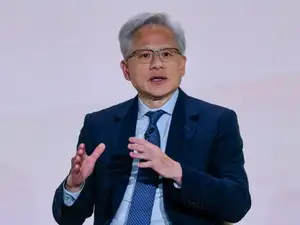
Nvidia‘s extraordinary rise from a specialist graphics-chip manufacturer to one of the world’s most valuable technology companies has been closely tied to the leadership of co-founder and chief executive Jensen Huang. Over several decades, Huang has shaped the company’s strategy, culture and product direction, helping turn its graphics processing units into essential infrastructure for the Artificial Intelligence industry.
That close association between the company and its chief executive is now drawing attention to a difficult question: what happens to Nvidia when Huang eventually steps aside?
The question has become more significant amid controversy surrounding personal allegations involving Huang and reported concerns about possible foreign intelligence interest. While these developments do not establish wrongdoing by the executive, they have added to investor scrutiny of the risks associated with a company whose identity and market success are so closely connected to one individual.
Huang’s management structure offers another reason succession planning is attracting attention. He reportedly has around 60 direct reports and remains involved in decisions across the business, including matters such as employee compensation. His hands-on approach has helped maintain close control over Nvidia’s operations, but it also raises questions about how responsibilities would be distributed under a future leader.
A Company Built Around Jensen Huang
Nvidia’s corporate culture reflects Huang’s unusually direct approach to management. Rather than relying on a conventional executive hierarchy with a small group of senior leaders reporting directly to him, he has maintained a broad organisational structure in which dozens of executives report to the chief executive.
With approximately 60 direct reports, Huang can remain closely connected to different parts of the company. This structure gives him visibility into operational decisions and allows him to engage with executives responsible for major business functions.
His involvement reportedly extends beyond high-level strategy. Huang has also taken an interest in employee compensation, illustrating how closely he monitors decisions that would typically be delegated to other senior managers in many large corporations.
Supporters of this management approach may see it as a way to reduce organisational distance between leadership and employees. It can also allow a chief executive to identify problems quickly and maintain consistency across teams working on different products and markets.
However, such a structure can create challenges when a company becomes enormous. As Nvidia expands across AI computing, data-centre infrastructure, networking and software, the number of strategic decisions requiring executive attention also increases.
The model also creates a succession challenge. A future chief executive would need to manage an organisation accustomed to receiving direction and oversight from Huang personally. Replacing him would therefore involve more than appointing another executive; it could require changes to the company’s leadership structure and decision-making culture.
How Nvidia Delivered an Extraordinary Return for Investors
Nvidia’s remarkable stock-market performance is a major reason investors pay close attention to the company’s leadership. The company’s long-term share-price appreciation has been extraordinary, with the headline figure of roughly 700,000% reflecting the scale of wealth created for investors who held the stock over an extended period.
The transformation was driven by Nvidia’s evolution beyond its original graphics-chip business. Its GPUs became increasingly important for demanding computing tasks, including scientific research, data processing and machine learning.
The expansion of generative AI accelerated that transition. Training and running advanced AI models require substantial computing capacity, making high-performance processors and related infrastructure central to the technology industry’s investment plans.
Nvidia benefited from this shift because it had spent years developing hardware and software designed for parallel computing. Its products became important components of the infrastructure being built by cloud providers, technology companies and organisations developing AI systems.
The company’s position was also strengthened by its broader technology ecosystem. Customers do not simply purchase individual chips; they increasingly rely on connected hardware, software, networking and development tools. That integrated approach has helped Nvidia establish a significant position in the AI computing market.
Huang’s leadership has been central to the company’s long-term strategic direction. His decisions helped position Nvidia to benefit from the growth of accelerated computing before generative AI became a mainstream commercial priority.
That history explains why investors may view a leadership transition as an important event. The concern is not simply whether another executive can manage a large semiconductor company, but whether a successor can preserve the strategic direction and execution that helped produce Nvidia’s extraordinary growth.
Nvidia Is at the Centre of Circular AI Deals
Another issue attracting investor attention is Nvidia’s position within the wider network of AI investments, infrastructure spending and commercial agreements. The company is a major supplier to the AI industry, while its products are also central to the expansion plans of cloud providers and companies developing advanced models.
This has placed Nvidia at the centre of a fast-growing investment ecosystem in which technology companies, investors, cloud operators and AI developers have overlapping commercial interests.
Some arrangements across the industry have raised questions about circular financing. This term generally describes situations in which companies invest in, finance or enter commercial agreements with other businesses that subsequently spend money on products or services from the original investor or partner.
Such arrangements can create a complicated picture of demand. An investment announcement may support a partner’s expansion, while that partner’s purchases can generate revenue for the company providing the investment or infrastructure.
That does not automatically mean the underlying business is artificial or that a transaction is improper. Investments, supply agreements and strategic partnerships are common in capital-intensive technology industries. However, overlapping financial relationships can make it harder for investors to assess how much growth is supported by independent customer demand.
Nvidia’s importance to the AI supply chain makes these questions particularly relevant. Its financial performance is closely watched as a measure of demand for AI infrastructure, while the spending plans of major technology companies influence expectations for future chip sales.
Investors therefore have to consider more than Nvidia’s current revenue and market position. They also need to assess whether customers can sustain their spending, whether AI services will generate sufficient returns and how the industry’s financing arrangements may evolve.
Investors Wary of a Leadership Shake-Up
For a company of Nvidia’s size, succession planning is a normal corporate governance issue. However, the subject carries particular weight when the chief executive has been so closely associated with the company’s identity and strategic success.
Huang is not simply an executive appointed to manage an established business. He co-founded Nvidia and has led its development through multiple technology cycles. His influence extends across product strategy, organisational culture and the company’s relationships with customers and industry partners.
That history can make investors cautious about any unexpected leadership change. A successor would inherit a business operating in a highly competitive industry, where product development, manufacturing capacity and customer relationships require long-term planning.
The uncertainty is amplified by the speed of the AI market. Nvidia faces competition from established semiconductor companies as well as technology firms developing their own specialised processors. Maintaining its position requires continued investment in research, engineering and the wider computing ecosystem.
Investors may therefore be concerned about whether a new leader could maintain the pace of innovation while preserving the confidence of customers, employees and business partners.
Controversies involving a high-profile chief executive can also attract attention to governance and reputational risks. However, personal allegations and reported intelligence concerns should not be treated as evidence of misconduct or as proof that a leadership change is imminent.
Huang Wants His Successor to Come From Within
Huang has indicated that he would prefer a future successor to emerge from within Nvidia rather than arrive as an outside appointment. That preference reflects the importance he places on the company’s existing culture and the experience of people who understand its technology and business.
An internal candidate could offer continuity. Executives who have worked closely with Huang may already understand Nvidia’s approach to product development, customer relationships and long-term investment decisions.
They may also have experience navigating the company’s expansion from a graphics-chip business into a major provider of AI computing infrastructure.
However, an internal appointment would not automatically guarantee a smooth transition. The next chief executive would need to establish independent authority while managing executives who have become accustomed to Huang’s direct involvement.
The challenge would be to preserve the strengths of Nvidia’s existing culture without simply attempting to reproduce Huang’s management style. A successor would also need to decide which responsibilities should remain centralised and which should be delegated through a more conventional leadership structure.
Huang’s preference for an internal candidate suggests that succession planning is being considered in terms of continuity rather than a complete change in corporate direction. Yet the company would still need to demonstrate that its leadership capabilities extend beyond its co-founder.
No Heir Apparent in Nvidia’s Top Ranks
Despite Nvidia’s extensive executive team, there is no publicly established successor who is widely recognised as Huang’s clear replacement. Several senior leaders have substantial responsibilities, but none has emerged as an obvious second-in-command with authority across the entire company.
Chief Financial Officer Colette Kress is among Nvidia’s most visible executives. She regularly represents the company during financial results presentations and investor discussions. Her role gives her an important position in communicating Nvidia’s performance and financial strategy, although that does not automatically make her the leading candidate for chief executive.
Other senior executives oversee important areas, including worldwide operations, engineering, software and legal affairs. Their experience is valuable, but Nvidia’s organisational structure means many leaders have responsibility for specific functions rather than broad control over the business.
Huang’s large number of direct reports is particularly relevant here. In a more traditional corporate structure, a chief operating officer or president might serve as the recognised deputy, gaining experience across multiple divisions before eventually taking over. Nvidia’s flatter structure does not make that kind of succession path immediately visible.
There may be confidential succession arrangements that have not been disclosed publicly. The absence of a publicly identified heir does not prove that the board has no contingency plan. Nevertheless, the lack of an obvious successor has become a governance concern as investors examine the company’s dependence on its co-founder.
Why Replacing Huang Won’t Be Easy
Replacing Huang would be difficult because his influence extends beyond the responsibilities normally associated with a chief executive. He has helped shape Nvidia’s technical direction, built relationships with major customers and become one of the most recognisable figures in the global AI industry.
His understanding of the company’s products and engineering priorities is particularly important. Nvidia operates in a market where decisions about chip architecture, computing systems and software ecosystems can influence its competitive position for years. A successor would need enough technical understanding to make strategic decisions while relying on experienced engineering leaders for specialist knowledge.
Huang has also become an important representative of Nvidia in discussions with governments and policymakers. The company’s business is closely connected to international trade, semiconductor supply chains and restrictions on advanced technology exports. His relationships with political leaders and industry executives have therefore become part of Nvidia’s broader strategic position.
A new chief executive would have to establish credibility with customers, investors and governments while maintaining the confidence of employees. That transition could be especially challenging if it happened unexpectedly or during a period of uncertainty surrounding the company’s leadership.
There is also the question of management style. Huang’s direct involvement in numerous decisions has helped create a company culture centred on his leadership. A successor might need to delegate more authority, establish clearer reporting structures and give senior executives greater independence.
Such changes would not necessarily weaken Nvidia. A more distributed leadership model could help the company manage its expanding operations. But any transition would need to be handled carefully to avoid disrupting product development, customer relationships and strategic decision-making.
China Spy Allegations Add to Nvidia’s Leadership Scrutiny
The succession debate has intensified amid reports that Huang may have been targeted by a foreign intelligence operation involving Alice Huang, a former executive at Singapore-based data-centre company Megaspeed International. The allegations have attracted attention because of Nvidia’s importance to the global AI industry and the sensitivity surrounding advanced semiconductor technology.
Reports citing US intelligence assessments have alleged that Alice Huang had links to Chinese intelligence and may have sought information about Jensen Huang and Nvidia. These claims have not been independently established in public, and China has rejected the allegations as unfounded.
Jensen Huang separately acknowledged being unfaithful to his wife and apologised to his family and Nvidia employees. The admission brought the personal controversy into sharper focus, but it does not establish that he knowingly participated in any intelligence activity.
Nvidia’s board has announced an independent investigation into reports that its chief executive was the target of a foreign intelligence effort. The company has said it has no reason to believe that national security information or Nvidia trade secrets were compromised. Huang has supported the review and committed to cooperating with it.
The investigation is important because Nvidia’s products are central to the development of advanced AI systems. Questions about whether sensitive information was exposed, what the chief executive knew and whether the company followed appropriate security procedures have implications beyond Huang’s personal circumstances.
For investors, the immediate issue is whether the controversy could affect leadership continuity, corporate governance or confidence in the company’s management. The board’s findings may help clarify those questions, but the allegations should not be treated as established facts before the investigation reaches its conclusions.
What Nvidia’s Succession Challenge Means for Investors
Nvidia’s extraordinary market performance has rewarded investors who backed the company over the long term. However, the latest controversy highlights a risk that cannot be measured through chip shipments, quarterly revenue or AI infrastructure spending alone: the company’s dependence on its founder.
This is commonly described as key-person risk. It arises when a company’s performance, strategy or reputation depends heavily on an individual whose departure could create uncertainty.
For Nvidia, that risk is particularly significant because Huang has been involved in the company’s development since its founding. His leadership has helped guide its transition into a central supplier for the AI economy, and his public profile is closely associated with its technological ambitions.
Investors will therefore be watching several issues beyond the immediate share-price reaction. These include the outcome of the board’s investigation, the company’s approach to succession planning, the strength of its senior management team and its ability to maintain customer confidence.
The wider AI market also matters. Nvidia’s future performance depends on continued demand for advanced computing infrastructure, the ability of customers to fund their AI investments and the company’s capacity to remain competitive as rivals develop alternative chips and systems.
A leadership transition would not automatically undermine Nvidia’s business. The company has a large workforce, experienced engineers, established customer relationships and an extensive technology ecosystem. Those strengths could support continuity under a new chief executive.
However, investors would need evidence that the company can operate effectively without Huang’s unusually broad involvement. A credible succession framework would help demonstrate that Nvidia’s long-term strategy is institutional rather than dependent entirely on its founder.
Can Nvidia Remain Successful Beyond Its Founder?
Nvidia’s next leadership chapter will test whether the company can turn the success built under Huang into a durable corporate institution. Its position in AI computing gives it substantial technological and commercial advantages, but those advantages do not remove the need for effective governance and succession planning.
Huang’s preference for an internal successor points towards continuity, yet the company has not publicly identified a clear heir apparent. Its broad reporting structure, the chief executive’s involvement in daily decisions and his influence over product strategy make the eventual transition unusually complex.
The controversy surrounding the reported intelligence operation has brought these questions into sharper focus. Nvidia’s independent board investigation will be important in clarifying whether any sensitive information was compromised and what, if any, governance or security changes may be necessary.
For now, Huang remains Nvidia’s chief executive, and the board has said it has no reason to believe company secrets or national security information were compromised. The longer-term question is whether Nvidia can build a leadership structure capable of sustaining its position regardless of who occupies the top job.
The company’s remarkable investor returns reflect decades of technological decisions and market expansion. Preserving that success will require more than another breakthrough chip. It will also require a succession strategy that gives shareholders confidence that Nvidia’s future does not depend on one person alone.
For breaking news and live news updates, like us on Facebook or follow us on Twitter and Instagram. Read more on Latest World on thefoxdaily.com.






COMMENTS 0