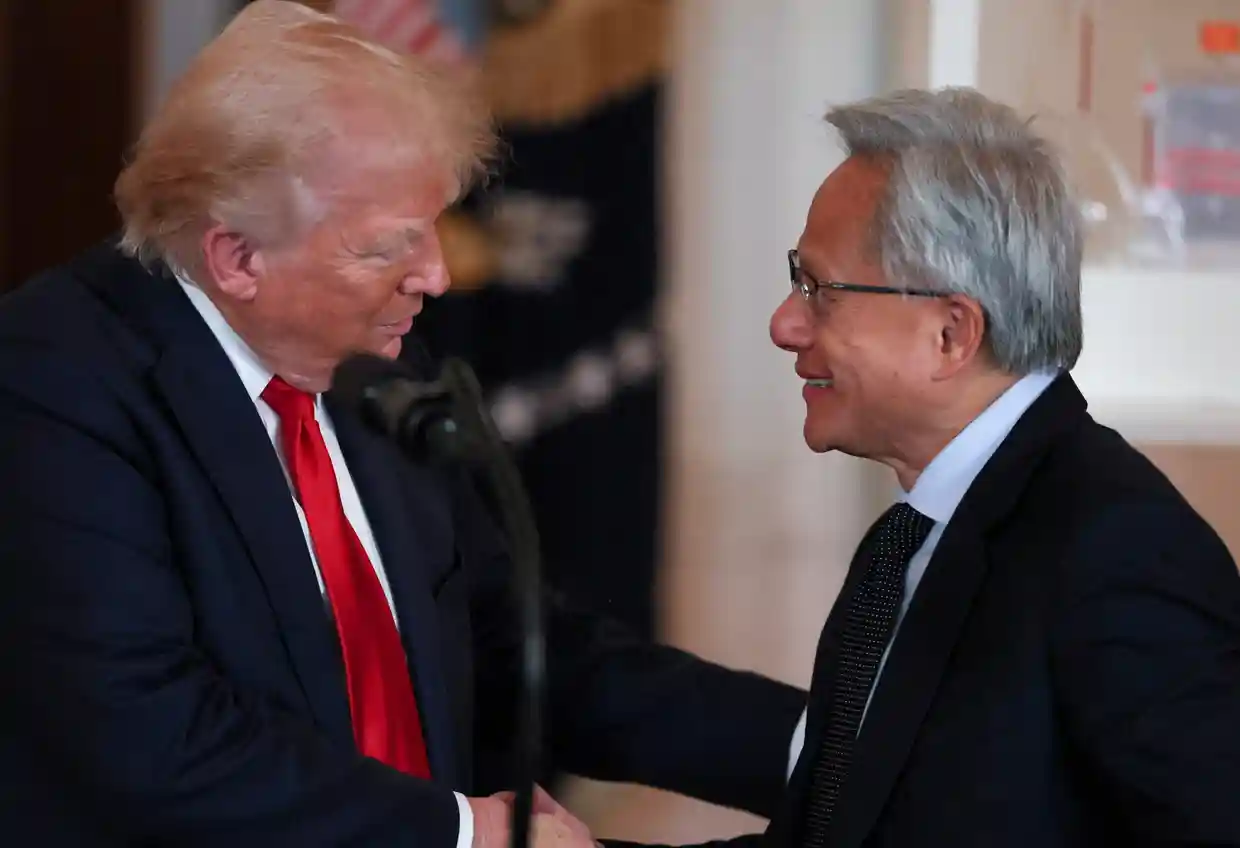
The personal life of Nvidia chief executive Jensen Huang has become the subject of a National Security debate after he acknowledged having an affair with Alice Huang, a former executive at Singapore-based technology company Megaspeed who has been alleged in reports to be connected to Chinese intelligence.
The disclosure has added a new dimension to questions surrounding Nvidia’s international business relationships, US export controls and Huang’s unusually close access to President Donald Trump. The concerns extend beyond the executive’s personal reputation to the possibility that a foreign intelligence operation could have sought information through someone close to one of America’s most influential technology leaders.
Nvidia has announced an independent investigation into reports concerning the relationship and possible security implications. The company’s board said it had no reason to believe that national security or Nvidia’s confidential information had been compromised, while stressing that its inquiry would examine all available information.
The allegations have not established that Alice Huang obtained or passed sensitive information to Beijing. However, the circumstances have prompted renewed scrutiny of the connections between the global semiconductor industry, government decision-making and foreign intelligence risks.
How the Jensen Huang and Alice Huang story emerged
The story began attracting attention last year when reports raised questions about Megaspeed, a Singapore-based buyer of Nvidia’s advanced artificial intelligence chips. The company came under scrutiny over concerns that Nvidia inventory might have been diverted to China in violation of American export restrictions.
Such allegations were significant because Nvidia’s graphics processing units, or GPUs, are among the most important components used to develop and operate advanced AI systems. Washington has introduced restrictions on the export of certain high-performance chips to limit China’s access to technologies that could strengthen its artificial intelligence and military capabilities.
Nvidia and Megaspeed denied the allegations concerning the diversion of chips. Megaspeed maintained that it operated in compliance with applicable laws, including US export control regulations.
The controversy took another turn when a subsequent report said Jensen Huang had developed a close relationship with Alice Huang, a Megaspeed executive. The report also stated that American officials believed she was a Chinese intelligence asset and that Trump had been informed about the matter.
Huang’s admission that the relationship was an affair has intensified questions about the circumstances in which the two met and the potential access Alice Huang may have had to sensitive information.
Footage showing the pair interacting at a venue in Taipei in 2025 has also attracted attention. What initially appeared to be an ordinary social interaction has acquired a different significance following the disclosure.
However, the available allegations do not establish that the relationship was part of a confirmed intelligence operation. Nor do they demonstrate that classified government information or Nvidia trade secrets were transferred.
Why Alice Huang’s alleged intelligence links matter
The central security concern is the possibility that a person with access to a powerful technology executive could gain insights into commercial decisions, government discussions and sensitive policy developments.
Jensen Huang occupies an influential position in the global AI industry. Nvidia supplies the advanced chips required by many companies and governments seeking to develop artificial intelligence infrastructure. Its products are central to the computing systems used for AI research, training and deployment.
That position gives Huang access to information that extends beyond ordinary corporate operations. He regularly interacts with political leaders, government officials and executives from major technology companies. His conversations can involve chip availability, international trade restrictions, AI investment and the future direction of the industry.
If someone close to him had been attempting to collect information for a foreign government, even informal conversations could potentially have provided valuable insights. Such information might include the priorities of policymakers, the direction of negotiations or the commercial expectations of major technology companies.
There is an important distinction between access to sensitive information and proof that it was obtained. The reports have raised questions about what Alice Huang might have learned, but the extent of any access and whether information was shared with Chinese authorities remain unestablished.
Huang’s relationship with Trump adds another layer
The controversy has become particularly sensitive because of Jensen Huang’s relationship with Donald Trump. Since the beginning of Trump’s second presidential term, the Nvidia chief has met the president repeatedly and maintained direct access to the White House.
According to the supplied reporting, the two have met at least seven times. Huang has also travelled aboard Air Force One and received calls from Trump during public appearances.
Their discussions have frequently involved one of the most consequential areas of US-China economic policy: restrictions on the export of advanced artificial intelligence chips.
These restrictions affect Nvidia’s business directly. The company dominates the market for several categories of advanced AI processors, making decisions about which chips can be sold to which countries particularly important for its revenue and international position.
Huang’s access to the president has therefore placed him at the intersection of private commercial interests and government decisions involving national security.
The reported relationship with Alice Huang has raised a further question: whether someone allegedly connected to Chinese intelligence could have gained indirect insight into discussions involving the American president and the future of US technology policy.
That possibility has attracted attention, but the existence of a personal relationship does not by itself establish that presidential discussions were compromised.
Why Nvidia’s chip exports to China became a major political issue
To understand the potential security implications, it is necessary to examine the restrictions Washington has placed on advanced semiconductor exports to China.
Advanced GPUs are essential for training large AI models and operating increasingly sophisticated computing systems. Access to large quantities of high-performance processors can influence how quickly a country develops AI capabilities.
US policymakers have therefore sought to limit China’s access to certain advanced semiconductor technologies. The objective has been to restrict the transfer of computing capabilities that could support China’s strategic and military ambitions.
These controls have also created a difficult commercial environment for American chipmakers. China has historically been an important market for Nvidia, accounting for roughly a quarter of its revenue during the 2020–2022 period, according to the supplied report.
Restrictions introduced under former president Joe Biden limited which advanced chips American companies could sell to Chinese customers. Nvidia responded by developing modified versions of some products designed to comply with export requirements.
Among those products were the A800 and H800 processors. However, subsequent restrictions also affected some of these alternatives, forcing the company to reconsider its product and sales strategies for China.
The result was a continuing conflict between two priorities: protecting America’s technological advantage and preserving access to a major international market.
How Trump’s export policy changed Nvidia’s position
Trump’s return to the White House brought a different approach to the debate over advanced chip exports. Huang was invited to meet the president shortly after the beginning of the second administration, with discussions involving artificial intelligence policy and semiconductor exports.
Further meetings followed during 2025. According to the supplied account, the administration subsequently allowed Nvidia to export certain previously restricted chips to China under a revenue-sharing arrangement.
Under the reported agreement, Nvidia would provide the US government with 15 per cent of the revenue generated from the permitted sales.
The decision represented an important change for Nvidia. Rather than relying exclusively on restrictions to limit China’s access to advanced computing technology, the administration appeared willing to permit some sales while seeking a financial return for the United States.
Critics of the approach raised concerns that allowing the exports could help China strengthen its domestic AI capabilities. Supporters of greater commercial access have argued that American companies also have economic interests in maintaining international markets.
The debate became more significant when Trump later agreed to allow Nvidia to export its more powerful H200 chips to China, according to the supplied reporting.
The arrangement reportedly involved a higher revenue-sharing commitment, with the US government receiving 25 per cent of the relevant sales revenue.
Trump publicly referred to a positive response from Chinese President Xi Jinping following the decision. The development highlighted how semiconductor exports had become closely connected to the wider relationship between Washington and Beijing.
Did the relationship overlap with Nvidia’s lobbying efforts?
The timing of the reported relationship has become one of the most closely examined aspects of the controversy.
Jensen Huang and Alice Huang were photographed together in 2024, before Trump’s second administration began. They were later filmed together at a Taipei venue several months after Trump took office.
That period coincided with Nvidia’s efforts to influence American policy on chip exports. Huang was meeting the president and discussing restrictions that had direct consequences for Nvidia’s access to the Chinese market.
The overlap has raised questions about whether Alice Huang could have learned anything about the company’s lobbying strategy, its expectations for government decisions or the administration’s thinking on semiconductor policy.
People close to major corporate executives can sometimes become aware of business plans and policy discussions through informal conversations. Even information that is not formally classified can be commercially or strategically valuable when it concerns negotiations, government priorities or future regulatory decisions.
However, the timeline alone does not prove that Alice Huang collected information or influenced any government decision. Establishing whether information was accessed or transferred would require evidence beyond the existence of the relationship.
Reports of pressure on a US investigation raise further questions
Another development has added to the scrutiny surrounding Nvidia’s dealings with Washington. A report said the company appeared to have successfully influenced the US Commerce Department to halt an investigation into possible chip smuggling involving Megaspeed.
According to the report, the process involved a Trump administration appointee who allowed Nvidia to communicate with the department about the case.
The allegations are significant because export-control investigations are intended to establish whether restricted American technologies have been transferred to destinations or entities that are not permitted to receive them.
If an investigation involving a major customer or intermediary is halted after pressure from a company whose products are at the centre of the issue, questions can arise about the independence of regulatory oversight.
Nevertheless, the reported intervention does not by itself establish that Nvidia or its executives acted unlawfully. It also does not prove that Megaspeed diverted chips to China. The underlying allegations and the circumstances surrounding the reported decision remain important subjects for scrutiny.
Megaspeed has maintained that it complies with applicable laws and US export-control requirements.
What information could have been valuable to Beijing?
The potential value of information available to a person close to Jensen Huang extends beyond Nvidia’s internal business operations.
As the head of a company that supplies essential AI infrastructure, Huang is involved in discussions with governments and technology businesses around the world. His professional interactions can provide insight into how different countries are approaching artificial intelligence and what computing resources they require.
During 2025, he met political and business leaders from several countries, including South Korea and Saudi Arabia. He also appeared alongside British Prime Minister Keir Starmer at an event in London.
These engagements reflect Nvidia’s importance to national AI strategies. Governments seeking to build advanced computing infrastructure often depend on access to Nvidia’s processors and related technology.
Information about government ambitions, investment plans, chip requirements and commercial negotiations could therefore be valuable to a competitor seeking to understand the direction of global AI development.
Details about Washington’s approach to export controls could be particularly sensitive. Even an early indication of a possible policy change might help businesses or governments prepare for new restrictions, identify opportunities or adjust their technology strategies.
There is also a difference between commercially sensitive information and classified national security material. The former can still have strategic value, but the available reports do not establish that classified information was accessed or disclosed through the relationship.
Why Nvidia has launched an independent investigation
Nvidia’s board has responded by initiating an independent inquiry into the allegations. Its statement indicated that the company had no reason to believe national security or Nvidia secrets had been compromised, while making clear that the investigation would examine all available information.
The inquiry is important because the concerns involve more than an executive’s private conduct. They touch on corporate governance, information security and the potential exposure of a company whose products are central to the global AI industry.
An independent investigation can help establish what information, if any, was accessible through the relationship and whether company policies or security procedures were breached.
It may also examine the circumstances surrounding Alice Huang’s position at Megaspeed, her professional connections and any interactions involving Nvidia’s business operations.
For Nvidia, the findings could have consequences for investor confidence and its relationships with customers, governments and regulators. The company has become a strategically important supplier, meaning questions about its security practices can extend well beyond ordinary corporate reputation concerns.
Until the investigation produces findings, however, it would be premature to conclude that Nvidia’s systems, confidential information or American national security interests were compromised.
The wider challenge of protecting technology policy from foreign influence
The allegations highlight a broader challenge facing governments and major technology companies. As artificial intelligence becomes increasingly important to economic growth and national security, the people who control access to critical technology have become influential figures in international politics.
That influence creates complex relationships between corporate executives and government leaders. Companies need access to policymakers to explain their commercial interests, while governments rely on industry leaders for technical knowledge and information about the global semiconductor market.
These relationships can be legitimate and necessary. However, they also create potential security risks when individuals with access to senior executives are suspected of having connections to foreign intelligence services.
Traditional security measures often focus on protecting classified documents, computer networks and restricted facilities. Yet sensitive information can also emerge through informal conversations, personal relationships and business interactions.
The Nvidia controversy illustrates why security assessments may need to consider not only who has direct access to sensitive systems, but also the wider networks surrounding influential decision-makers.
It also raises questions about how governments should manage the relationship between corporate lobbying and national security policy. When a company has significant commercial interests in decisions made by senior officials, transparency and independent oversight become especially important.
What happens next for Jensen Huang and Nvidia?
The immediate focus will be on the findings of Nvidia’s independent investigation and whether any evidence emerges that confidential company information or sensitive policy discussions were accessed or shared.
The allegations concerning Alice Huang’s reported links to Chinese intelligence also remain central to the story. Their significance will depend on what investigators can establish about her activities, her access to information and any possible communication with foreign officials.
For Jensen Huang, the affair has introduced a new reputational challenge at a time when Nvidia is one of the most influential companies in the global technology industry. His close relationship with Trump and involvement in semiconductor policy have made the questions surrounding his personal connections particularly consequential.
For Washington, the episode raises difficult questions about the security of government-industry relationships during a period of intense competition with China over artificial intelligence and advanced computing.
The most serious possibility is that a foreign intelligence operation could have sought to exploit personal access to a major technology executive. But that possibility must be distinguished from proven wrongdoing or confirmed information transfers.
Ultimately, the investigation will need to establish whether the affair created an actual security breach or exposed weaknesses that require stronger safeguards. Until then, the case remains a significant warning about the intersection of personal relationships, corporate influence and national security in the age of artificial intelligence.
For breaking news and live news updates, like us on Facebook or follow us on Twitter and Instagram. Read more on Latest Technology on thefoxdaily.com.






COMMENTS 0